Videos

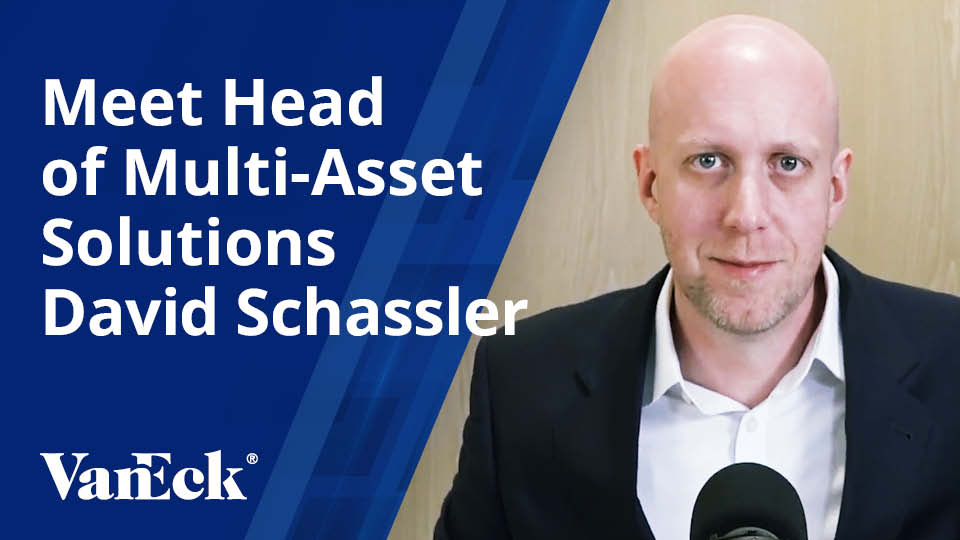
Hi, this is Dave Schassler with the Multi-Asset Solutions Group at VanEck. Here's what we're going to talk about today. We're macro thematic investors. We're going to talk about the big trends leading markets higher.
The AI Investment Thesis
Now, if you've been listening to us for some time, you know that we're excited about AI. We believe that AI is a general purpose technology. It's going to drive profound change throughout society, happen faster than people expect. Let's take a step back and talk about where we are. Big picture. GPT launches November 2022, kicks off a massive capex cycle.
What's happening really quickly is it's transitioning to a global infrastructure build out a massive one going to take a long time. The end of this, the pot of gold, the end of the rainbow is going to be a productivity boom. That's where we see it. And if you look at the market, you're actually seeing it unfold exactly that way. What started very, very narrow with a rally in companies like Nvidia beneficiaries of capex spending is now broadening out throughout technology. What we're seeing is critical bottlenecks being resolved. Micron's a perfect example. Up a lot this year. Why? Because it's solving for a shortage in memory. Supply chain resiliency. You're looking at companies like AMD providing a reasonable alternative to companies like Nvidia. So you're starting to see broadening within technology. The expectation is that eventually that broadens out, transcends borders, sectors, geographies, industries, companies, and individuals.
And as you'd expect that, that's when you end up with the productivity boom.
The Scarcity Trade
Despite all the optimism regarding technology and AI, there's material risk of an extended duration conflict between the Iran and United States. So let me state this really simply. Every day where oil is not freely flowing through the Strait of Hormuz risk increases non-linearly.
Current oil shocks that we're dealing with are contributing to inflationary risks in a material way. There's an easy solution for this. During periods of inflation, you have to own assets with embedded scarcity, assets that actually benefit from higher inflation. That's how you handle it. You hedge your portfolio from higher inflation with assets with embedded scarcity. We're talking about commodities. We're talking about natural resource equities. We're talking about gold bullion. We're talking about even Bitcoin.
So let's bring this back to our playbook. What are we doing within our models? It's really simple. We're riding these trends, and we expect to continue to ride these trends for a long time. What does that mean more specifically? We're going to continue to play the bottlenecks that must be cleared to make AI a reality. So how do we build supply chain resiliency? How do we diversify? How do we solve critical problems to make this technology a reality? And one of the most obvious places to go is real assets.
The new world doesn't happen without the old world building it. We are invested heavily within all the assets in the ground and the picks and shovels removing those assets from the ground required to build out the new world. And then we're also hedging those risks. And the reason why we're hedging those risks is because debasement, how are we going to pay for this, is a material risk. So we own assets with embedded scarcity within our portfolio. Think of assets like gold, think of assets like Bitcoin.
RAAX | VanEck Real Asset Allocation ETF
The VanEck Real Asset Fund, the ticker's RAAX, R-A-A-X, can be really thought of simply as a one-stop shop of real asset investing. So if you believe in real assets, you believe that real assets have a critical role in the future. Old world assets required to build out the new world, that's a growth catalyst. Well then, RAAX is a great alternative. As well, if you're worried about the amount of debt that we have globally, and you'd like some hedge against continued debasement, well, RAAX is a great solution as well, because it has a significant amount of gold.
Alternatively, if you want exposure to economically delinked assets, things like infrastructure in place that pay a constant yield to be in these assets, RAAX also provides that as well. So really, what it is, is a one stop shop for real asset investing that has all those different hallmarks embedded in one solution. So that's RAAX the VanEck real asset solution.
Thank you very much. Continue to follow us.
RAAX | VanEck Real Assets ETF
IMPORTANT DISCLOSURES
Definitions
Bitcoin (BTC) is a decentralized digital currency, without a central bank or single administrator, that can be sent from user to user on the peer-to-peer Bitcoin network without the need for intermediaries.
Risk Considerations
This is not an offer to buy or sell, or a recommendation to buy or sell any of the securities, financial instruments or digital assets mentioned herein. The information presented does not involve the rendering of personalized investment, financial, legal, tax advice, or any call to action. Certain statements contained herein may constitute projections, forecasts and other forward-looking statements, which do not reflect actual results, are for illustrative purposes only, are valid as of the date of this communication, and are subject to change without notice. Actual future performance of any assets or industries mentioned are unknown. Information provided by third party sources are believed to be reliable and have not been independently verified for accuracy or completeness and cannot be guaranteed. VanEck does not guarantee the accuracy of third party data. The information herein represents the opinion of the author(s), but not necessarily those of VanEck or its other employees.
An investment in the VanEck Real Assets ETF (RAAX) may be subject to risks which include, among others, risks related to investing in real assets ETPs, which may subject the Fund to commodities, gold, natural resources companies, MLPs, real estate sector, infrastructure, ETP-related equity securities, small- and medium-capitalization companies, foreign securities, emerging market issuers, ETP-related foreign currency, credit, interest rate, call, concentration and derivative risks, all of which may adversely affect the Fund. The Fund may also be subject to fund of funds, affiliated fund, U.S. Treasury securities, subsidiary investment, commodity regulatory, subsidiary tax, liquidity, gap, cash transactions, high portfolio turnover, data, active management, operational, authorized participant concentration, no guarantee of active trading market, trading issues, market, fund shares trading, premium/discount risk and liquidity of fund shares risks. Foreign investments are subject to risks, which include changes in economic and political conditions, foreign currency fluctuations, changes in foreign regulations, and changes in currency exchange rates which may negatively impact the Fund's returns. Small- and medium-capitalization companies may be subject to elevated risks.
Digital asset investments are subject to significant risk and may not be suitable for all investors. Digital asset prices are highly volatile, and the value of digital assets, can rise or fall dramatically and quickly. If their value goes down, there’s no guarantee that it will rise again. As a result, there is a significant risk of loss of your entire principal investment.
Investing involves substantial risk and high volatility, including possible loss of principal. An investor should consider the investment objective, risks, charges and expenses of a Fund carefully before investing. To obtain a prospectus and summary prospectus, which contain this and other information, call 800.826.2333 or visit vaneck.com. Please read the prospectus and summary prospectus carefully before investing.
© Van Eck Securities Corporation, Distributor, a wholly owned subsidiary of Van Eck Associates Corporation.
666 Third Avenue, New York, NY 10017