Welcome to VanEck
Select Investor Type


Looking to invest in bonds? Eurozone government bonds are generally considered to be one of the safest investments available, as they are backed by the full credit of the respective governments. While investing in government bonds is still associated with risks, they tend offer a more stable source of income compared to equities and corporate bonds, which are subject to greater market fluctuations. VanEck’s Government Bonds ETF Suite provides investors with a tool to diversify and deleverage their exposure.


Typically lower reward
Typically higher reward

Typically lower reward
Typically higher reward
Are you looking to potentially cushion your investments against unforeseen risks? If so, Eurozone government bonds can be considered. The perceived likelihood of a government defaulting on its loan payments is relatively low, so such bonds are often viewed as the more solid investments.
Governments everywhere borrow money for public spending. In fact, the bond market is the world’s largest financial market and government bonds are the largest part of it.1Governments normally commit to reward investors by paying a coupon, or interest, on the bond, as well as to repay it at maturity after a set number of years. So, investing in government bonds is a contribution to countries being able to finance their public services – from transport, to healthcare, to education.
1 Source: ICMA.
Investing in a Government Bonds ETF can be a fitting opportunity for investors looking for:
Both variants of the Fund deliver a blend of relatively low cost and high quality.
One of the main risks of investing in Fixed Income ETFs is the interest rate risk. When the interest rates rise, the bond price is expected to drop, because the bond income is discounted at a higher rate. This drop is usually more pronounced in bonds of higher quality, since they tend to pay lower yields. Measure of sensitivity of a bond’s price to changes in the interest rates is called duration. This is a factor to consider when investing in a Government Bonds ETF.
For long-term investors in bonds, interest rate changes bring two opposing forces into play:
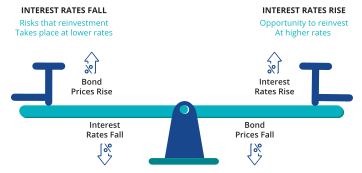
Prices of the bonds that are reaching their maturity normally converge to their par – the amount repaid at the bond expiration. Such bonds are also less susceptible to the interest rate risk.
* Past performance is not a reliable indicator for future performance. Source: VanEck. Yield is represented by Yield-to-Worst.
2 This is not guaranteed to persist in the future.
| Holding Name |
% of Net Assets |
|---|---|
| Bundesobligation | 10.83 |
| Bundesrepublik Deutschland Bundesanleih | 9.92 |
| Bundesrepublik Deutschland Bundesanleih | 9.19 |
| Kingdom Of Belgium Government Bond | 8.50 |
| Kingdom Of Belgium Government Bond | 7.51 |
| Netherlands Government Bond | 7.26 |
| Kingdom Of Belgium Government Bond | 6.48 |
| Republic Of Austria Government Bond | 6.30 |
| Netherlands Government Bond | 6.00 |
| Netherlands Government Bond | 5.97 |
| Top 10 Total (%) | 77.96 |

The issuer or guarantor of a debt security may be unable and/or unwilling to make timely interest payments and/or repay the principal on its debt or to otherwise honour its obligations. Bonds are subject to varying degrees of credit risk which may be reflected in credit ratings. There is a possibility that the credit rating of a bond may be downgraded after purchase, which may adversely affect the value of the security.
Exists when a particular financial instrument is difficult to purchase or sell. If the relevant market is illiquid, it may not be possible to initiate a transaction or liquidate a position at an advantageous or reasonable price, or at all.
Bond prices could rise or fall as the result of changes in the interest rates and the interest rate curve. Potential or actual downgrades in the credit rating can increase the assumed risk level.