
Bienvenue chez VanEck
Sélectionnez le type d’investisseur
30 May 2024
Temps de lecture 8 MIN
Please note that VanEck has exposure to bitcoin.
We often refer to bitcoin as “digital gold” because, like the metal, it is a potential store of value. Like gold, bitcoin’s characteristics include:
However, unlike gold, bitcoin is:
There will only ever be 21 million bitcoin in existence. This supply cap was designed intentionally and is one of the primary characteristics of bitcoin. Furthermore, bitcoin has “halvings” programmed into it. A halving is defined as a 50% block reward cut to the bitcoin production rate, and they occur roughly every four years. This means that the rate at which new bitcoins are introduced into circulation slows down over time until it eventually reaches zero (estimated to occur around the year 2140).
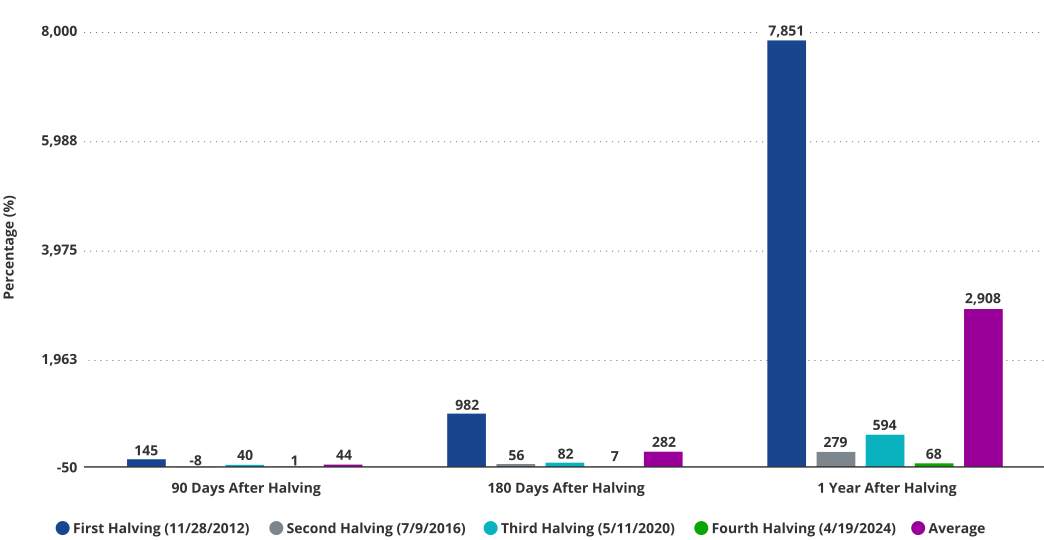
Source: Bloomberg, VanEck research as of 31/03/24. Past performance is not indicative of future results. The information, valuation scenarios and price targets presented on Bitcoin in this blog are not intended as financial advice or any call to action, a recommendation to buy or sell Bitcoin, or as a projection of how Bitcoin will perform in the future. Actual future performance of Bitcoin is unknown, and may differ significantly from the hypothetical results depicted here. There may be risks or other factors not accounted for in the scenarios presented that may impede the performance of Bitcoin. These are solely the results of a simulation based on our research, and are for illustrative purposes only. Please conduct your own research and draw your own conclusions.
These halvings increase the difficulty of mining bitcoin and will occur until the supply cap is reached. In addition, the built-in finite supply of bitcoin means that it is not subject to inflation in the same manner that fiat currencies are. Central banks around the world have ushered in unprecedented growth in money supply, effectively eroding their currencies’ purchasing value. In comparison, bitcoin’s limited supply and increased mining difficulty over time may support the idea of bitcoin as a long-term store of value and as an alternative to gold.
The fourth halving occurred in April 2024. Historically, the price of bitcoin has rallied leading up to and following a halving. The chart above indicates the explosive returns that are typically associated with following the bitcoin halvings.
In its early years, bitcoin was largely used by a small group of tech enthusiasts. It was difficult and cumbersome to obtain with limited use cases and very few merchants accepting it as a form of payment. In 2023, bitcoin adoption has grown substantially as it has become more mainstream. Now, more than ever, merchants and businesses are accepting bitcoin as a form of payment and infrastructure has been built to make it more convenient for the average person to use. The development of user-friendly wallets, exchanges, and marketplaces has removed the technical barriers to entry that existed in bitcoin’s early years.
Bitcoin interest among institutional investors has also increased. Hedge funds, asset management firms, and endowments are increasingly recognizing bitcoin’s potential as a store of value and as an effective portfolio diversifier, specifically, when looking through the lens of an uncorrelated asset that has the potential to hedge against inflation. Approximately $175B worth of bitcoin are now held by ETFs, countries, public and private companies.

Source: Buybitcoinworldwide as of 31/03/2024. Past performance is not a guarantee of future results.
Layer 2s (such as Liquid by BlockStream) may be the next step in boosting bitcoin adoption as they allow for scalability and customizations while retaining many of bitcoin’s security properties. Built on top of the Bitcoin blockchain, we believe the Lightning Network pushes the boundaries of Bitcoin payment capabilities with lower costs and faster speeds.
One notable upcoming layer 2 development on the bitcoin network is RGB. This development is important because it enables the creation and management of digital assets on top of the Bitcoin blockchain. Assets such as stocks, bonds, real estate, or even other cryptocurrencies can be issued and traded on top of the Bitcoin network, adding a new layer of functionality. The RGB protocol is designed to be scalable and not resource-intensive, allowing users to create and manage digital assets without requiring extensive changes to the underlying Bitcoin network. It can be integrated into existing bitcoin wallets and infrastructure, thus making it easier for developers and users to create and manage digital assets. RGB has the potential to expand the use cases of bitcoin, making it a more versatile and useful platform for developers and users alike, ushering in new opportunities for innovation and growth within the ecosystem.
The unprecedented worldwide growth in money supply following the COVID-19 pandemic led to widespread inflation, eroding the purchasing power of established fiat currencies. Bitcoin’s role as a potential hedge against inflation has increasingly become a talking point central to investment decision-making. As previously alluded to, the cornerstone of this idea lies in its limited supply and decentralized nature. Unlike fiat, which can be printed by governments and central banks, bitcoin has a fixed supply, with supply growth decreasing by 50% roughly every 4 years with the halving events. Bitcoin is not subject to the same inflationary pressures caused by fiat money supply growth, making it an attractive option for investors concerned about the impact of inflation on their portfolios and their subsequent purchasing power.
Bitcoin’s decentralized nature makes it impervious to geopolitical events or economic policies that may lead to currency devaluation, such as QE (quantitative easing) or excessive government spending.
If bitcoin is increasingly used as an asset with monetary value, what role might it play?
Bitcoin may potentially increase portfolio diversification because of its low correlation to traditional asset classes.
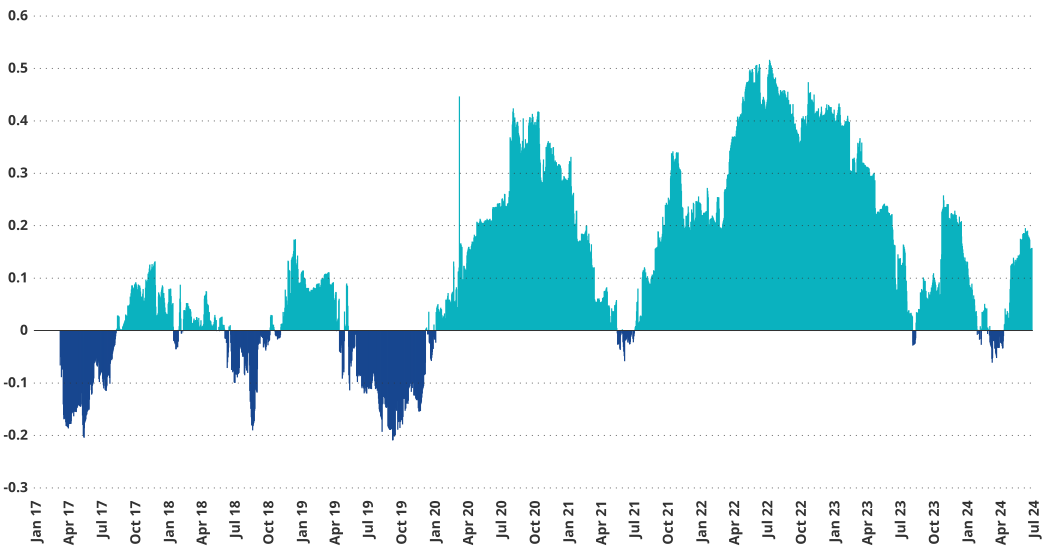
Source: Bloomberg as of 31/03/2024. Past performance is not a guarantee of future results.
Bitcoin may also enhance risk-return profiles. As the chart below shows, a small allocation to Bitcoin significantly enhanced the cumulative return of a traditional 60% equity and 40% bond mix while only minimally impacting overall volatility.
Source: Morningstar. Data as of 31/03/2024. Equities are represented by the S&P 500 Index, Bonds are represented by the Bloomberg Barclays US Aggregate Index, Bitcoin is represented by the MarketVector Bitcoin Index. Past performance is no guarantee of future results. Not intended as a recommendation to buy or sell any securities mentioned herein, to adopt any investment strategy, or as any call to action. Index performance is not representative of fund performance. It is not possible to invest directly in an index. Please see important disclosures at the end of this commentary regarding hypothetical performance.
| 1 year Return |
3 year Return |
5 year Return |
Since Inception Return (Annualized) |
Since Inception Std Dev |
Since Inception Max Drawdown |
Since Inception Sharpe Ratio |
|
| 60% Equities / 40% Bonds | 17.97 | 5.94 | 9.30 | 9.24 | 9.33 | -20.10 | 0.87 |
| 59.75% Equities / 39.75% Bonds / 0.5% Bitcoin | 18.50 | 6.04 | 9.69 | 9.95 | 9.47 | -20.30 | 0.92 |
| 59.5% Equities / 39.5% Bonds / 1% Bitcoin | 19.02 | 6.15 | 10.09 | 10.65 | 9.68 | -20.50 | 0.97 |
| 58.5% Equities / 38.5% Bonds / 3% Bitcoin | 21.15 | 6.56 | 11.66 | 13.45 | 11.08 | -21.31 | 1.09 |
Source: Morningstar. Data as of 31/03/2024. Past performance is no guarantee of future results. Not intended as a recommendation to buy or sell any securities mentioned herein, to adopt any investment strategy, or as any call to action. Index performance is not representative of fund performance. It is not possible to invest directly in an index. Please see important disclosures at the end of this commentary regarding hypothetical performance.
Despite its infamous volatility, bitcoin has managed to outshine other asset classes over the past decade. In fact, it has been the best-performing asset class for eight out of the past eleven years.
Let's take a closer look at bitcoin's historical returns for various holding periods (as of 31 March 2024):
These figures underscore the incredible growth potential that bitcoin has exhibited over time, making it an attractive option for investors seeking high returns.

Source: Morningstar, as of 31 March 2024. Bitcoin is represented by MarketVector Bitcoin PR USD; US Equities are represented by the S&P 500 TR USD; Gold is represented by the S&P GSCI Gold Spot; Emerging Markets is represented by Fidelity Emerging Markets TR; Real Estate is represented by the NASDAQ Global Real Estate TR USD; US Bonds are represented by Bloomberg US Aggregate Bond USD; Treasuries are represented by the Bloomberg Aggregate Bond Treasury TR USD; Commodities are represented by the Bloomberg Commodity TR USD.
While bitcoin shares some of the characteristics attributed to gold, below are differences that, in our view, potentially make it superior.
Overall, while gold has been used as a store of value and in transactions for centuries all over the world, its lack of transparency can make it more challenging to verify and track compared to digital assets like bitcoin. As inflation poses challenges to investors globally, both gold and bitcoin are likely to come front and center as potential hedges to protect purchasing power. With bitcoin’s benefits like divisibility and transparency, we see it as a competitor to gold, and believe it is likely to garner even more adoption among retail and institutional investors alike.
To receive more Digital Assets insights, sign up to our Newsletter.
This is not financial research but the opinion of the author of the article. We publish this information to inform and educate about recent market developments and technological updates, not to give any recommendation for certain products or projects. The selection of articles should therefore not be understood as financial advice or recommendation for any specific product and/or digital asset. We may occasionally include analysis of past market, network performance expectations and/or on-chain performance. Historical performance is not indicative for future returns.
Informations importantes
À titre indicatif et promotionnel uniquement.
Ces informations proviennent de la société VanEck (Europe) GmbH sise Kreuznacher Strasse 30, 60486 Francfort-sur-le-Main. Elles ont pour unique objectif de fournir des renseignements généraux et préliminaires aux investisseurs et ne doivent pas être interprétées comme des conseils d'investissement, juridiques ou fiscaux. VanEck (Europe) GmbH et ses sociétés associées et affiliées (dénommées conjointement « VanEck ») déclinent toute responsabilité concernant toute décision d'investissement, de désinvestissement ou de rétention prise par l'investisseur à partir de ces informations. Les points de vue et opinions exprimés sont ceux connus à la date de publication de ces informations et sont susceptibles de changer en fonction des conditions du marché. Certaines déclarations contenues dans le présent document peuvent constituer des projections, des prévisions et d’autres déclarations prospectives, qui ne reflètent pas les résultats réels. VanEck ne fait aucune déclaration ou garantie, expresse ou implicite, concernant l’opportunité d’investir dans des titres ou des actifs numériques en général, ou dans le produit mentionné dans ces informations (le « Produit »), ou la capacité de l’indice sous-jacent à suivre la performance du marché des actifs numériques concernés.
L’indice sous-jacent est la propriété exclusive de MV Index Solutions GmbH, qui a passé un contrat avec CC Data Limited pour maintenir et calculer l’indice. CC Data Limited met tout en œuvre pour s’assurer du calcul correct de l’indice. Indépendamment de ses obligations à l’égard de MV Index Solutions GmbH, CC Data Limited n’est pas tenue de signaler les erreurs de l’indice à des tiers.
L'investissement est soumis à des risques, notamment la perte éventuelle du capital à hauteur du montant investi total et l'extrême volatilité des ETNs. Vous devez lire le prospectus et le DIC avant d'investir, afin de bien comprendre les risques et avantages potentiels associés à la décision d'investir dans le Produit. Le Prospectus approuvé est disponible à l'adresse www.vaneck.com. L'approbation du prospectus ne doit pas être comprise comme un cautionnement des Produits offerts ou admis à la négociation sur un marché réglementé.
Les performances citées représentent les performances passées, qui ne garantissent pas les résultats futurs et qui peuvent être inférieures ou supérieures aux performances actuelles.
Le rendement actuel peut être inférieur ou supérieur aux rendements annuels moyens indiqués. Il s'agit des performances sur 12 mois jusqu'à la fin du trimestre le plus récent pour chacune des 5 dernières années, le cas échéant. Par exemple, « 1ère année » désigne la période de 12 mois la plus récente et « 2ème année » la période de 12 mois précédente et ainsi de suite. Les données de performance sont affichées dans la devise de base, avec le revenu net réinvesti, net de frais. Des frais de courtage ou de transaction s'appliquent. La rentabilité du capital investi et la valeur nominale d'un investissement fluctuent. Les billets peuvent valoir plus ou moins que leur coût d'origine au moment du rachat.
Les rendements de l'indice ne sont pas les rendements de l'ETN et ne reflètent pas les frais de gestion ou de courtage. La performance d'un indice n'illustre pas la performance de l'ETN. Les investisseurs ne peuvent pas investir directement dans l'indice. Les indices ne sont pas des titres dans lesquels il est possible d'investir.
Aucune partie de ce document ne peut être reproduite sous quelque forme que ce soit, ou référencée dans une autre publication, sans l'autorisation écrite expresse de VanEck.
© VanEck (Europe) GmbH
À des fins d’information et de publicité uniquement.
Ces informations proviennent de VanEck (Europe) GmbH qui a été désignée comme distributeur des produits VanEck en Europe par la société de gestion VanEck Asset Management B.V., de droit néerlandais et enregistrée auprès de l’Autorité néerlandaise des marchés financiers (AFM). VanEck (Europe) GmbH, dont le siège social est situé Kreuznacher Str. 30, 60486 Francfort, Allemagne, est un prestataire de services financiers réglementé par l’Autorité fédérale de surveillance financière en Allemagne (BaFin). Les informations sont uniquement destinées à fournir des informations générales et préliminaires aux investisseurs et ne doivent pas être interprétées comme des conseils d’investissement, juridiques ou fiscaux. VanEck (Europe) GmbH et ses sociétés associées et affiliées (ensemble « VanEck ») n’assument aucune responsabilité en ce qui concerne toute décision d’investissement, de cession ou de rétention prise par l’investisseur sur la base de ces informations. Les points de vue et opinions exprimés sont ceux du ou des auteurs, mais pas nécessairement ceux de VanEck. Les avis sont à jour à la date de publication et sont susceptibles d’être modifiés en fonction des conditions du marché. Certains énoncés contenus dans les présentes peuvent constituer des projections, des prévisions et d’autres énoncés prospectifs qui ne reflètent pas les résultats réels. Les informations fournies par des sources tierces sont considérées comme fiables et n’ont pas été vérifiées de manière indépendante pour leur exactitude ou leur exhaustivité et ne peuvent être garanties. Tous les indices mentionnés sont des mesures des secteurs et des performances du marché commun. Il n’est pas possible d’investir directement dans un indice.
Toutes les informations sur le rendement sont historiques et ne garantissent pas les résultats futurs. L’investissement est soumis à des risques, y compris la perte possible du capital. Vous devez lire le Prospectus et le DICI avant d’investir.
Aucune partie de ce matériel ne peut être reproduite sous quelque forme que ce soit, ou mentionnée dans toute autre publication, sans l’autorisation écrite expresse de VanEck.
© VanEck (Europe) GmbH

12 mai 2026

10 octobre 2024

19 septembre 2024
27 février 2024
12 mai 2026
10 octobre 2024
19 septembre 2024
27 février 2024