
Bienvenue chez VanEck
Sélectionnez le type d’investisseur
12 February 2024
Temps de lecture 2 MIN
Emerging markets (EM) debt, in various forms, posted admirable returns in 2023. The most commonly cited form – US dollar denominated sovereign debt – benefited from the late year rate rally and posted a total return of +11.1% for the year. That was more than 550 basis points (bps) better than US aggregate investment grade bonds, 270 bps better than investment grade US corporates, and approximately 700 bps better than intermediate Treasuries. EM local currency sovereign bonds did even better than dollar-denominated sovereigns, outpacing the other asset classes listed above by an additional 160 bps, and without the benefit of a sustained EM currency rally. EM US dollar denominated corporate bonds did not fare as well as sovereigns overall, and both the investment grade and high yield components lagged their US corporate counterparts, but both still enhanced returns as satellite additions to core bond allocations.1
Given the higher yields available in EM and, in aggregate, stronger debt fundamentals versus DM counterparts, the overall outperformance in 2023 (and over the entire two-year period of 2022 and 2023) is not surprising2. What might be surprising is that EM debt funds suffered consistent outflows throughout both 2022 and 2023. Flows out of dedicated hard currency EM debt funds were $45 billion in 2022 and $25 billion in 2023, while dedicated local currency debt funds saw outflows of $45 billion in 2022 and $9.0 billion in 2023. At the same time, net supply of EM dollar denominated sovereign and corporate debt shrank as well. Net new issuance in EM dollar sovereigns was only $21 billion in 2023, after registering -$28.6 billion in 2022. For EM dollar denominated corporates the numbers were -$157 billion in 2023 and -$259 billion in 2022. As the EM debt universe continues to mature in a variety of ways, apparently another important development is that outperformance is no longer driven exclusively by “hot money” flows. In fact, 2023 appears to have been a year of outperformance that was also characterized by an improving technical picture.
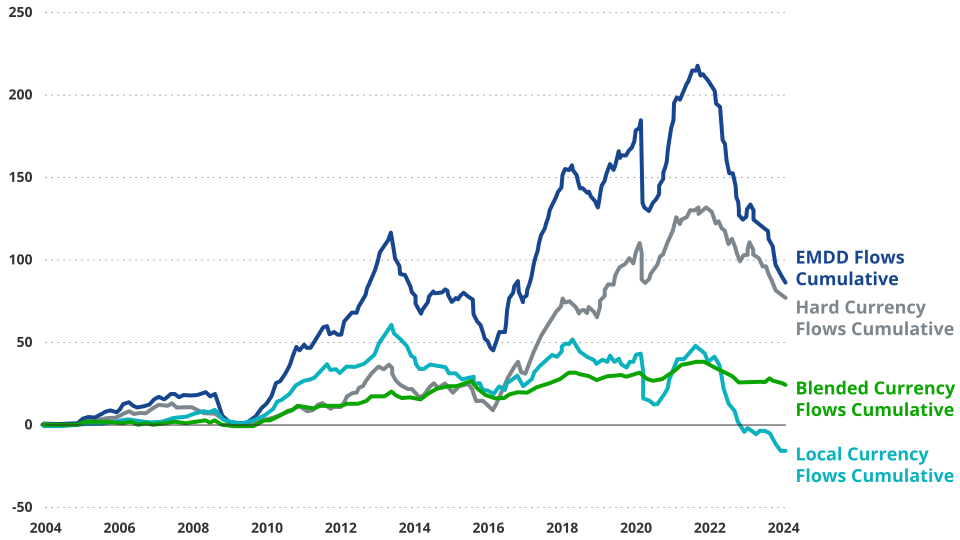
Source: EPFR, Morgan Stanley Research.
Both US high yield and municipal bond asset classes also witnessed net outflows in 2023, but US Treasury and Aggregate funds experienced significant inflows, particularly into ETFs, representing the majority of some $220 billion that came into taxable bond funds. That number does not include money market funds, which took in nearly $1 trillion in 2023! We believe that the favorable technical picture, combined with the attractive fundamental profile of EM debt, sets the stage for another year of potential outperformance versus DM bonds. Investors who are under-allocated to the asset class may want to consider increasing their exposure within their global bond portfolio.
DISCLOSURES
1 EM hard currency sovereign bonds represented by the J.P. Morgan EMBI Global Diversified Index; EM local currency sovereign bonds represented by the J.P. Morgan GBI-EM Global Diversified Index; EM corporate bonds represented by the CEMBI Broad Diversified Index; aggregate investment grade bonds represented by the ICE BofA US Broad Market Index; US corporate bonds represented by the ICE BofA US Corporate Index; Intermediate treasuries represented by the ICE BofA 1-10 Year US Treasury Index; US high yield corporate bonds represented by the ICE BofA US High Yield Index.
2 Past performance is not guarantee of future results.
À des fins d’information et de publicité uniquement.
Ces informations proviennent de VanEck (Europe) GmbH qui a été désignée comme distributeur des produits VanEck en Europe par la société de gestion VanEck Asset Management B.V., de droit néerlandais et enregistrée auprès de l’Autorité néerlandaise des marchés financiers (AFM). VanEck (Europe) GmbH, dont le siège social est situé Kreuznacher Str. 30, 60486 Francfort, Allemagne, est un prestataire de services financiers réglementé par l’Autorité fédérale de surveillance financière en Allemagne (BaFin). Les informations sont uniquement destinées à fournir des informations générales et préliminaires aux investisseurs et ne doivent pas être interprétées comme des conseils d’investissement, juridiques ou fiscaux. VanEck (Europe) GmbH et ses sociétés associées et affiliées (ensemble « VanEck ») n’assument aucune responsabilité en ce qui concerne toute décision d’investissement, de cession ou de rétention prise par l’investisseur sur la base de ces informations. Les points de vue et opinions exprimés sont ceux du ou des auteurs, mais pas nécessairement ceux de VanEck. Les avis sont à jour à la date de publication et sont susceptibles d’être modifiés en fonction des conditions du marché. Certains énoncés contenus dans les présentes peuvent constituer des projections, des prévisions et d’autres énoncés prospectifs qui ne reflètent pas les résultats réels. Les informations fournies par des sources tierces sont considérées comme fiables et n’ont pas été vérifiées de manière indépendante pour leur exactitude ou leur exhaustivité et ne peuvent être garanties. Tous les indices mentionnés sont des mesures des secteurs et des performances du marché commun. Il n’est pas possible d’investir directement dans un indice.
Toutes les informations sur le rendement sont historiques et ne garantissent pas les résultats futurs. L’investissement est soumis à des risques, y compris la perte possible du capital. Vous devez lire le Prospectus et le DICI avant d’investir.
Aucune partie de ce matériel ne peut être reproduite sous quelque forme que ce soit, ou mentionnée dans toute autre publication, sans l’autorisation écrite expresse de VanEck.
© VanEck (Europe) GmbH