
Welcome to VanEck
Select Investor Type
19 January 2021
The Thanksgiving holiday attempt by short speculators to drive gold prices below the technically important $1,800 per ounce level failed, as gold rebounded to $1,815/oz on 1 December and gained $121.41 (6.8%) to end the month at $1,898.36/oz. Gold stocks also had strong moves with gains of 4.57% for the NYSE Gold Miners Index (GDMNTR)1 and 10.76% for the MVIS Global Junior Miners Index (MVGDXJTR)2.
News of vaccine shipments and shots during the month had no impact on gold, which suggests the vaccine excitement was fully priced into the gold market weakness in November. Gold trended to its monthly high of $1,906/oz on 21 December, when Congress reached a final agreement on $900 billion of deficit spending for a new coronavirus relief package. Gold was also supported by a weakening dollar, which fell to new 30-month lows brought on by “risk-on” trading with new highs in the stock market. Importantly, the heavy gold bullion ETF outflows seen in November also stopped in December.
Silver sprang to life in the second half of the year, outperforming gold by 38% and gaining 16.6% in December. As both a monetary and industrial metal, silver is enjoying the best of both worlds—one of systemic risks in which gold thrives, and the other of post pandemic growth expectations and green initiatives in which copper thrives. As reference, copper ended the year at $3.52 per pound, its highest price in nearly seven years.
Gold Closes The Decade Strongly
Gold gained 25.1% or $381/oz in 2020, its largest annual percentage gain in ten years. A myriad of pandemic-related drivers moved gold beginning in January with the outbreak in China. Gold advanced to seven-year highs in February as COVID spread to South Korea. However, in the last week of February, news of infections in Italy, Iran and the U.S. caused markets to crash and gold fell to its low of the year of $1,451 on 16 March. Gold stocks also tumbled as investors sought to raise cash for margin calls, redemptions and risk-off positioning. Once the panic abated, gold and gold stocks snapped back, returning to their pre-crash levels in early April. Gold reached new long-term highs in April, May and June. On 27 July, it surpassed the $1,921/oz all-time high set in 2011 and went on to its ultimate high of $2,075/oz on 7 August.
Since August, gold has taken a breather, consolidating in the $1,800 - $2,000/oz range. News of positive COVID vaccine test results in early November brought hopes for a return to normalcy, causing gold to fall and test long-term technical support at $1,800/oz. Support held and gold trended higher in December as the U.S. Dollar Index (DXY)3 made new lows, ending the year at $1,898/oz.
Gains Highlighted By Market Uncertainty, Systemic Risks
The gold bull market in 2020 had a number of drivers, including:
Record inflows into gold bullion exchange traded products are a testament to how investors are using gold to protect their portfolios from currency debasement, systemic collapse or inflation that may come as the unintended consequences of zero-rate policies, massive debt loads and the trillions of dollars of liquidity being pumped into the global economy.
Miners Outpace The Metal
Gold miners’ performance outpaced gold for most of the year, despite some consolidation towards the end of the year. And while, broadly speaking, investors should expect gold equities to outperform the commodity in a rising gold price environment (due to the inherent leverage miners have to the metal), it is not uncommon to see companies underperform when carrying elevated risks. A majority of the gold miners we invested in proved adept at handling COVID protocols, while production and costs were not significantly impacted. The most successful producers remained focused on controlling costs, free cash flow, disciplined capital allocation and returns to shareholders. As well, according to quarterly reports, many of these same companies increased their dividends throughout the year and now have yields that, on average, exceed two percent.
We expect the same drivers that propelled gold in 2020 to continue in 2021. Later in the year, the world will become a very different place once the U.S. and other nations achieve herd immunity. Here we try to identify the remaining risks that might drive gold once the virus has been tamed:
Gold has been in a bull market since December 2015 (Chart 1). The chart pattern of this market looks similar to the first five years of the 2001 to 2011 bull market (Chart 2). It will be interesting to see if the chart similarities continue. After 2006, the former bull market found catalysts in the 2008 Global Financial Crisis and the European Debt Crisis in 2010. The current bull market will certainly need further catalysts to realize similar gains. The risks we have outlined along with the dollar’s trend could provide such catalysts.
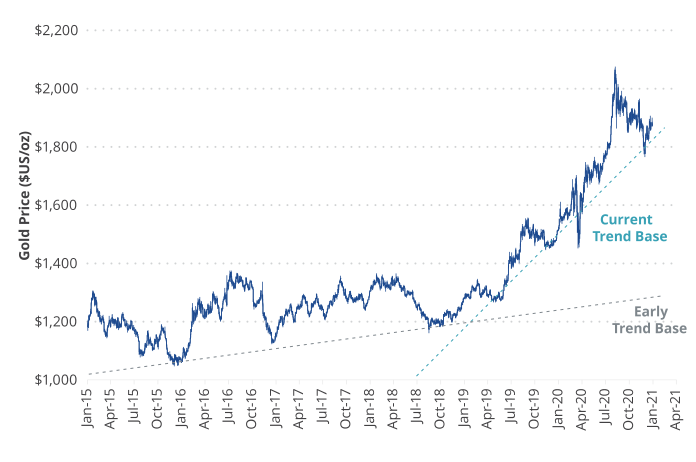
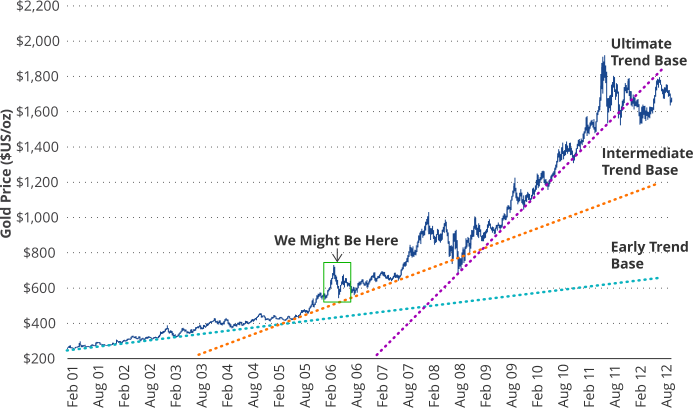
Source: Bloomberg, VanEck. Data as of 4 January 2020.
All company, sector, and sub-industry weightings as of 31 December 2020, unless otherwise noted. Source: VanEck, FactSet.
1NYSE Arca Gold Miners Index (GDMNTR) is a modified market capitalization-weighted index comprised of publicly traded companies involved primarily in the mining for gold.
2MVIS Global Junior Gold Miners Index (MVGDXJTR) is a rules-based, modified market capitalization-weighted, float-adjusted index comprised of a global universe of publicly traded small- and medium-capitalization companies that generate at least 50% of their revenues from gold and/or silver mining, hold real property that has the potential to produce at least 50% of the company’s revenue from gold or silver mining when developed, or primarily invest in gold or silver.
3The U.S. Dollar Index (DXY) measures the value of the U.S. dollar relative to a basket of foreign currencies, often referred to as a basket of U.S. trade partners' currencies.
This is a marketing communication. Please refer to the prospectus of the UCITS and to the KID before making any final investment decisions.
This information originates from VanEck Switzerland AG which has been appointed as distributor of VanEck products in Switzerland by the Management Company VanEck Asset Management B.V., incorporated under Dutch law and registered with the Dutch Authority for the Financial Markets (AFM). VanEck Switzerland AG’s registered address is at Genferstrasse 21, 8002 Zürich, Switzerland.
The information is intended only to provide general and preliminary information to investors and shall not be construed as investment, legal or tax advice. VanEck Switzerland AG and its associated and affiliated companies (together “VanEck”) assume no liability with regards to any investment, divestment or retention decision taken by the investor on the basis of this information. The views and opinions expressed are those of the author(s) but not necessarily those of VanEck. Opinions are current as of the publication date and are subject to change with market conditions. Certain statements contained herein may constitute projections, forecasts and other forward-looking statements, which do not reflect actual results. Information provided by third party sources is believed to be reliable and have not been independently verified for accuracy or completeness and cannot be guaranteed. Brokerage or transaction fees may apply. A copy of the latest prospectus, the Articles, the Key Information Document, the annual report and semi-annual report can be found on our website www.vaneck.com or can be obtained free of charge from the representative in Switzerland: First Independent Fund Services Ltd, Feldeggstrasse 12, 8008 Zurich, Switzerland. Swiss paying agent: Helvetische Bank AG, Seefeldstrasse 215, CH-8008 Zürich.
All performance information is based on historical data and does not predict future returns. Investing is subject to risk, including the possible loss of principal.
No part of this material may be reproduced in any form, or referred to in any other publication, without express written permission of VanEck.
© VanEck Switzerland AG

15 December 2025
15 December 2025