FT, EM FX, and A Pinch of Salt
15 February 2023
Read Time 2 MIN
EM FX Devaluations
An FT article caught our attention this morning – but it’s not the one about the sustainability of Japan’s central bank government bond purchases and potential changes in the yield curve control mechanism (YCC) under the new governor (albeit this might have very serious implications for global Fixed Income, especially Investment Grade instruments with their super-tight spreads). “Our” article talks about “a spate” and “a further slew” of emerging markets (EM) FX devaluations caused by the strong U.S. Dollar. We are not sure how well this characterizes EM, especially in light of strong performance of many EM currencies last year or a dramatic repricing lower of Asian interest rates. Further, letting currencies go while accelerating structural reforms and engaging multilateral financial support is probably the best thing that can happen to developing economies from the longer-term perspective. This is the lesson learned by their predecessors – many of whom are now “EM Graduates” - in the wake of the 1997/98 global financial crisis. Egypt is not doing this – yet - and therefore still strikes us as vulnerable to such episodes - it’s really a “classic” setup including the part about learning the hard way.
EM Structural Adjustment
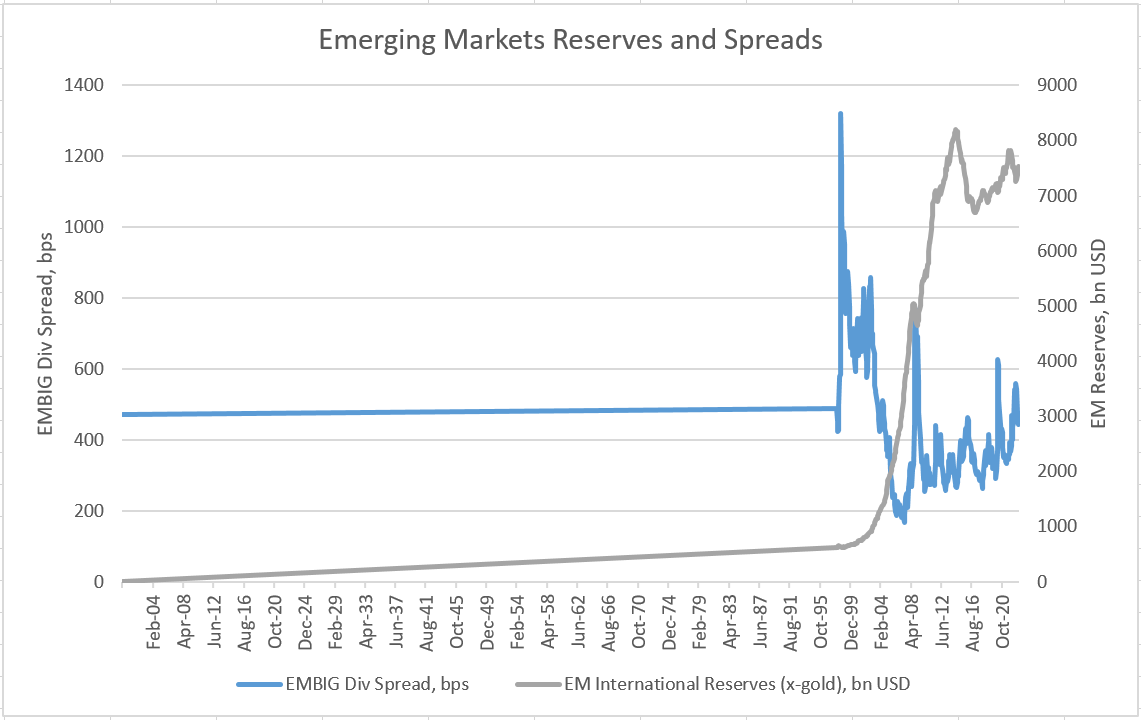
Using FX as a shock-absorber – while relying on interest rates as the primary policy instrument to target inflation – helps to initiate a “textbook” adjustment of the current account balance (less imports and more competitive exports). With fewer FX interventions, this is the fastest way to start rebuilding the international reserves. Over time, the accumulation of reserves and a stronger structural/institutional backdrop should lead to a major decline in sovereign spreads, limiting the extent of potential “flare-ups” in the future. The chart below demonstrates all these points very well (higher reserves/tighter spreads/lower peaks). Many EMs are now net sovereign creditors in U.S. dollars!
EM FX And U.S. Dollar
EMs that used their past devaluation experiences wisely – reforms, accumulation of reserves, inflation-targeting – are now less tied up to the U.S. Dollar cycle. The Brazilian real, the Mexican peso, the Peruvian sol, and the Chilean peso ended up stronger vs. the U.S. Dollar last year. The final point here is that there are different ways to get exposure to emerging markets these days. For example, we don’t like Brazil’s local market currently (due to policy noise), so we just don’t own it…but the current environment can still be positive for Brazilian credits that pay in real and earn in U.S. Dollar (for example). Stay tuned!
Chart at a Glance: EM Reserves vs. Sovereign Spreads in Different Regimes
Source: Bloomberg LP.
Related Insights

Related Insights
07 April 2025
06 March 2025
20 February 2025
10 February 2026
Debasement is back in focus. Here’s what’s driving it, what could reverse it and how we’re positioning portfolios for both scenarios.
07 April 2025
Trump’s tariffs spark trade war fears, fueling market volatility, inflation risk, and recession threats. With global retaliation likely, near-term growth is clearly at risk.
06 March 2025
Trump’s tariffs, AI’s next phase, and a potential U.S. gold revaluation could shake markets—investors who stay ahead of these transitions will be best positioned.
20 February 2025
China's AI breakthrough, persistent inflation, gold’s outperformance, and rising energy demand underscore a shifting investment landscape.
16 January 2025
In 2025, navigating turbulence means balancing tech innovation, inflation hedges, energy shifts, and risks from spending cuts and inflation.