Policy Tightening – Topping Up
09 February 2023
Read Time 2 MIN
Higher Peak Rates
Bank of Japan’s hawkish turn is an important element of the global policy chatter – given potential implications for Investment Grade bonds in developed markets (DM) and emerging markets (EM) – but Sweden’s central bank stole the monetary policy limelight this morning with a hawkish QT tweak (in addition to a 50bps rate hike). Sweden’s move resonates with a storyline that global central banks might tighten more and start easing later than currently priced in. The recent comments from the governor of the Colombian central bank are quite instructive in this regard. Governor Villar said that policy rates in the region should remain “relatively restrictive” for “an important amount of time” to bring inflation back to target and anchor expectations.
Inflation Pressures
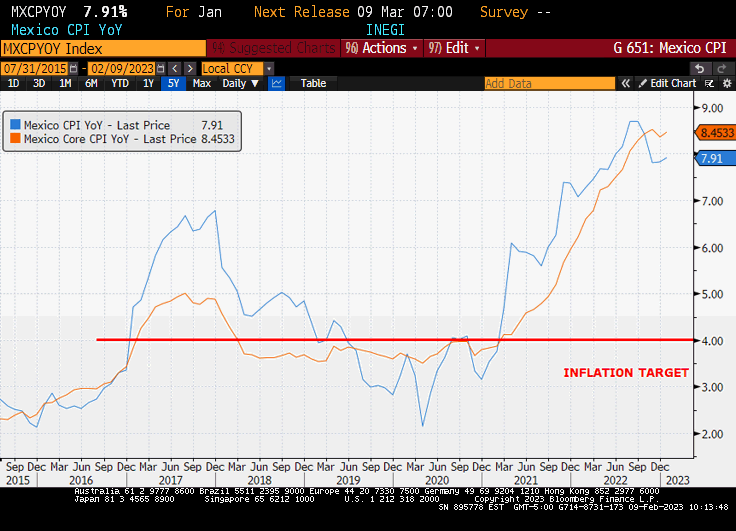
One reason for caution is that - with food and energy prices normalizing – the remaining inflation pressures are increasingly considered a locally-driven phenomenon. This is the view, for example, of some board members of Mexico’s central bank, which is meeting later this afternoon (the consensus expects a 25bps rate hike following an upside inflation surprise – see chart below). The Peruvian central bank is also expected to extend the hiking cycle today (+25bps) – we would like to know how a bill on another round of private pension withdrawals fits into the equation, given its potential to boost domestic demand.
Policy Easing
The situation is not completely hopeless for doves – provided disinflation does not stall. For example, the Romanian central bank’s new assessment is that the disinflation rate might be faster than expected in H2-2023/H1-2024 (a side note – the Romanian central bank has been quite hawkish lately, so it is not Poland’s “perpetual doves” situation). Today’s move in the market expectations for Brazil’s policy rate (after a small downside inflation surprise) shows that successful disinflation creates a nice potential for rate cuts (especially when real rates are very high). However, Brazil’s policy space might be constrained by the new administration’s attacks on the central bank’s independence and attempts to change the inflation target. Stay tuned!
Chart at a Glance: Mexico’s Disinflation – A Bumpy Ride
Source: Bloomberg LP.
Related Insights

Related Insights
07 April 2025
06 March 2025
20 February 2025
10 February 2026
Debasement is back in focus. Here’s what’s driving it, what could reverse it and how we’re positioning portfolios for both scenarios.
07 April 2025
Trump’s tariffs spark trade war fears, fueling market volatility, inflation risk, and recession threats. With global retaliation likely, near-term growth is clearly at risk.
06 March 2025
Trump’s tariffs, AI’s next phase, and a potential U.S. gold revaluation could shake markets—investors who stay ahead of these transitions will be best positioned.
20 February 2025
China's AI breakthrough, persistent inflation, gold’s outperformance, and rising energy demand underscore a shifting investment landscape.
16 January 2025
In 2025, navigating turbulence means balancing tech innovation, inflation hedges, energy shifts, and risks from spending cuts and inflation.