IMF Spring 2026 Meeting Takeaways: EM Debt View
28 April 2026
Read Time 10 MIN
We’ve attended these meetings for decades and tend to take a meta-perspective on them. We’re looking for insights on our countries, of course, but the real value of the meetings is the sentiment of the trillions in AUM who attend, many who are old friends of ours. If we we’re hanging out in-person with you, dear reader, we’d probably say something like the following:
- Meetings were packed, including tourists like big asset managers not focused on emerging markets (EM), but hearing that it is the new thing.
- Everyone was bearish on the US dollar (USD). We are bullish USD (vs. majors) as a result of this and more. (We own and like EMFX, but focused on exporters.)
- China was loved, but still unowned.
- Commodities exporters > importers.
Below, we go into the more formally discussed takeaways. We start with three takeaways on the global economy and financial markets, and then three elaborated takeaways on emerging markets. We then review some key observations on key emerging markets.
The Setup - Top 3 Global Economy and Financial Risk Takeaways
- Economic uncertainty is certain. Let’s address some basics on the global economy and financial markets. The IMF published its key documents – the World Economic Outlook (WEO) and Global Financial Stability Report (GFSR) - in the midst of an outbreak of war in the Middle East. At these meetings, the IMF presented a “reference forecast” as opposed to its usual “baseline”, underlining economic and financial uncertainty. The IMF didn’t emphasize this fact, but this uncertainty can’t be under-emphasized. On topics ranging from a confident damage assessment in Qatar, to the economic implications for Thailand and the Philippines of resource constraints, uncertainty was the context. To be geeks about it, though, this reference forecast assumes the war will have “limited duration, intensity, and scope…consistent with commodity futures prices as of March 10.” Things are so uncertain, so let’s assume they are not, in a way.
- Commodity exporters win, importers lose. Should anyone still care, with those assumptions, what the actual growth, inflation, and other forecasts are, and how they changed? Didn’t think so, we’ll glide over them. Growth is forecast to be a couple tenths lower at 3.2%, inflation similarly a couple tenths higher at 4.4% for 2026 (and declining thereafter). The most interesting observations come from cross-country dispersion in the reference forecast. If you have a pre-existing fragility, worse. The rest, shall we say, is speculation over the future of the US/Israel war with Iran, which we do not discuss.
- Financial stability risks unstable and in DM. OK, we’re being a bit cheeky, “elevated” was the word used to describe financial stability risks, and this is where the attitude implied by the “reference forecast” in the WEO fell apart slightly. Of course, “the war” and it’s inflationary pressures are the driver which could transmit into financial instability. The market’s “orderly” corrections were rightly noted. The key channels leading to financial stability risks were as follows. High debt/GDP levels lead risks, which led to higher bond yield gyrations; these, in turn, raise again the risk of the sovereign-banking nexus. Currency and capital outflows, particularly if they lead to greater portfolio and lesser foreign direct investment (FDI) flows, are another channel for risk.
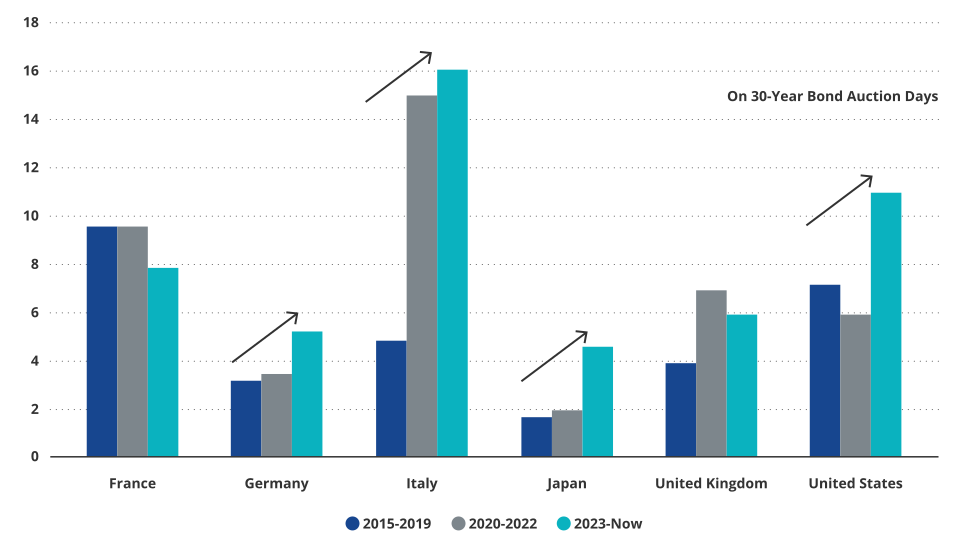
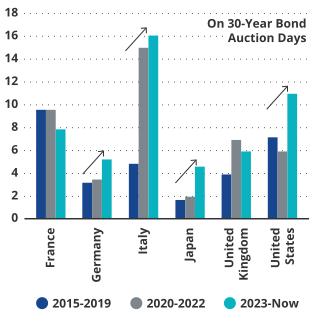
Exhibit 1 shows the greater bond yield reactions on auction days, which the IMF uses to represent this phenomenon. It’s a good chart. Our spin would be that these are DM markets subject to “fiscal dominance” which is the real driver, and many in EM are not subject to this, and have thus outperformed DM bonds over multiple time horizons. This has been our framing for over a decade, and it is gaining popularity. Such a spin would be unwelcome to the IMF’s biggest shareholders, but we think it is still the better framing.
Exhibit 1 – DM Bond Markets Look Riskier
Bond Yields React More to Bond Auctions
(Basis point change on auction days, 90th percentile within indicated periods)
Sources: Bloomberg Finance L.P.; national debt offices; and IMF staff calculations.
Note: The figure shows the 90th percentiles of daily 10-year bond yield changes on 30-year bond auction days within the indicated periods.
What We Really Care About - The Top 3 Takeaways for EM
- Apotheosis for EM. Participants both from the policy world and markets were extremely bullish on EM as well as bearish on the US dollar. The asset-price implication of this, in our view, is bullish support for USD against the majors.
- The US dollar’s reserve status and “de-dollarization” were elevated to a supposed enduring force driving markets.
- China was seen to have risen and to be rising, generally.
- We also observed to meeting participants that Chinese Government Bonds (CGBs) outperformed US Treasuries during the war phase; everyone knew but nobody said it, but discussions opened up quickly. Private common knowledge became public common knowledge at IMF meetings. Noteworthy.
- This Chinese yuan (CNY) and CGB performance also anchored a big portion of Asia, which otherwise would normally have been subject to much more FX weakness. China itself, Malaysia, Korea, and Taiwan also behaved as safer assets than expected. Net International Investment Position (NIIP) were central in our argument that CNY was curiously unpopular throughout 2025 (we even wrote a paper on it).
- Much of this anti-USD sentiment fits the ideological leanings of most participants. Concerns about the dollar are laid entirely at the feet of the current administration, not decades of fiscal profligacy and monetary forbearance, nor geopolitical shifts. A key observation.
- Let’s try to see through the war/majors version. There was a palpable desire to “move on” which for this crowd means scenario analyses to detect permanent winners and losers. The asset-price implication of this, in our view, is that again USD bullish against majors (EUR, JPY, GBP).
- The US wins, economically, or is last to fall (after South Asia and Europe). This was a consistent conclusion from US-focused participants. This is consistent with a bullish USD asset price view, particularly versus the majors (EUR, JPY, GBP).
- The major DMs had no positive story emerging from IMF meetings, as outside the US they all lose via an adverse terms of trade shock and leveraged sovereigns/financial systems.
- Let’s try to see through the war/EM version. EM has winners, DM has losers (other than US). The asset-price implication of this, in our view, is EM exporters over importers.
- Commodity exporters over commodity importers. The primary lens for this EM opportunity is (correctly, in our view) commodity exporters versus importers, but our broader point is that this is a manageable and diversified set of winners and losers not just losers in DM bonds which dominate investor portfolios.
- But also, it includes a “safe” Asia that also generates (non-commodity) external surpluses; these have emerged as winners, or not losers. The meetings more-or-less congealed on a stylized version for the major EMs as we describe in the table below, and which has been a good description of our positioning. Asset-price moves during the war are consistent with this version of who wins and losses from rising commodity prices.
- EM Europe (Poland, Hungary in particular) is basically left out of this framing (other than Turkey as a loser), because the continent and those names are net commodities importers of course, with larger debt loads recently, to boot. This is generally bearish for the region. (We have an overweight Hungary for purely idiosyncratic reasons, for the record, and an overweight on Czech due to its cheapness, and an underweight in regional behemoth Poland, as well as Turkey).
Exhibit 2 – Stylized Table of EM Winners and Losers
Commodities Exporters Asian Exporters Asian Importers Colombia China India Brazil Malaysia Indonesia Chile Korea Philippines Peru Taiwan Pakistan South Africa Sri Lanka Sub-Saharan Africa Thailand Turkey
- Some countries have pain already clearly in the pipeline. Regardless of one’s war outlook, they require a quick resolution in order to avoid a sharp change in their economic conditions. Philippines, Thailand, India, Indonesia, as well as smaller Pakistan and Sri Lanka fall clearly in this category.
- The Gulf will be permanently changed. Bond markets are not cheap enough to warrant exposure, even if there is a “positive” outcome, which is elusive to define. The opportunity costs of avoiding Gulf exposure are practically 0. For example, Oman is emerging as a winner from the crisis but the USD bonds trade at 80 basis points (bps) over US Treasuries; hard to see a case in the region (though Egypt did cheapen out and became attractive).
- Sub-Saharan Africa (which mostly offers USD-denominated bonds but also some serious local currency bond markets) was such a clear winner that an inaugural bond for Democratic Republic of Congo was issued during the meetings.
On to Details – Key Observations on Key Countries
Brazil – Polls boosted investor sentiment, as they show that the opposition candidate has a fighting chance in upcoming presidential elections. Another positive is that the central bank remains independent, calibrating its easing cycle in line with fundamentals rather than pre-election politics. However, the fiscal situation is concerning – and it remains to be seen whether the opposition can make a breakthrough if it wins the presidential election in the fall.
There was a lot of optimism about Venezuela during the Spring meetings culminating in the IMF restoring formal contact. The US administration is prioritizing government and social stability in Venezuela to try to engineer a recovery of the oil sector. At least for now, the US appears content to work with the Rodriguez government indefinitely. A reform of the electoral system and new Presidential elections could be delayed until 2028 or even later. The return of Maria Corianna Machado to Venezuela could spoil the calm environment for the US administration and force a discussion of elections sooner by activating the street.
Peru’s terms of trades are at the strongest levels since 1951! Last year, GDP grew by 3.4%, formal employment grew by 2.6% and the fiscal deficit was just 2.2% of GDP. International reserves reached $100bn. Inflation was just 1.5%. Peru achieved these amazing results without a President completing a full 5-year term since 2016! On June 7, Peru will elect a new President who will have a good chance of serving a full term and implementing a reform agenda. Hopefully, this will lead to higher FDI and stronger and more inclusive growth in Peru.
Colombia will have Presidential elections at the end of May, and investors are becoming hopeful that the next government will be a center right government led by Paloma Valencia. The expectation of fiscal tightening and market friendly reforms under a Valencia government are helping the market ignore the very concerning actions of the Petro government which include a 23.7% minimum wage increase, the abandonment of the fiscal rule and ordering his Minister of Finance not to attend central bank board meetings in order to block rate hikes. The drama around the central bank was a lively topic of discussion during the Spring meetings!
After last year’s midterm election victory (and scare), Argentina under the Milei government is making steady progress on implementing reforms before the 2027 Presidential elections. The government passed a budget, labor reform, a fiscal innocence reform to improve tax collection and made changes to mining legislation to encourage investment. Most importantly for bond holders, the government has purchased $10bn in dollar reserves so far this year. However, the country may be reaching reform fatigue with Milei’s popularity declining recently. While Milei is not up for re-election until late next year, having a non-Peronist win re-election in Argentina would be the most market positive event possible.
Romania is in a better position to handle Middle East challenges compared to its regional neighbors, but political noise can be deafening at times. There is an understanding among key coalition partners that there is no alternative to fiscal consolidation, this year’s budget projections look credible, and, importantly, all fiscal measures that had to be passed were passed. However, there might be no room to cut rates until 2027.
Poland’s geopolitical standing might have strengthened since 2022, but the country’s deteriorating fiscal outlook is concerning, especially given that neither party is pushing particularly hard for fiscal consolidation.
Hungary is a key election turnaround story of the year, which put the euro adoption on the map following the resounding victory of the pro-EU Tisza party in parliamentary elections. Hungary’s fundamentals improved since 2022, adding to investors’ optimism and easing concerns about macro spillovers from the Middle East.
Indonesia – Negative outlooks by Fitch and Moody’s worsened investors’ sentiment, and there is still a risk that MSCI might downgrade Indonesia to “frontier” due to free float and investability concerns. The fiscal target is likely to hold, but the authorities need to utilize buffers prudently. The IMF is also pushing the government to boost revenue collection (which is low at 14% of GDP). The newly created sovereign wealth fund Danantara is considered a major contingent liability risk.
Philippines – The corruption scandal hit growth prospects going into the Iran war, which unfortunately means stronger headwinds for revenue collection and smaller fiscal space to manage the Middle East conflict’s fallout. A high passthrough from oil prices to inflation can limit the central bank’s room for additional easing.
Thailand is facing a combination of structural challenges, cyclical issues, background political noise, and geopolitical complications. The response to the Middle East crisis is different from the Ukraine conflict though. The new government is less populist and not willing to sacrifice fiscal consolidation for short-term political success.
Egypt emerged as a poster kid for healthy policy responses to the Iran war, allowing the pound to act as a shock absorber instead of wasting international reserves and with the central bank turning hawkish to address potential inflation risks.
Sub-Saharan Africa – The Middle East conflict is testing gains from stabilization policies implemented by many countries in the region after the pandemic. Oil exporters – Angola, Nigeria, Gabon, Cameroon - have larger cushions, but are still facing growth and fiscal headwinds. Commodity importers – Benin, Cote d’Ivoire, Kenya, and Uganda – are in a more difficult situation, with Kenya seeking emergency funding from the World Bank.
Related Insights

Related Insights

11 February 2026
05 December 2025
18 December 2025
Get your portfolio ready for 2026 with detailed insights from VanEck’s investment team about the factors driving risk and returns in their respective asset classes.
05 December 2025
EM local-currency bonds offer high real yields, strong 2025 returns, and resilience to shocks, driven by credible policy and solid fundamentals.
04 December 2025
EM high yield has extended its 2025 momentum, delivering strong carry and compelling yields. With higher credit quality and lower defaults, the segment offers a more attractive risk profile than US high yield.
28 October 2025
The EM Debt team just returned from the Fall IMF Annual Meeting, here are their takeaways.
11 September 2025
Emerging markets bonds continue to outperform DM bonds as EM inflation eases and CNY strength lifts EMFX.