Vietnam as a Manufacturing Hub: Why Companies Are Leaving China and What It Means for Investors
03 August 2026
Read Time 8 MIN
In 2019, Apple began shifting AirPod production out of China and into Vietnam. That single decision marked a turning point. Since then, Samsung, Nike, and dozens of other major manufacturers have made similar moves, building real production capacity in the same country. Global companies are actively constructing a second manufacturing base outside China, and Vietnam is the top destination. This shift is changing who captures economic value from global trade, and investors paying attention to Southeast Asia need to understand what is driving it.
What Is China+1 and Why Does It Matter?
China+1 is a business strategy where companies keep production in China but also build a second manufacturing base in another country to reduce supply chain risk.
Three events accelerated the shift. The U.S.-China trade war, which escalated sharply in 2018 and 2019, imposed significant tariffs on goods made in China and exported to the United States. Companies that had concentrated all their production in a single country suddenly faced a cost problem they had not priced into their business models. When COVID hit, factory shutdowns in China in 2020 and again in 2022 froze supply chains globally, leaving businesses unable to source the components they needed. The disruptions made the risk of geographic concentration impossible to ignore. On top of both, wages in China have been rising steadily for over a decade, narrowing the labor cost advantage that originally drew manufacturers there.
Vietnam is the most common destination for companies putting the "+1" into practice.
$193.9 billion
U.S. imports from Vietnam in 2025, up from $66.4 billion in 2019.1
Why Are Companies Choosing Vietnam Over Other Countries?
Five factors help explain why Vietnam has been winning this competition against alternatives like Thailand, Indonesia, and India.
Geography: Vietnam shares a 1,300-kilometer border with China, connecting logistics networks, supplier relationships, and transport corridors directly into Vietnam. The supply chain infrastructure does not have to be rebuilt from scratch.
Labor costs: Wages in Vietnam remain significantly lower than in China, though they have been rising as the country develops. For industries where labor is a meaningful share of total cost, the gap still creates a financial incentive to locate production there.
Young workforce: Vietnam has a population of about 100 million people, with the median age of 33.4 years.2 Literacy rates are high by regional standards, and the government has been investing in vocational and technical training, producing an increasingly skilled labor pool.
Trade agreements: Vietnam has free trade agreements with the EU, the U.S., and most of Asia. For manufacturers, that means lower costs getting finished goods to the markets where they are sold.
Government policy: The Vietnamese government has actively courted foreign direct investment with tax incentives, favorable land items, and fast approvals.
Vietnam Compared to Other Manufacturing Countries
| Factor | Vietnam | Thailand | Indonesia | India |
| Proximity to China | Very close | Close | Moderate | Far |
| Labor cost | Low | Moderate | Low | Low |
| FDI-friendly policies | Strong | Strong | Moderate | Improving |
| Infrastructure quality | Improving fast | Strong | Moderate | Improving |
| Trade agreements | Broad | Broad | Broad | Selective |
Source. VanEck
Which Companies Have Moved Production to Vietnam?
The companies that have expanded manufacturing in Vietnam include some of the largest consumer brands in the world.
- Apple has shifted AirPod and iPad manufacturing to Vietnam after tariff escalation in 2019, and that expansion has continued significantly through 2024 and 2025.
- Samsung has operated major smartphone factories in Vietnam for over a decade, making it one of the company’s largest production hubs globally.
- Nike manufactures more footwear in Vietnam than in any other country. Vietnam has held the top position among Nike's production countries for some time.
How Big Is Vietnam's Economy and How Fast Is It Growing?
Vietnam's economy is still relatively small compared to its larger neighbors. However, it has been growing faster than almost any of them. GDP growth has consistently come in above 6% in most recent years, and in some years has reached 7% or higher. That pace puts Vietnam well ahead of Thailand, Indonesia, and the Philippines.
The sectors driving that growth reflect the manufacturing story directly: surging exports, industrial real estate, and lending to businesses that serve foreign manufacturers.
Vietnam GDP Growth vs. Neighboring Economies
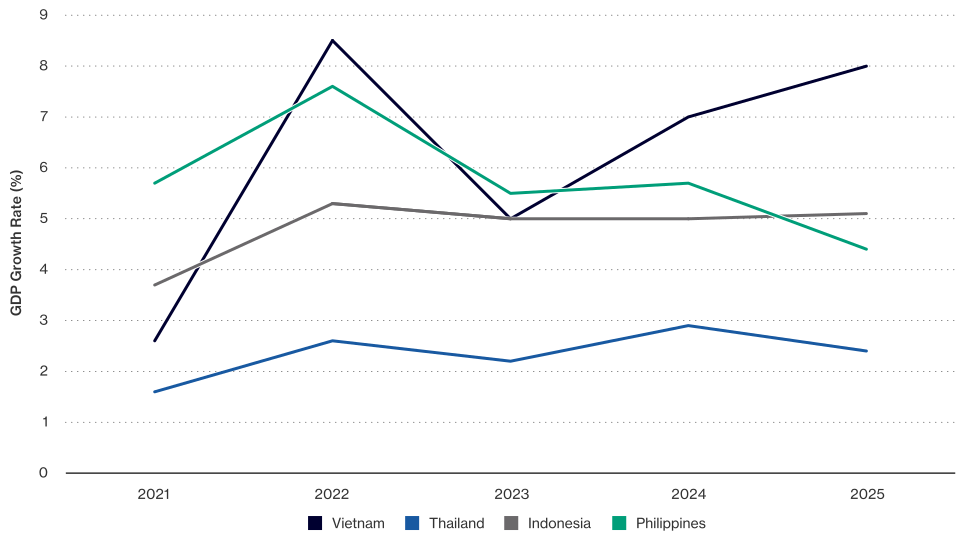
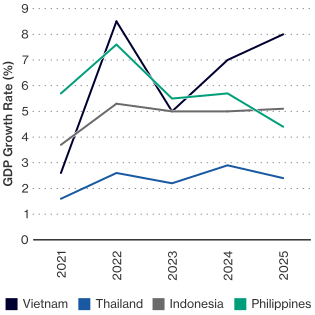
Source: World Bank
What Is Vietnam's FTSE Emerging Market Upgrade and Why Does It Matter?
FTSE Russell is one of the world's two major index providers, alongside MSCI. It classifies stock markets into tiers, from frontier to emerging to developed, and enormous pools of institutional capital are benchmarked to its indexes.
Until now, Vietnam has been classified as a frontier market. That is changing in a significant way. Vietnam is being reclassified from frontier market to emerging market status, effective September 21, 2026. When the reclassification takes effect, global emerging market funds that track FTSE indexes will be required to hold Vietnamese stocks as part of their mandates. That creates a new and structural source of demand that did not previously exist.
The market has already been responding to this reclassification positively. Vietnamese equities posted strong performance in 2025 as investors began positioning ahead of the change.
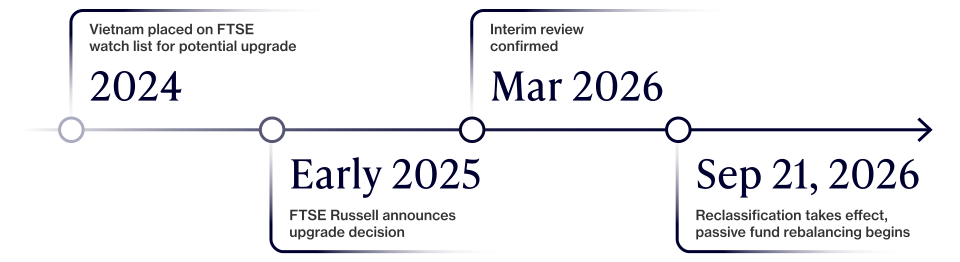
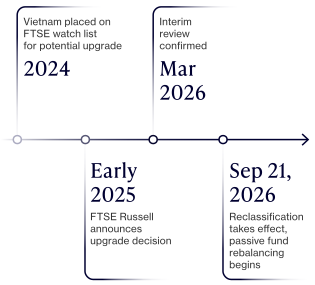
Source: Financial Times Stock Exchange Russell. As of July 2026. Dates are subject to change. For illustrative purposes only.
What Are the Risks of Investing in Vietnam?
Vietnam's growth story is real, but so are the risks. Investors should understand all four before making any allocation decisions.
- Currency risk: The Vietnamese dong can fluctuate against the U.S. dollar. When the dollar strengthens, returns measured in dollars can shrink even if the underlying investment performs well in local currency terms.
- Sector concentration: Vietnam's stock market is heavily weighted toward real estate and banking. An investor buying Vietnamese equities is not getting diversified exposure to all of Vietnam's economic activity.
- Liquidity: Individual Vietnamese stocks can be harder to trade than stocks in larger, more developed markets. Since the market is smaller and less liquid, this can create challenges when entering or exiting positions.
- Policy risk: Vietnam is governed by a single party, which means that regulatory and political changes can happen without the advance notice that investors in democratic markets often receive.
For U.S. investors, an ETF structure like the VanEck VNM ETF addresses some of these risks directly. It trades on a U.S. exchange, removing the liquidity and access barriers of buying Vietnamese stocks individually, and its diversified index can address sector concentration concerns.
How Do Global Tariffs Affect Vietnam's Manufacturing Growth?
Vietnam's rapid rise as an export hub has made it more visible in global trade policy discussions. When a country's exports to the United States grow fast enough, it tends to attract attention.
Tariff pressure has had an impact in some sectors, including footwear exports to the U.S., which fell during periods of elevated trade tension.
But Vietnam has shown more resilience to that pressure than many comparable countries. Its broad network of free trade agreements gives it alternative routes to major markets. And its position as a China+1 destination means that many of the companies manufacturing there moved specifically to reduce tariff exposure in the first place.
What Does Vietnam's Manufacturing Rise Mean for Investors?
Vietnam's economic growth is not happening in isolation. It is being driven in large part by the activity of global companies operating inside the country. Apple, Samsung, and Nike are generating wages, creating demand for services, and producing economic activity that flows through the broader Vietnam economy.
This benefits Vietnamese companies in banking, real estate, logistics, and consumer sectors. Banks lend to businesses that supply the factories, developers build the industrial parks, and consumer businesses serve a workforce with growing incomes.
For U.S. investors, accessing Vietnamese equities directly is not straightforward. There are very few U.S.-listed products in this space, local brokerage requires custody arrangements most investors don't have in place, and individual stocks can be illiquid.
As the largest and oldest Vietnam-focused ETF listed in the United States, VNM offers a liquid and accessible way to get this exposure.
How to Invest in Vietnam with VNM
Vietnam has become a hub for some of the world's largest multinational manufacturers, including Apple, Samsung, and Nike. That production activity generates economic output inside the country, flowing through Vietnamese banks, property developers, logistics companies, and consumer businesses serving a workforce with growing incomes.
For U.S. investors, accessing that economy directly is difficult. Vietnamese stocks are not listed on U.S. exchanges and buying them requires local custody arrangements and regulatory approvals that most investors do not have in place.
The VanEck Vietnam ETF (VNM) is the largest and oldest U.S.-listed ETF focused on Vietnam. It holds approximately 50-55 Vietnamese companies in a single, exchange-traded product, making it the most direct way for U.S. investors to access Vietnam's manufacturing rise.
Important Disclosure
1 Source: U.S. Census Bureau
2 Source: worldometers.com, macrotrends.net, The World Bank
This is not an offer to buy or sell, or a recommendation to buy or sell any of the securities, financial instruments or digital assets mentioned herein. The information presented does not involve the rendering of personalized investment, financial, legal, tax advice, or any call to action. Certain statements contained herein may constitute projections, forecasts and other forward-looking statements, which do not reflect actual results, are for illustrative purposes only, are valid as of the date of this communication, and are subject to change without notice. Actual future performance of any assets or industries mentioned are unknown. Information provided by third party sources are believed to be reliable and have not been independently verified for accuracy or completeness and cannot be guaranteed. VanEck does not guarantee the accuracy of third party data. The information herein represents the opinion of the author(s), but not necessarily those of VanEck or its other employees.
The MarketVector Vietnam Local Index tracks the performance of publicly traded companies that are locally incorporated in Vietnam.
MarketVector Vietnam Local Index is the exclusive property of MarketVector Indexes GmbH (a wholly owned subsidiary of the Adviser), which has contracted with Solactive AG to maintain and calculate the Index. Solactive AG uses its best efforts to ensure that the Index is calculated correctly. Irrespective of its obligations towards MarketVector Indexes GmbH, Solactive AG has no obligation to point out errors in the Index to third parties. The VanEck Vietnam ETF is not sponsored, endorsed, sold or promoted by MarketVector Indexes GmbH and MarketVector Indexes GmbH makes no representation regarding the advisability of investing in the Fund.
FTSE Russell is a global index provider that develops and maintains indexes and market-classification frameworks. FTSE Russell is a trading name of certain London Stock Exchange Group plc businesses.
MSCI is a global provider of indexes used to measure the performance of investment markets.
Index returns are not Fund returns and do not reflect any management fees or brokerage expenses. Certain indices may take into account withholding taxes. Investors can not invest directly in the Index. Returns for actual Fund investors may differ from what is shown because of differences in timing, the amount invested and fees and expenses. Index returns assume that dividends have been reinvested.
An investment in the Fund may be subject to risks which include, but are not limited to, special risk considerations of investing in Vietnamese issuers, foreign securities, emerging and frontier market issuers, foreign currency, depositary receipts, real estate sector, consumer staples sector, financials sector, basic materials sector, industrials sector, micro-,small- and medium-capitalization companies, cash transactions, equity securities, market, operational, index tracking, authorized participant concentration, no guarantee of active trading market, trading issues, passive management, fund shares trading, premium/discount, liquidity of fund shares, issuer-specific changes, non-diversified and index-related concentration risks, all of which may adversely affect the Fund. Emerging and frontier market issuers and foreign securities may be subject to securities markets, political and economic, investment and repatriation restrictions, different rules and regulations, less publicly available financial information, foreign currency and exchange rates, operational and settlement, and corporate and securities laws risks. Micro-, small- and medium-capitalization companies may be subject to elevated risks.
Investing involves substantial risk and high volatility, including possible loss of principal. An investor should consider the investment objective, risks, charges and expenses of the Fund carefully before investing. To obtain a prospectus and summary prospectus, which contains this and other information, call 800.826.2333 or visit vaneck.com/etfs. Please read the prospectus and summary prospectus carefully before investing.
© Van Eck Securities Corporation, Distributor, a wholly owned subsidiary of Van Eck Associates Corporation.
Related Insights

Related Insights
28 July 2026
INDZ was built to capture India's compounders and lifecycle winners and cut the losers. Four months in, the process is working — across cap sizes, sectors, and market conditions.
22 May 2026
India has compounded book value through every crisis for 20 years. That quality now trades at a near 20-year relative discount to broad emerging markets.
13 April 2026
Vietnam offers above-peer earnings growth, an attractive valuation, and credible catalysts in index reclassification and manufacturing expansion. VNM provides one-trade access to this opportunity.
19 March 2026
VanEck has over three decades of experience in emerging markets spanning equity and fixed income. Explore our full suite of broad EM and targeted single-country solutions.
18 December 2025
Get your portfolio ready for 2026 with detailed insights from VanEck’s investment team about the factors driving risk and returns in their respective asset classes.