Defense Lifts Moat Stocks As Tech Stumbles
11 March 2026
Read Time 10 MIN
Key Takeaways:
- Moat Index gained 2.13% in February, outperforming the S&P 500 by nearly 3 percentage points as defensive rotation favored its equal-weighted, valuation-conscious approach.
- Top contributors to Moat Index gains were Applied Materials, driven by strong earnings and confidence in AI infrastructure spending, and Bristol-Myers Squibb, which climbed on pipeline momentum and improving sentiment.
- SMID Moat Index rose 1.11% in February, trailing small- and mid-cap benchmarks as technology stock selection weighed on relative performance despite positive sector allocation.
- The SMID Moat Index was led by Hershey, thanks to easing cocoa cost headwinds and strong earnings, and Generac, boosted by data center backup power demand.
* Index performance is not illustrative of fund performance.
U.S. equity markets experienced a notable divergence in February. An accelerating rotation out of mega-cap technology stocks and into more defensive and cyclical areas of the market drove starkly different outcomes across benchmarks. The S&P 500 declined 0.76% during the month, pulled lower by its heavy concentration in technology names, while the S&P 500 Equal Weight Index rose 3.55%, underscoring the breadth of participation outside of the largest constituents. The NASDAQ Composite fell more than 3%, reflecting the pronounced weakness among technology and software companies.
Concerns around artificial intelligence disruption of traditional software business models intensified early in the month, triggering a multi-day selloff in enterprise software names that extended a pattern of weakness that had been building in recent months. Leadership came from sectors positioned away from the AI disruption narrative, with utilities, energy, materials, and consumer staples all gaining between 8% and 10%.
The Morningstar Wide Moat Focus Index (the “Moat Index”) gained 2.13% in February, outperforming the S&P 500 by nearly 3 percentage points as the Index's equal-weighted, valuation-conscious approach proved well suited to the month's rotation away from mega-cap technology. Sector allocation was the overwhelming driver of relative performance, as the strategy's substantial overweights in consumer staples and industrials contributed meaningfully. The Moat Index's overweight to health care also provided a tailwind, while its underweight to information technology, which declined roughly 3.6%, was beneficial on a relative basis. Year-to-date through February, the Moat Index has gained 3.38%, leading the S&P 500's 0.68% return.
The Morningstar US Small-Mid Cap Moat Focus Index (the "SMID Moat Index") rose 1.11% in February but trailed both the S&P MidCap 400, which gained 4.12%, and the S&P SmallCap 600, which rose 2.17%. Small- and mid-cap stocks broadly outperformed large-caps during the month, consistent with the ongoing rotation into more cyclical and value-oriented areas of the market. Within the SMID Moat Index, stock selection was the primary headwind to relative performance this month, with weakness concentrated among information technology holdings. Sector allocation was modestly positive, with the strategy's overweight to materials and underweight to financials contributing favorably.
Defensive Leadership Lifts Moat Strategies in February

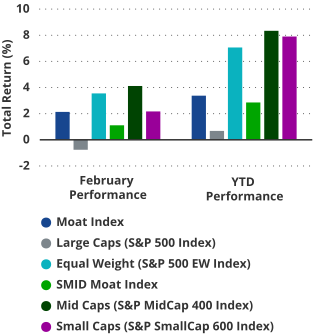
Source: Morningstar. Data as of 2/28/2026. Past performance is no guarantee of future results. Index performance is not representative of fund performance. It is not possible to invest directly in an index. Please see index definitions and other important disclosures at the end of this content. Fund performance current to the most recent month end is available by visiting vaneck.com or by calling 800.826.2333.
Moat Index Highlights: Earnings Strength Overcomes Software Drag
In February, relative performance within the Moat Index was driven almost entirely by sector allocation, while stock selection was effectively neutral. Overweights in consumer staples and industrials were the primary contributors to relative performance versus the S&P 500, while the strategy's overweight to health care and underweight to information technology also proved beneficial during a month in which the cap-weighted benchmark was weighed down by its heavy concentration in technology names.
Applied Materials Inc. (AMAT) was the top contributor to Moat Index performance during the month, with shares rising approximately 16%. The company reported strong quarterly earnings results in mid-February and provided an impressive outlook for 2026, with management guiding for more than 20% growth in equipment sales driven by an accelerating AI infrastructure buildout cycle. Investor enthusiasm reflected growing confidence in a sustained, multi-year expansion in wafer fabrication equipment demand, as AI chip supply constraints continue to far outstrip available capacity. Morningstar views Applied Materials' position as the world's largest and most diversified supplier of wafer fabrication equipment as central to its wide economic moat, underpinned by intangible assets from its industry-leading research and development spending and steep switching costs from the complexity of its equipment and embedded customer relationships.
Bristol-Myers Squibb Co. (BMY) was the second-largest contributor, with shares gaining approximately 13%. The company reported full-year 2025 results in early February that demonstrated its ability to hold revenue roughly steady despite significant headwinds from generic competition for legacy oncology drugs. Growth in newer therapies, including Camzyos in cardiology, Reblozyl in hematology, and Breyanzi and Opdualag in oncology, reinforced the company's ability to diversify beyond maturing franchises. An active late-stage pipeline with numerous catalysts expected through the end of 2026 also supported investor sentiment, as the market increasingly looks toward Bristol-Myers' trajectory beyond the patent cliffs for Eliquis and Opdivo in 2028. Morningstar assigns Bristol-Myers a wide economic moat, supported by a broad lineup of patent-protected drugs, an entrenched salesforce, and economies of scale, and views shares as undervalued heading into a year filled with pipeline readouts.
Other notable contributors during the month included Clorox Co. (CLX), a household cleaning and consumer products company; United Parcel Service Inc. (UPS), a global package delivery and logistics provider; and The Hershey Co. (HSY), a confectionery and snack food company whose shares surged more than 22% following encouraging quarterly results and improving sentiment around easing cocoa cost headwinds.
Companies detracting the most from Moat Index performance in February were concentrated within technology and software, reflecting the broader market's intensifying concerns around AI disruption of traditional enterprise software business models. Workday Inc. (WDAY), a human capital management and financial software firm, was the largest detractor, with shares falling roughly 24%. Adobe Inc. (ADBE), a digital media and creative software company; Salesforce Inc. (CRM), a provider of enterprise cloud software; and Microsoft Corp. (MSFT) also weighed on results, as each was caught in the rolling selloff that impacted software names throughout the month. LPL Financial Holdings Inc. (LPLA), a brokerage platform supporting independent financial advisors, was the only non-software detractor among the bottom five.
Moat Index Top Contributors and Detractors - February 2026
Contributors
| Company | Ticker | Sector | Avg. Weight (%) | Contribution (%) |
| Applied Materials Inc. | AMAT | Technology | 2.37 | 0.37 |
| Bristol-Myers Squibb Co. | BMY | Health Care | 2.73 | 0.36 |
| Clorox Co. | CLX | Consumer Staples | 2.48 | 0.32 |
| United Parcel Service Inc. | UPS | Industrials | 2.86 | 0.31 |
| The Hershey Co. | HSY | Consumer Staples | 1.32 | 0.29 |
Detractors
| Company | Ticker | Sector | Avg. Weight (%) | Contribution (%) |
| Workday Inc. | WDAY | Technology | 1.88 | -0.45 |
| Adobe Inc. | ADBE | Technology | 2.06 | -0.22 |
| LPL Financial Inc. | LPLA | Financials | 1.22 | -0.21 |
| Microsoft Corp. | MSFT | Technology | 2.09 | -0.18 |
| Salesforce Inc. | CRM | Technology | 2.01 | -0.17 |
Source: Morningstar. Past performance is no guarantee of future results. Index performance is not illustrative of fund performance. Not intended as a recommendation to buy or to sell any of the securities mentioned herein.
SMID Moat Index Highlights: Defensive Contributors Offset Tech Weakness
The SMID Moat Index posted a positive return in February, supported by contributions from consumer staples, health care and industrial holdings, though performance trailed small- and mid-cap benchmarks as stock selection within information technology weighed heavily. Sector allocation was modestly positive during the month, while the overall shortfall relative to benchmarks was attributable to company-specific weakness among several technology-oriented names.
The Hershey Co. (HSY) was the top contributor to SMID Moat Index performance, with shares rising more than 22%. Fourth-quarter results included 6% organic sales growth, and management's fiscal 2026 outlook called for more than 30% growth in adjusted earnings per share, signaling that the worst of the cocoa inflation headwinds may be easing. Morningstar views Hershey's dominant position in the U.S. confectionery aisle, where it holds more than one third of chocolate market share against minimal private-label competition, as the foundation of its wide economic moat, underpinned by strong intangible brand assets and an entrenched retail distribution network.
Generac Holdings Inc. (GNRC) was the second-largest contributor, with shares advancing approximately 34% during the month. The company reported fourth-quarter earnings that highlighted growing traction in the data center backup power market, with management guiding for 30% growth in commercial and industrial sales in 2026 as it executes against its growing backlog. Morningstar assigns Generac a narrow moat, supported by its dominant brand in home standby generators and cost advantages stemming from its unmatched scale in sales and distribution within the category.
Other notable contributors included Hasbro Inc. (HAS), a toy and entertainment company benefiting from its shift toward higher-margin digital gaming properties; Royalty Pharma PLC (RPRX), a buyer of biopharmaceutical royalties; and Zimmer Biomet Holdings Inc. (ZBH), a medical device company specializing in orthopedic implants.
Detractors from SMID Moat Index performance during February included several technology and software names, consistent with the pattern observed in the Moat Index. EPAM Systems Inc. (EPAM), a provider of digital platform engineering and software development services, was the largest detractor, with shares falling more than 32%. Zoom Communications Inc. (ZM), a provider of video communications and collaboration tools, declined roughly 20%, while Mattel Inc. (MAT), a toy manufacturer, fell approximately 19%. Workday Inc. (WDAY) and LPL Financial Holdings Inc. (LPLA) also detracted. The weakness among technology holdings reflected the same AI disruption concerns that pressured software names across the broader market, as investors reassessed the viability of traditional software business models in the face of rapidly advancing AI capabilities.
SMID Moat Index Top Contributors and Detractors - February 2026
Contributors
| Company | Ticker | Sector | Avg. Weight (%) | Contribution (%) |
| The Hershey Co. | HSY | Consumer Staples | 1.42 | 0.31 |
| Generac Holdings Inc. | GNRC | Industrials | 0.67 | 0.23 |
| Hasbro Inc. | HAS | Consumer Discretionary | 1.49 | 0.18 |
| Royalty Pharma | RPRX | Health Care | 1.52 | 0.17 |
| Zimmer Biomet Inc. | ZBH | Health Care | 1.19 | 0.16 |
Detractors
| Company | Ticker | Sector | Avg. Weight (%) | Contribution (%) |
| EPAM Systems Inc. | EPAM | Technology | 0.86 | -0.28 |
| Zoom Communications Inc. | ZM | Technology | 1.40 | -0.28 |
| Mattel Inc. | MAT | Consumer Discretionary | 1.47 | -0.28 |
| Workday Inc. | WDAY | Technology | 1.03 | -0.25 |
| LPL Financial Inc. | LPLA | Financials | 1.38 | -0.24 |
Source: Morningstar. Past performance is no guarantee of future results. Index performance is not illustrative of fund performance. Not intended as a recommendation to buy or to sell any of the securities mentioned herein.
Choose Your Moat Strategy
VanEck’s suite of moat investing strategies is powered by Morningstar’s equity research team, which seeks quality companies trading at attractive valuations. The below ETFs offer access to US moat companies:
VanEck Morningstar Wide ETF (MOAT): companies with a wide moat rating, which means Morningstar believes the company is likely to sustain its competitive advantage for at least the next 20 years.
VanEck Morningstar SMID Moat ETF (SMOT): small and mid-cap moat companies.
VanEck Morningstar Wide Moat Value ETF (MVAL): wide moat companies within Morningstar’s value style category.
Related Insights


Related Insights
30 March 2026
The Moat Index added NVIDIA, Broadcom and new names following its quarterly review, as tech dislocations created opportunity, while maintaining a value tilt and notable discount to fair value.
12 January 2026
A strong December capped a year of resilience for moat strategies, as quality stock selection and renewed exposure to mega-caps position them for 2026.
23 December 2025
The 4Q 2025 reconstitution of the Morningstar® Wide Moat Focus Index saw selective additions to the Magnificent 7, including NVIDIA and Meta, as AI-driven volatility created valuation opportunities. Despite adding growth-oriented tech names, the Index remains contrarian.
09 December 2025
Market breadth improved in November, lifting both the Moat Index and SMID Moat Index, with health care and materials driving gains despite weakness in technology and consumer names.
10 November 2025
Markets extended gains in October as earnings strength, AI investment, and Fed easing supported sentiment, helping moat strategies show selective strength.