Moat Investing Stays in Style
12 October 2021
Read Time 4 MIN
Once again, September lived up to its billing as the most difficult month of the year for U.S. equities. The S&P 500 Index finished the month in negative territory (-4.65%), which was its first monthly loss since January 2021, and the worst monthly return since March 2020, when economies across the world closed to address the early spread of COVID-19. U.S. equity markets had plenty to navigate in September, from debt ceiling negotiations and the prospect of Federal Reserve (Fed) tapering to persistent uncertainty surrounding the global pandemic and its potential trajectory. The Morningstar® Wide Moat Focus IndexSM (the “Moat Index” or “Index”), though not immune to market pressures, proved somewhat resilient with a -4.17% return.
Few areas of the market escaped the month unscathed, with both growth stocks and value stocks in negative territory. The Russell 1000 Growth Index posted a -5.60% return in September and the Russell 1000 Value Index was only down -3.48%. After a long run of growth outperforming value, the two styles have exchanged blows in 2020, with value outdoing growth for a few months and growth then bouncing back. Despite this push/pull environment, the Moat Index has managed to outperform the S&P 500 Index, Russell 1000 Growth Index and Russell 1000 Value Index in 2021 through September.
Moat Index Still in Style
As of September 30, 2021
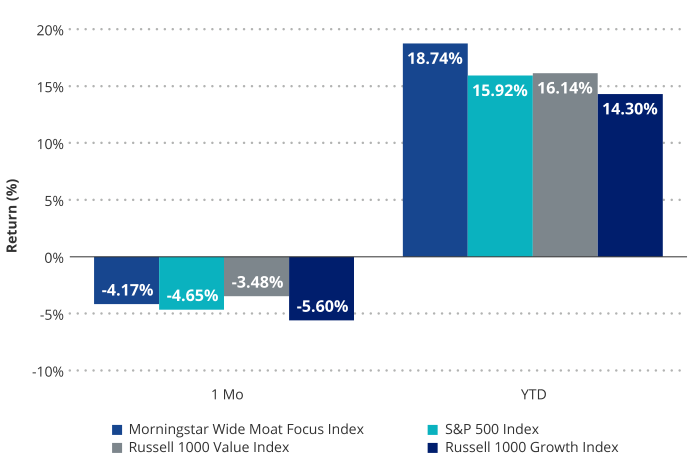
Source: Morningstar. Past performance is no guarantee of future results. Individual company and index performance is not illustrative of fund performance. For fund performance current to the most recent month-end, visit vaneck.com.
Tech Selections Boost Moat Index in September
Salesforce.com (CRM) was a standout for the Moat Index in September and its overweight compared to the S&P 500 Index boosted relative performance. Shares of Salesforce spiked following its investor day in late September. Subsequently, Morningstar raised its fair value estimate from $292 per share to $312, leaving shares attractively priced despite gains for the month. Morningstar noted encouraging increases to 2022 and 2023 guidance as well as an emerging margin story and intense interest in all things Slack following the completion of its acquisition of Slack Technologies this summer.
Blackbaud Inc. (BLKB) and Guidewire Software (GWRE), both software companies, also provided strong relative returns in October and both owe their wide moat rating to high customer switching costs. Both operate in niche areas (Blackbaud in the non-profit ecosystem and Guidewire in the property and casualty industry) and both have entrenched their products and services in their customers’ business models. Both remain modestly undervalued according to Morningstar.
Health Care Detractors Cause Portfolio Pain
Biogen Inc. (BIIB), Veeva Systems Inc. (VEEV) and Bristol-Myers Squibb Co (BMY), all overweight in the Moat Index vs. the S&P 500, were the three largest relative detractors from returns for the month. Biogen and Bristol-Myers Squibb have been forced to navigate upcoming congressional proposals and a plan from the U.S. Department of Health and Human Services that are putting drug pricing policy back in the spotlight. However, Morningstar has not seen a proposal to date that appears moderate enough to pass the razor thin Democratic majority in the Senate. Therefore, Morningstar does not anticipate any near term changes to fair value estimates or moat ratings for its biotech and pharmaceutical coverage. They expect innovative drugs will carry strong pricing powers, a core pillar in moat ratings and valuations for the industry.
Index Review Yields Modest Changes
The Moat Index underwent its third quarter review in late September. While eight companies were added and removed from the sub-portfolio under review, there weren’t any major shifts in sector or style exposure. Value stocks remained the largest exposure in the Index at approximately 43%, followed by core stocks at approximately 32% and growth stocks at nearly 25%.
The tech sector saw its prominence in the Index increase, driven mostly by semiconductor companies KLA Corp., Lam Research Corp. and Microchip Technologies re-joining the Index this quarter. Health care, a long-term overweight in the Index saw a modest decrease to its exposure.
Related Insights


Related Insights
09 December 2025
Market breadth improved in November, lifting both the Moat Index and SMID Moat Index, with health care and materials driving gains despite weakness in technology and consumer names.
10 November 2025
Markets extended gains in October as earnings strength, AI investment, and Fed easing supported sentiment, helping moat strategies show selective strength.
15 October 2025
US equity market dominance by a handful of giants is leaving many investors with overlapping exposure and expensive holdings. Here’s why diversification matters more than ever.
08 October 2025
Tech gains helped moat strategies navigate September’s headwinds, with fresh picks from the quarterly Moat Index review keeping value opportunities in focus.
24 September 2025
The September Moat Index review trimmed tech exposure, added new names and maintained a strong value tilt, highlighting its contrarian position in today’s market.