A Milder Growth Slowdown?
16 December 2022
Read Time 2 MIN
DM Rate Hikes
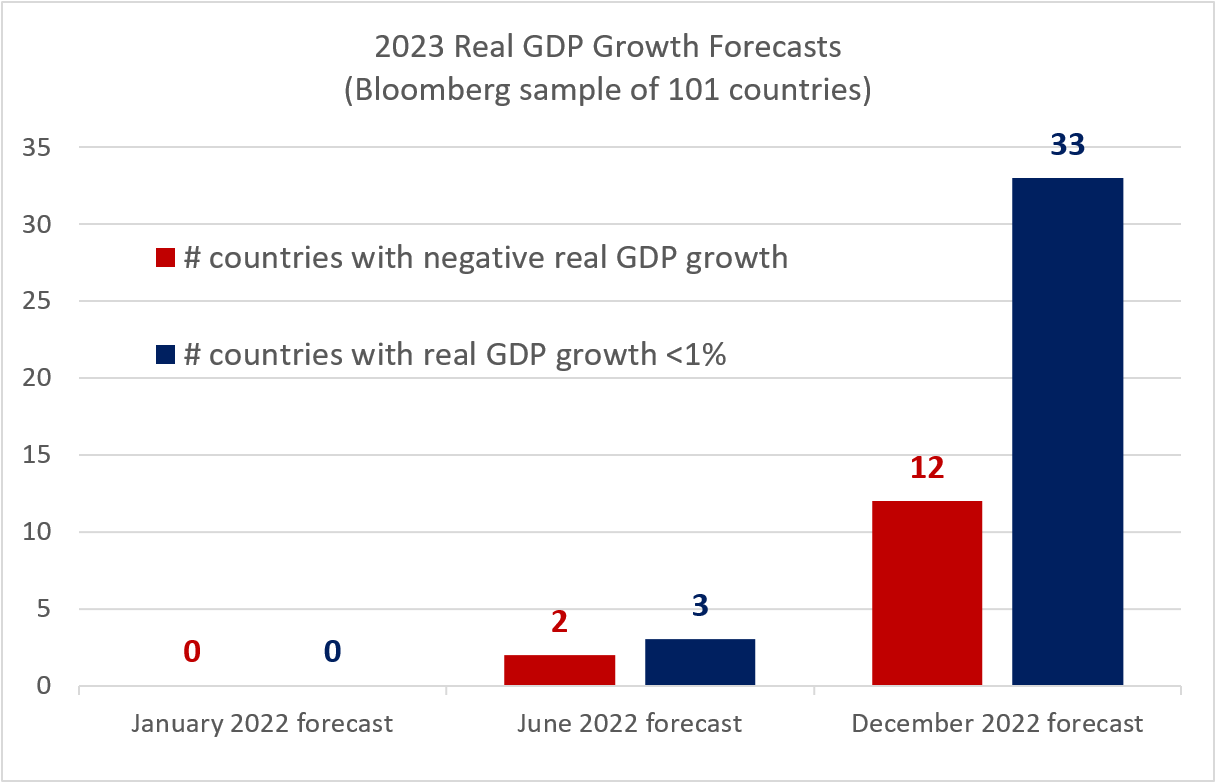
The consensus global growth outlook is quite bleak – according to the Bloomberg pool of forecasters, about 1/3 of countries will grow by less than 1% next year (see chart below). This is a very big increase from only three countries back in June. Elevated recession risks are one of the reasons why the market is not fully convinced about the extent of additional policy tightening in developed markets (DM) – despite major central banks’ hawkish messaging. The U.S. peak policy rate implied by Fed Funds Futures is still below 5%, and even though the implied ECB peak rate went up after this week’s meeting, it is still well below the previous high of 3.65%. Today’s preliminary activity gauges in Europe signaled that the slowdown might be milder than expected, but the U.S. PMIs (Purchasing Managers Indices) surprised significantly to the downside, moving deeper into the contraction zone and weighing on the rates expectations.
EM Tightening Cycles
The growth outlook for most emerging markets (EMs) is not amazing either, but disinflation is getting more entrenched, and this should allow to safely slow the pace rate hikes and possibly open room for rate cuts in order to prop up growth going forward. Some central banks are better positioned to do this than others – they started tightening earlier and government policies (especially fiscal) are less problematic. The Mexican central bank delivered a smaller 50bps hike yesterday, and the local swap curve now prices in only 85bps of additional tightening before reaching the peak rate in Q1-2023. The Colombian central bank, however, is under more pressure to keep frontload rate hikes due to higher inflation risks (headline inflation accelerated more than expected in November to 12.53% year-on-year), questionable policy signals from the government, and a large “twin” deficit (a sum of fiscal and current account balances). The consensus sees another 100bps hike in Colombia this afternoon.
EM Disinflation
The inflation/growth policy trade-off might be particularly difficult in Central Europe. Poland, Hungary, and the Czech Republic are likely to grow by less than 1% next year, but headline inflation is still in double digits. An additional complication is that core price pressures – which should be less dependent on external shocks - are also quite persistent. Poland’s core inflation exceeds expectations once again in November, accelerating to 11.4% year-on-year. The market continues to believe that all three central banks will be able to stay on hold, avoiding “emergency” hikes. The question is whether local bonds – which staged a nice comeback in Q4 – will agree with this narrative. Stay tuned!
Chart at a Glance: More Countries Growing By Less Than 1% Next Year
Source: Bloomberg LP
Related Insights

Related Insights
07 April 2025
06 March 2025
13 August 2026
See how Jan van Eck's Q3 outlook can be translated into actionable ETF ideas across semiconductors, private credit, gold and bitcoin.
10 February 2026
Debasement is back in focus. Here’s what’s driving it, what could reverse it and how we’re positioning portfolios for both scenarios.
07 April 2025
Trump’s tariffs spark trade war fears, fueling market volatility, inflation risk, and recession threats. With global retaliation likely, near-term growth is clearly at risk.
06 March 2025
Trump’s tariffs, AI’s next phase, and a potential U.S. gold revaluation could shake markets—investors who stay ahead of these transitions will be best positioned.
20 February 2025
China's AI breakthrough, persistent inflation, gold’s outperformance, and rising energy demand underscore a shifting investment landscape.