Does 60/40 Still Work in China?
17 December 2020
Read Time 2 MIN
The classic 60/40 portfolio has been challenged due to the extremely low yields in developed markets currently, with prospects for a meaningful increase appearing unlikely any time soon. This has driven many investors to increase their risk exposure to maintain an adequate yield, by increasing allocations to non-core asset classes such as high yield credit, emerging markets debt and equity income. While these can provide an attractive yield pickup, they do not come without additional risks. In addition, an investor’s exposure to equity markets increases with these asset classes due to their higher correlation to stocks, increasing the risk of drawdowns and higher volatility.
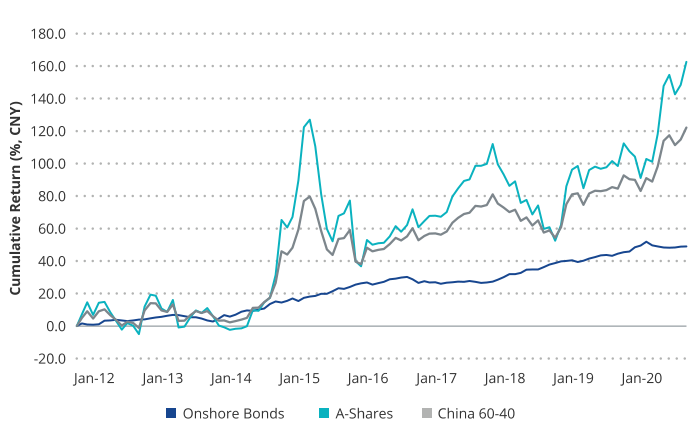
Outside of the U.S., however, there are still opportunities to use a broad fixed income allocation as both a yield enhancer as well as a diversifier and risk-reducer within a diversified portfolio. China’s onshore bond markets, in particular, may be attractive to the growing number of investors seeking exposure to that country’s impressive economic growth and ongoing transformation into a consumer led economy. Adding bonds to an equity exposure historically has helped to increase risk adjusted returns by lowering volatility and drawdowns. A simplified analysis using two asset classes, large cap equities (represented by the CSI 300 Index) and investment grade aggregate fixed income (represented by the ChinaBond China High Quality Bond Index) helps to illustrate this. Although an efficient frontier analysis would suggest a much higher allocation to bonds to optimize the risk/return tradeoff, we think a 60/40 allocation serves as a useful benchmark. Since we believe the asset allocation decision within China is distinct from the currency analysis, we show the risk and return statistics in both CNY and USD terms.
Growth of a Balanced China Portfolio
| February 2012 through November 2020 | |||||||||
| Return | Std Dev | Sharpe Ratio | Max Drawdown | Yield | |||||
| USD | CNY | USD | CNY | USD | CNY | USD | CNY | ||
| Onshore Bonds | 3.94 | 4.44 | 4.52 | 2.78 | 0.72 | 0.69 | -7.14 | -3.78 | 3.55% |
| A-Shares | 10.14 | 10.67 | 24.81 | 23.47 | 0.48 | 0.47 | -42.98 | -39.78 | 1.80% |
| China 60-40 | 8.34 | 8.86 | 15.52 | 14.01 | 0.55 | 0.53 | -27.20 | -23.11 | 2.50% |
Source: Morningstar and Bloomberg, as of 11/30/2020.
The blended portfolio provides not only a higher yield, but also a significantly improved risk adjusted return due to the negative correlation between the two asset classes. Volatility and maximum drawdown of the 60/40 blend is nearly 40% lower than an all-equity exposure, while capturing 0.70% of additional annual yield. A blended portfolio may also benefit from the many tailwinds that we expect onshore bonds to benefit from going forward, including positive real yields, several potential sources of support for CNY and increasing inflows from international investors. We believe a less aggressive tone from Washington D.C. may also benefit a China oriented portfolio.
Related Insights

Related Insights
28 abril 2026

11 febrero 2026
18 diciembre 2025
05 diciembre 2025
28 abril 2026
El equipo de Deuda de Mercados Emergentes acaba de regresar de las reuniones de primavera de 2026 del FMI en Washington, donde se reunió con autoridades financieras, bancarias y políticas de todo el mundo.
18 diciembre 2025
Prepare su portafolio para 2026 con información detallada del equipo de inversiones de VanEck sobre los factores que determinarán el riesgo y los rendimientos en sus respectivas clases de activos.
05 diciembre 2025
Los bonos de mercados emergentes en moneda local ofrecen rendimientos reales elevados, sólidos rendimientos en 2025 y resiliencia ante shocks, impulsados por políticas creíbles y fundamentos sólidos.
04 diciembre 2025
La deuda de alto rendimiento de mercados emergentes ha extendido su dinamismo en 2025, ofreciendo un carry sólido y rendimientos atractivos. Gracias a una mayor calidad crediticia y a menores tasas de incumplimiento, este segmento presenta un perfil de riesgo más favorable que la deuda estadounidense de alto rendimiento.
28 octubre 2025
El equipo de deuda de mercados emergentes acaba de regresar de las reuniones anuales de otoño del FMI; estas son sus conclusiones.