Fed’s Inconclusive Vision Keeps Gold in Sight
13 July 2021
Read Time 8 MIN
Fed: Shake, Rattle and Roll
Gold’s second quarter rally came to an abrupt end on June 16 following the Federal Open Market Committee (FOMC) announcement for its June meeting. The U.S. Federal Reserve Bank’s (the Fed’s) projections showed two rate increases in 2023, compared to previous projections for a first rate hike in 2024. In addition, the FOMC made it clear that discussions about tapering its treasury and mortgage-backed securities purchases have begun. These subtle changes caught markets by surprise, causing strong moves across most asset classes.
The Fed, at its June 2021 Federal Open Market Committee meeting, also upgraded its GDP growth expectations for 2021 from 6.5% to 7.0% and increased its core inflation projections for 2021 (from 2.2% to 3%), but it continues to see recent inflationary pressures as transitory. This outlook propelled the U.S. dollar above its 200-day moving average, and the U.S. Dollar Index (DXY)1 rose almost 2% over the three days following the Fed policy announcement.
Gold succumbed to dollar strength, falling 5.1% over the same three-day period, and trading below multiple technical support levels. Equities also sold off, as did commodities during the week of the announcement. The reaction in the Treasury bond market was mixed. The 10-year and 30-year yields were up initially, but quickly reverse course to end that week below pre-FOMC announcement levels.
The Fed appears to have been successful in communicating a slight shift in policy to support its outlook for strong economic growth and under-control inflation. Only a week after the FOMC announcement, equity markets had bounced back, and by the end of the month the S&P 500 was trading at all-time highs. The dollar added to its gains on the last day of June. Gold pared some of its earlier losses, but remained bound in the $1,750-$1,800 per ounce range, closing at $1,770.11 on June 30, down 7.02% for the month, for a loss of 6.76% year-to-date.
Still Hope For the Miners
Gold stocks are also down for the year, reflecting gold’s performance. June was a terrible month for the gold equities, erasing all the gains made in the first five months of 2021. However, the larger cap gold stocks, as measured by the NYSE Arca Gold Miners Index (GDMNTR)2 are still outperforming gold l year to date, with the GDMNTR down 5.62% during the first half. This is atypical in a period of declining gold prices, and may be a reflection of several factors.
One factor could be that these larger cap stocks lagged gold slightly last year, despite a phenomenal year for gold, which should have translated to significant outperformance by the equities. Thus, the markets may be playing catch up.
Sector fundamentals could also be an important driving factor. Gold mining companies as a group are in great shape operationally and financially, perhaps the best they have ever been. With gold prices at current levels, even after the recent pullback, profit margins are very healthy and companies are generating significant free cash flow. Excess cash is being deployed responsibly, used to fund lower risk projects that carry higher returns and to enhance return to shareholders in the form of dividends and share buy backs. The gold mining sector of today may be starting to attract more and more investors, as they demonstrate they are profitable companies that remain investable through the metal price cycle.
The smaller gold mining companies, which outperformed both gold and larger cap gold companies last year, have underperformed year to date. The MVIS Global Junior Gold Miners Index (MVGDXJTR)3ended the first half of 2021 down 13.89%.
Outlook Seems All But Clear
In our view the markets seem to have adopted the Fed’s scenario of growth without unwanted levels of inflation in the longer term. While this would be negative for gold as a safe haven or inflation hedge, we think there are many reasons to be cautious about this view.
The Fed said it is thinking about tapering, and it may start to slowly increase rates two years from now. There were no details around the structure or timing for tightening. Furthermore, any tapering would be gradual, which means further liquidity would continue to be pumped into the system until the program comes to a full stop. For now, purchases continue at the extraordinary rate of $120 billion per month and rates remain near zero, which should intensify concerns that this unprecedented level of monetary (along with fiscal) stimulus could bring on an inflationary cycle. If fears of higher inflation is what prompted Fed members to forecast rate hikes in 2023, then 25 basis point increments two years from now may likely be too little, too late.
In other words, we believe the Fed’s projections and guidance do not paint a conclusive picture. In fact, because we are going through a unique period of economic reopening/normalization, it is very difficult to forecast where all the important variables will be both in the near term and once the transient pandemic effects subside. The Fed’s message could change rapidly and significantly. For now, the market has chosen to ignore these uncertainties and risks.
One Thing For Sure: Dollar Strength is a Headwind
Despite the June price weakness, gold continues to trade within a longer-term bull market trend. The bottom of this trend historically is around $1,740 per ounce. In the shorter-term, gold may spend some time consolidating at current levels in a pattern we have seen since it reached its peak of $2,075 per ounce in August 2020. Investors will be focused on the Fed’s policy outlook, with gold pricing in any changes in markets perceptions. Movements in interest rates and the U.S. dollar should continue to affect gold’s direction. Lately, the U.S. dollar seems to be a more dominant factor, representing gold’s main headwind recently. Should dollar strength subside, and current inflation levels persist, gold could trend towards $2,000 by year-end.
Inflation May Still Be Underrated Though
Gold has historically exhibited stronger correlation with inflation when inflation rises above 3%. In addition, inflation surprises have had a very high positive correlation with gold over the past 45 years, as shown in the chart below.
Inflation surprises have generally benefitted gold
Correlation with Gold
As of May 31, 2021
| Variable | Last 45 Yr |
| Headline Inflation | 13% |
| Core Inflation | 11% |
| Wage Inflation | -2% |
| Services Inflation | 10% |
| Food Inflation | 6% |
| Oil ($/bbl) | 16% |
| Bloomberg Commodity Index | 50% |
| Copper ($/lb) | 23% |
| U.S. Trade Weighted Dollar | -40% |
| Inflation Surprise | 23% |
| U.S. 10-Year Real Yields | -25% |
| U.S. 3-Month Real Yields | -18% |
Source: Scotiabank, Bloomberg. Data as of May 31, 2021. Using monthly returns except for U.S. Trade Weighted Dollar, U.S. 10-Year Real Yields and U.S. 3-Month Real Yields, where computed with quarter-over-quarter returns. Inflation surprise: actual less forecasted inflation, quarterly. Headline Inflation = Consumer Price Index for All Urban Consumers; Core Inflation = Consumer Price Index for All Urban Consumers (Less Food & Energy); US Wage Inflation = US Average Hourly Earnings: Total Private Industries, Production and Nonsupervisory Employees; Services Inflation = Consumer Price Index for All Urban Consumers: Services (Less Energy); Food Inflation = Consumer Price Index for All Urban Consumers: Food and Beverages in U.S. City Average; Oil Inflation = WTI Crude Oil (Generic 1st Month Contract); US Trade Weighted Dollar = U.S. Dollar Index (DXY); Inflation Surprise = actual less forecasted inflation; U.S. 10-Year Real Yields = U.S. Treasury 10-Year Yield adjusted for inflation (less CPI); U.S. 3-Month Real Yields = U.S. Treasury 3-Month Yield adjusted for inflation (less CPI).
Inflation expectations remain well above the average of the past almost two decades. The U.S. Personal Consumption Expenditure (PCE) Core Price Index4, the Fed’s preferred gauge of inflation, rose to 3.4% on a yearly basis in May, up from 3.1% in April, levels last seen in the early 90s. The Fed’s projections show core PCE inflation at 3.0% for 2021, but declining to 2% in the longer run. We continue to believe that inflation at current levels could be more persistent than the Fed is projecting.
Anecdotally, we see supply chain and labor shortages in many sectors that could signal further inflationary pressures ahead. Commodities are at multi-year highs. Global growth is picking up, trillions of dollar in U.S. fiscal spending, and the increasing demand for many metals as part of the global energy transition, should support commodities in the longer-term, contributing to higher inflation expectations. In addition, ongoing monetary stimulus, alongside expected fiscal stimulus, adds conviction to the “here-for-longer” inflation case.
Hold On To That Gold
More persistent and higher inflation would offset the effect of any rise in rates, causing real rates to remain low or negative. While the market may drive rates higher, we think the Fed may not be able to raise rates in the foreseeable future, both for fears of the negative impact this would have on markets and for the unbearable debt service burden it would bring about. The risk of lower real rates, a weaker than expected post-stimulus economic recovery, higher inflation, a weaker dollar, extreme debt levels, the final bursting of asset price bubbles and other unintended consequences of the massive liquidity injected into the financial system are all factors that may support higher gold prices in the longer-term. It is not hard to imagine an environment where more than one of these risks could come into play, significantly increasing gold’s appeal as a safe haven, inflation hedge and portfolio diversifier.
Most recognize gold’s role as insurance in a portfolio. Perhaps less familiar is its volatility profile (chart below), which importantly, has been relatively consistent during the market shocks of the pandemic, and over the past decade. This enhances gold’s role as a diversifier and further justifies a proper allocation in a portfolio. These characteristics, exhibited by gold historically, position gold to potentially advance to new highs in the longer-term.
Gold has been a stable asset in good and bad times over the last decade
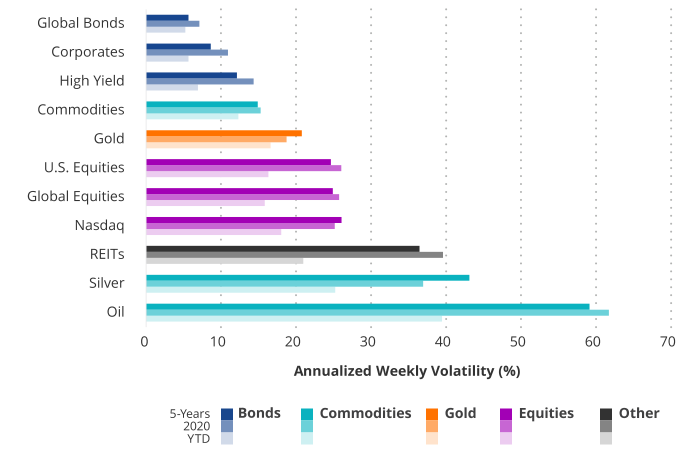
Source: World Gold Council, VanEck. Data as of June 30, 2021. Global Bonds = Bloomberg BarCap Global Aggregate Bond Index; Corporates = Bloomberg Barclays Global Aggregate – Corporates Index; High Yield = Bloomberg Barclays Global High Yield Index; Commodities = Bloomberg Commodity Index - Total Return; Gold = Gold (NYMEX); U.S. Equities = S&P 500 Index; Global Equities = MSCI World ex USA Index; Nasdaq = Nasdaq Composite; REITS = FTSE Nareit Composite Total Return Index; Silver = Dow Jones Commodity Silver Total Return Index; Oil = Bloomberg Crude Oil - Total Return Index.
Related Insights

Related Insights
10 febrero 2026
18 diciembre 2025
07 noviembre 2025
10 febrero 2026
Las oscilaciones del precio del oro en enero evidenciaron volatilidad, no debilidad. La fuerte demanda, las compras de los bancos centrales y la mejora de los fundamentos del sector minero siguen respaldando un mercado alcista sólido y duradero a largo plazo de cara a 2026.
18 diciembre 2025
Prepare su portafolio para 2026 con información detallada del equipo de inversiones de VanEck sobre los factores que determinarán el riesgo y los rendimientos en sus respectivas clases de activos.
18 noviembre 2025
El repunte del oro por encima de los USD 4,000/oz refleja fortaleza en un contexto de oferta limitada y demanda constante. Las mineras continúan subvaloradas, lo que abre oportunidades potenciales si persisten las tendencias actuales del mercado.
07 noviembre 2025
El oro alcanzó máximos históricos en 2025, impulsado por la demanda de los bancos centrales, la desdolarización y la rentabilidad de los inversores.
10 octubre 2025
El oro subió a máximos históricos, cerca de $3859/onza en septiembre, dado el aumento de la demanda tras los recortes de tasas de la Reserva Federal y las compras de los bancos centrales. Los mineros repuntaron gracias al fuerte flujo de caja, la disciplina y el renovado interés de los inversores.