Moat Companies for a Sustainable Future
29 October 2021
Read Time 4 MIN
Investors have increasingly been turning to sustainable investments. Mutual fund and ETF strategies focusing on climate issues, social causes or built with broad ESG considerations have grown rapidly in recent years. Those identified as a sustainable fund by Morningstar have seen assets increase by nearly 175% over the last three years. In that same time, the number of U.S. ETFs identified as sustainable have more than double from 91 ETFs three years ago to 174 as of September.1
Though investment options are expected to continue to expand, we are likely in the early stages of how to incorporate sustainable investment considerations into portfolio construction as investor views of ESG issues and company behaviors will undoubtedly evolve.
Morningstar has taken the long view by creating the Morningstar® US Sustainability Moat Focus IndexSM (the “Index”) that combines its proven equity research process with Sustainalytics’ forward-looking ESG research.
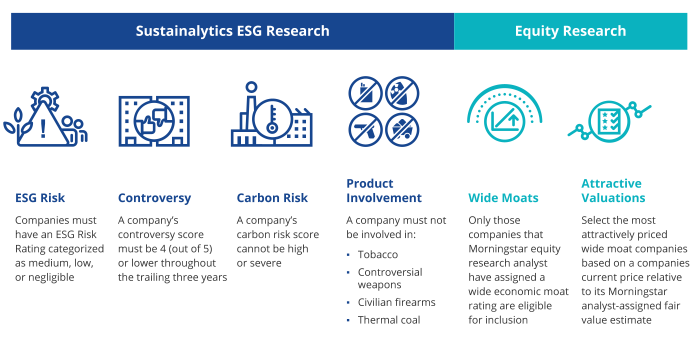
Source; Morningstar.
Sustainalytics: Forward-Looking ESG Perspective
Sustainalytics has built its reputation over the last 25 years as a market-leading ESG research provider. Its risk analysis assigns ratings to over 20,000 securities globally. Sustainalytics has long served the largest asset managers in the industry and has built a reputation as a leading provider of ESG data.
The Morningstar US Sustainability Moat Focus Index leverage several ESG ratings from Sustainalytics.
| ESG Risk |
The Sustainalytics ESG Risk Rating is their broad-based, flagship ESG risk assessment. It is forward-looking in nature and identifies a company’s financial exposure to material ESG risks that are specific to its industry and that company itself.Sustainalytics then determines how successfully a company has managed those ESG risks. The remaining unmanaged ESG risks form the basis for its ESG Risk Rating, which spans from Negligible to Severe. The Index will only consider those companies with a Negligible to Medium ESG Risk Rating. |
| Controversy |
Morningstar’s Controversy Score seeks to identify incidents and events that may have a negative impact on a company’s reputation. It is backward-looking in nature and seeks to identify the impact of an incident or series of incidents on the environment and/or society. It examines the financial risk to a company resulting from the incidents and how a company has responded to the incident to determine the severity of the controversy. Companies with a Severe Controversy Score in the last three years are not included in the Index. |
| Carbon Risk |
The Sustainalytics Carbon Risk Rating isolates a company’s financial risk associated with the transition to a low-carbon economy. This forward-looking assessment considers financial risk along a company’s value chain, from supply chain to operations to the products and services it offers. The Carbon Risk Score does not simply measure a company’s emissions; rather it reflects the level of unmanaged carbon risks affecting a company. Only those companies with Negligible to Medium Carbon Risk Ratings are eligible for the Index. |
| Product Involvement |
In addition to Sustainalytics ratings, the Index considers whether a company is involved in certain controversial products. • Tobacco: a company must not have more than 50% tobacco products involvement by revenue. • Controversial Weapons: a company must not have any involvement in the production of controversial weapons (as defined by third-party Sustainalytics Global Compact Compliance Service exclusionary lists). • Civilian Firearms: a company must not have any involvement in the manufacturing of firearms sold to civilian customers. • Thermal Coal: a company must not have any involvement in Thermal Coal (extraction or power generation). |
Source: Morningstar.
Morningstar’s Proven Moat Investing Philosophy
The Index pairs Sustainalytics ESG risk analysis with Morningstar’s equity research that identifies companies with long-term competitive advantages, or moats, that are trading at attractive valuations. Its methodology mirrors many of the attributes that have contributed to the long-term success of the Morningstar® Wide Moat Focus IndexSM, which serves as the benchmark index of the VanEck Morningstar Wide Moat ETF (MOAT).
The Index leverages Morningstar’s 100-person equity research team, which implements a single research philosophy across 1,500 companies globally. Each analysis assigns a forward-looking economic moat rating and fair value estimate to each company they cover based on the firm’s consistent research framework.
A Sustainable Approach to Moat Investing
Many of the most popular sustainable investment strategies seek to offer broad exposure to market indexes while applying some level of exclusionary or inclusionary ESG screens. This may reduce ESG risk in a portfolio, but does not address other performance drivers. The Morningstar US Sustainability Moat Focus Index’s unique combination of forward-looking equity research and ESG screening offers investors a U.S. equity strategy that seeks to provide investors with attractive risk-adjusted returns while mitigating ESG risks.
VanEck Morningstar ESG Moat ETF (MOTE) seeks to replicate as closely as possible, before fees and expenses the price and yield performance of the Morningstar US Sustainability Moat Focus Index.
Related Insights


Related Insights
12 enero 2026
23 diciembre 2025
09 diciembre 2025
12 enero 2026
Un sólido diciembre coronó un año de resiliencia para las estrategias de inversión en ventajas competitivas sostenibles, ya que la selección de acciones de calidad y la renovada exposición a empresas de megacapitalización las posicionan de manera favorable para 2026.
23 diciembre 2025
La reconstitución del 4T de 2025 del índice Morningstar® Wide Moat Focus incluyó incorporaciones selectivas de las 7 Magníficas, entre ellas NVIDIA y Meta, ya que la volatilidad impulsada por la inteligencia artificial generó oportunidades por valoraciones atractivas. A pesar de incorporar valores tecnológicos de perfil de crecimiento, el Índice mantiene una estrategia contraria.
09 diciembre 2025
La amplitud del mercado mejoró en noviembre, impulsando tanto al índice Moat como al índice SMID Moat, con los sectores salud y materiales liderando las subas pese a la debilidad de los valores tecnológicos y de consumo.
10 noviembre 2025
Los mercados ampliaron las ganancias en octubre, ya que la fortaleza de los beneficios, la inversión en inteligencia artificial y la relajación de la Fed favorecieron la confianza, lo que contribuyó a que las estrategias de ventaja competitiva o "moat" mostraran una fortaleza selectiva.
15 octubre 2025
El dominio del mercado de renta variable estadounidense por parte de unos cuantos gigantes deja a muchos inversionistas con exposiciones redundantes y posiciones costosas. Por eso, la diversificación es más importante que nunca