
Welcome to VanEck
Select Investor Type
16 January 2026
Read Time 7 MIN
Monthly gold market and economic insights from Imaru Casanova, Portfolio Manager, featuring her unique views on mining and gold’s portfolio benefits.
This article covers market developments through the end of December 2025. All performances are stated in USD. Returns may increase or decrease as a result of currency fluctuations.
Key Takeaways:
Key Risks:
What a year for gold! The metal closed at an all-time high of $4,533.21 on 26 December. Some profit taking was not surprising, given gold’s spectacular performance in 2025, which pushed prices lower during the final week of the year to close at $4,319.37 per ounce on 31 December. Gold finished the year up 64.58%1. The figures refer to the past and past performance is not a reliable indicator of future results.
The drivers behind this strength were twofold: central banks around the world continued net purchases of gold near record levels as they advance their de-dollarization agenda; and investors more broadly increasing their gold exposure to hedge against market uncertainty, volatility, and geopolitical risk. Gold also benefited from a growing need to diversify and protect portfolios globally, particularly as real rates declined and gold became a more attractive investment.
Gold performance in 2025 was impressive—its best annual gain since 1979. But gold stocks stole the spotlight, more than doubling bullion’s gains. The MarketVector™ Global Gold Miners Index (MVGDXTR) and the MVIS ® Global Junior Gold Miners Index (MVGDXJTR) were up 157.39%2 and 176.50%3, respectively, during the year.
After years of underperformance, gold mining stocks finally benefited from a gold rally that included the Western investor as one of the main driving forces—unlike recent years, when central bank demand was largely behind gold’s strength. As investors returned to gold, their appetite extended to gold stocks in search of a leveraged play. This flow of capital, while still modest relative to the broader equity markets, had a significant impact on the deeply oversold and comparatively tiny gold equity universe, which we estimate increased to just around $1 trillion of combined market cap at the end of 2025.
Despite triple digit gains in 2025, we believe gold stocks could continue to outperform gold in 2026. Gold companies remain at historically low valuations based on most metrics. While stocks experienced a re-rating in the second half of 2025, this came after almost two decades of persistent de-rating.
Gold stocks are rebounding from very oversold levels, so even after last year’s rally, valuations remain attractive.
Gold miners’ price-to-earnings ratios remain below historical averages, even after the strong performance seen in 2025.
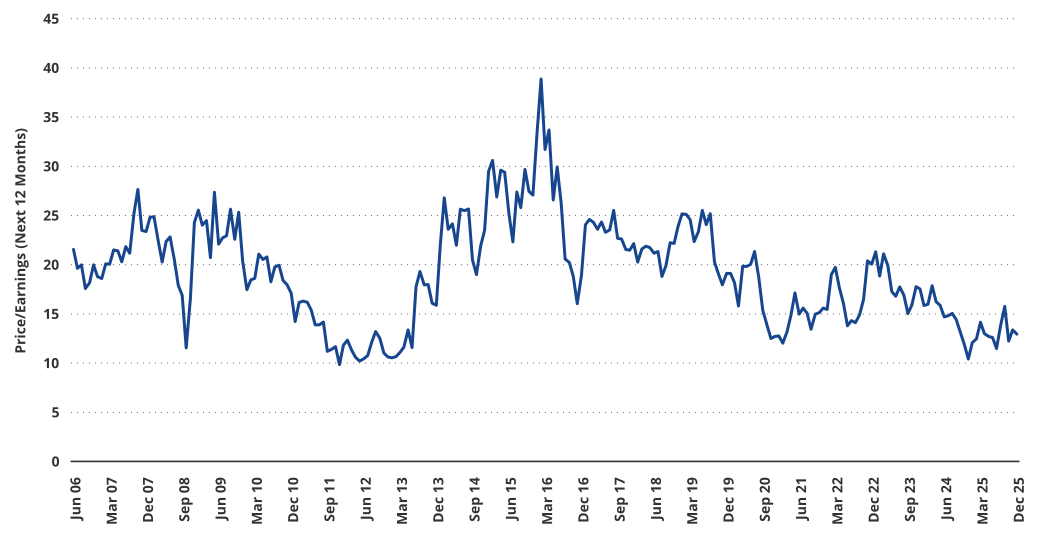
Source: FactSet. Data as of December 2025. "Gold Miners" represented by the NYSE Arca Gold Miners Index.
Gold and precious metals mining equities continue to trade at lower levels relative to gold.
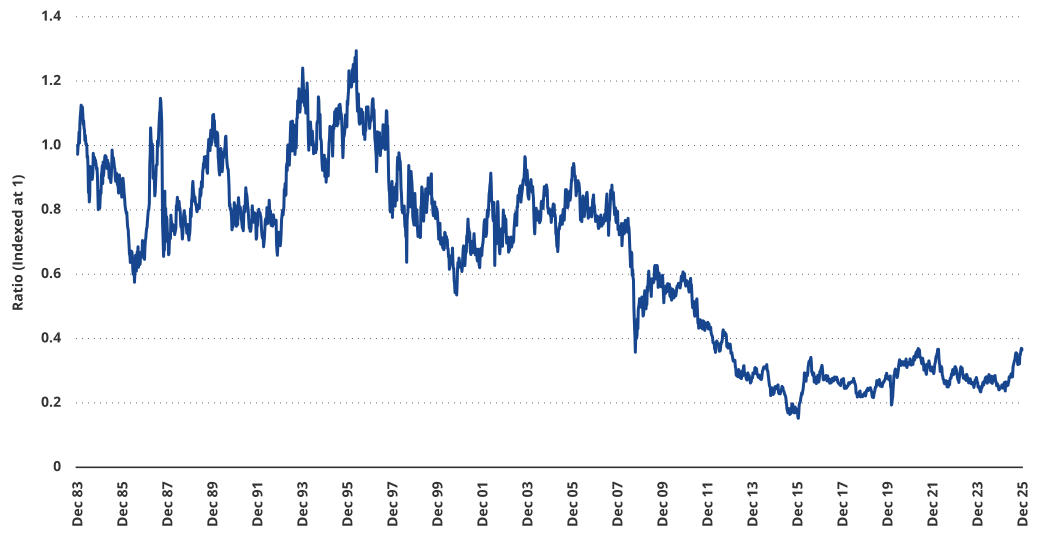
Source: Bloomberg. Data as of December 2025. “Gold & Precious Metals Miners” represented by the Philadelphia (PHLX) Gold/Silver Miners Index (TR). Past performance is not indicative of future results. It is not possible to directly invest in an index.
Our outlook for higher gold prices in 2026 is supported by increasing investment demand for gold, which should also translate into investment demand for gold stocks.
As shown in the chart below, gold and precious metals remain a relatively small allocation within global portfolios. With only an estimated 1–2% of assets globally currently allocated to gold and gold stocks, there is plenty of room for increased gold exposure across global portfolios.
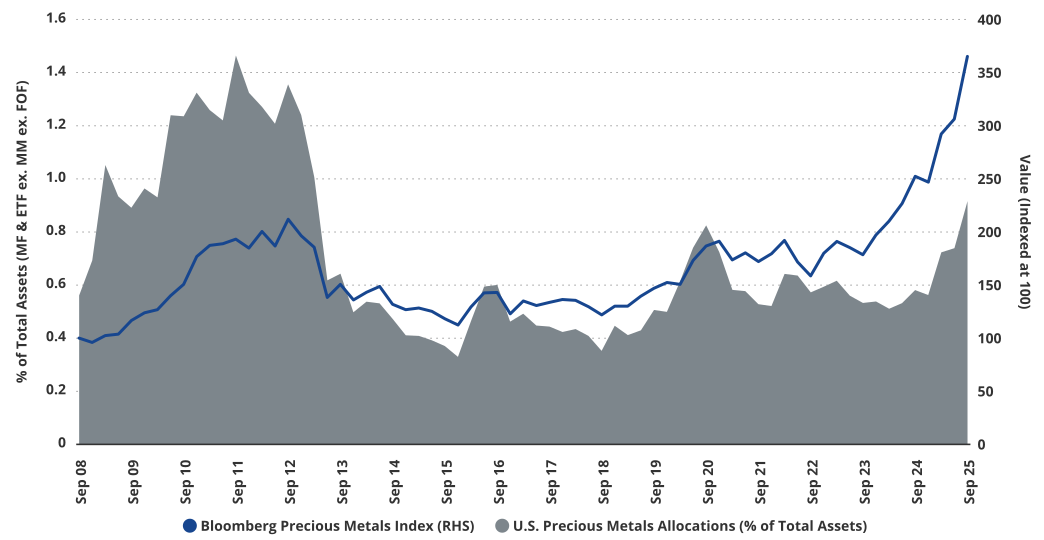
Source: Morningstar, VanEck. Data as of December 2025. Bloomberg Precious Metals Index (BCOMPR) tracks the performance of futures contracts for precious metals like gold and silver. Past performance is not indicative of future results. It is not possible to directly invest in an index.
While gold bullion may be the first stop for many investors, as they search for excess returns and look for alternatives to sectors with richer valuations, the gold stocks should emerge as a solid option. It won’t take much capital rotation to get gold stocks moving again in 2026. In addition, strong fundamentals should support further re-rating of the sector.
In a rising gold price environment, the case for gold equities will be easy to make, especially after a firm demonstration of leverage in 2025. If gold goes up, gold stocks should go up even more—most market participants would agree. Historically, gold stocks have outperformed gold when the gold price increases and underperformed gold when the gold price decreases or is trading sideways/rangebound.
There is a case to be made, however, that even in an environment where gold prices are sustained—perhaps rangebound around or even slightly below these record levels, the gold stocks have the potential to continue to re-rate and outperform the metal.
We estimate that senior gold producers are trading at valuations that imply, on average, a gold price assumption of around $3,400 per ounce. This leaves ample room for valuations to increase as markets grow more confident that gold prices will remain near current spot levels of around $4,400 per ounce and as stocks progressively price in higher long-term gold price assumptions.
In this scenario, even if gold stays at current levels, the stocks could continue to post gains.
Gold miners are enjoying record margins, by a long shot. For reference, at the peak of the last gold bull market in 2011, when the gold traded around $1,800 per ounce, average all-in-sustaining costs (AISC) were about $1,200 per ounce. In 2025, AISC for the sector was around $1,600 per ounce, compared to an average gold price of $3,440 per ounce.
Even the highest-cost producers are profitable at current spot prices, with more than 90% of all global gold production at AISC below $2,500 per ounce. This provides considerable runway for miners to maintain record levels of cash flow generation, even if gold prices were to decline.
We have a very positive outlook on gold prices, which is why we expect margins won’t compress materially in 2026. That said, we do anticipate higher AISC for the industry. Miners continue to focus on cost control and operational optimization to offset industry cost inflation. Another factor that can increase unit costs is the processing of lower grade ores leads to higher unit costs.
However, processing plants at major producers are operating at capacity, and as a group, the companies don’t appear to have plans to drop their cutoff grade. These cost control initiatives and production discipline give us comfort that costs won’t begin to spiral out of control. In addition, mine plans, reserve assumptions and project economics are being done at conservative gold price assumptions, significantly below spot prices.
With that said, certain elements of the cost structure remain outside of the miners’ control most significantly the gold price itself. Higher gold prices can contribute to higher demand for equipment, consumables, services, and labor, leading to industry-wide cost inflation. Higher gold prices can also strengthen foreign currencies in gold-producing countries, which in turn leads to higher U.S. dollar-denominated costs.
Beyond that, some costs are directly linked to the gold price such as royalties, production taxes, and profit-sharing agreements. The higher the gold price, the higher these costs will be. While the impact varies greatly from company to company, we estimate ballpark figures of about $100/oz increase in costs for every $1,000/oz increase in the gold price.
The gold price today is about $1,000/oz higher than the average price in 2025; this alone suggests costs in 2026 to be about $100/oz higher. Combined with industry-guided cost inflation of 3–5% annually, we expect total costs to rise approximately 10–12% versus 2025.
Companies will be providing 2026 annual production and cost guidance when they report their fourth-quarter 2025 results, starting at the end of February. The production cost sensitivity to the gold price appears to us to be well telegraphed. In our view, the sector remains exceptionally attractive.
Even if realized gold price doesn’t fully offset the costs increases this year, gold mining companies’ margins and free cash flow generation should be very robust and remain significantly above historical levels—while their stocks still trade at historically low multiples.
To receive more Gold Investing insights, sign up to our newsletter.
1 World Gold Council (31.12.2025)
2 MarketVector (31.12.2025)
3 MarketVector (31.12.2025)
Sources for other data/information unless otherwise indicated: Bloomberg and company research, December 2025.
IMPORTANT INFORMATION
This is marketing communication.
For investors in Switzerland: VanEck Switzerland AG, with registered office in Genferstrasse 21, 8002 Zurich, Switzerland, has been appointed as distributor of VanEck´s products in Switzerland by the Management Company VanEck Asset Management B.V. (“ManCo”). A copy of the latest prospectus, the Articles, the Key Information Document, the annual report and semi-annual report can be found on our website www.vaneck.com or can be obtained free of charge from the representative in Switzerland: Zeidler Regulatory Services (Switzerland) AG, Stadthausstrasse 14, CH-8400 Winterthur, Switzerland. Swiss paying agent: Helvetische Bank AG, Seefeldstrasse 215, CH-8008 Zürich.
For investors in the UK: This is a marketing communication targeted to FCA regulated financial intermediaries. Retail clients should not rely on any of the information provided and should seek assistance from a financial intermediary for all investment guidance and advice. VanEck Securities UK Limited (FRN: 1002854) is an Appointed Representative of Sturgeon Ventures LLP (FRN: 452811), which is authorised and regulated by the Financial Conduct Authority (FCA) in the UK, to distribute VanEck´s products to FCA regulated firms such as financial intermediaries and Wealth Managers.
This information originates from VanEck (Europe) GmbH, which is authorized as an EEA investment firm under the Markets in Financial Instruments Directive (“MiFiD”). VanEck (Europe) GmbH has its registered address at Kreuznacher Str. 30, 60486 Frankfurt, Germany, and has been appointed as distributor of VanEck products in Europe by the ManCo, which is incorporated under Dutch law and registered with the Dutch Authority for the Financial Markets (AFM).
This material is only intended for general and preliminary information and does not constitute an investment, legal or tax advice. VanEck (Europe) GmbH and its associated and affiliated companies (together “VanEck”) assume no liability with regards to any investment, divestment or retention decision on the basis of this information. All relevant documentation must be first consulted.
The views and opinions expressed are those of the author(s) but not necessarily those of VanEck. Opinions are current as of the publication date and are subject to change with market conditions. Information provided by third party sources is believed to be reliable and has not been independently verified for accuracy or completeness and cannot be guaranteed.
The MarketVector™ Global Gold Miners Index is the exclusive property of MarketVector Indexes GmbH (a wholly owned subsidiary of Van Eck Associates Corporation), which has contracted with Solactive AG to maintain and calculate the Index. Solactive AG uses its best efforts to ensure that the Index is calculated correctly. Irrespective of its obligations towards MarketVector Indexes GmbH (“MarketVector”), Solactive AG has no obligation to point out errors in the Index to third parties. VanEck’s ETF is not sponsored, endorsed, sold or promoted by MarketVector and MarketVector makes no representation regarding the advisability of investing in the ETF. Effective September 19, 2025 the NYSE Arca Gold Miners Index has been replaced with the MarketVector™ Global Gold Miners Index. It is not possible to invest directly in an index.
MVIS® Global Junior Gold Miners Index is the exclusive property of MarketVector Indexes GmbH (a wholly owned subsidiary of Van Eck Associates Corporation), which has contracted with Solactive AG to maintain and calculate the Index. Solactive AG uses its best efforts to ensure that the Index is calculated correctly. Irrespective of its obligations towards MarketVector Indexes GmbH (“MarketVector”), Solactive AG has no obligation to point out errors in the Index to third parties. VanEck’s ETF is not sponsored, endorsed, sold or promoted by MarketVector and MarketVector makes no representation regarding the advisability of investing in the ETF. It is not possible to invest directly in an index.
Investing is subject to risk, including the possible loss of principal. For any unfamiliar technical terms, please refer to ETF Glossary | VanEck.
No part of this material may be reproduced in any form, or referred to in any other publication, without express written permission of VanEck.
© VanEck (Europe) GmbH ©VanEck Switzerland AG © VanEck Securities UK Limited
This is a marketing communication. Please refer to the prospectus of the UCITS and to the KID before making any final investment decisions.
This information originates from VanEck (Europe) GmbH, which has been appointed as distributor of VanEck products in Europe by the Management Company VanEck Asset Management B.V., incorporated under Dutch law and registered with the Dutch Authority for the Financial Markets (AFM). VanEck (Europe) GmbH with registered address at Kreuznacher Str. 30, 60486 Frankfurt, Germany, is a financial services provider regulated by the Federal Financial Supervisory Authority in Germany (BaFin).
The information is intended only to provide general and preliminary information to investors and shall not be construed as investment, legal or tax advice VanEck (Europe) GmbH, VanEck Switzerland AG, VanEck Securities UK Limited and their associated and affiliated companies (together “VanEck”) assume no liability with regards to any investment, divestment or retention decision taken by the investor on the basis of this information. The views and opinions expressed are those of the author(s) but not necessarily those of VanEck. Opinions are current as of the publication date and are subject to change with market conditions. Certain statements contained herein may constitute projections, forecasts and other forward-looking statements, which do not reflect actual results. Information provided by third party sources is believed to be reliable and have not been independently verified for accuracy or completeness and cannot be guaranteed. Brokerage or transaction fees may apply.
All performance information is based on historical data and does not predict future returns. Investing is subject to risk, including the possible loss of principal.
No part of this material may be reproduced in any form, or referred to in any other publication, without express written permission of VanEck.
© VanEck (Europe) GmbH / VanEck Asset Management B.V.

15 December 2025
15 December 2025