
Welcome to VanEck
Select Investor Type
20 April 2026
Electrification, the shift from fossil fuels to electricity to power transport, industry, and daily life, is no longer a niche trend; it is rapidly becoming the backbone of modern economies. As economies digitalize, transport systems electrify, and industries transition toward cleaner processes, electricity demand is accelerating at an unprecedented pace. In fact, electricity demand is growing twice as fast as overall energy consumption1, driven by structural forces such as AI, data centers, electric vehicles (EVs), and urbanization.
This shift is not optional. It is foundational. Energy has always been tightly linked to economic prosperity, and historically no country has achieved sustained wealth with low energy consumption . Electrification, therefore, is not just an energy story it is a competitiveness story. The transition toward electrification is subject to a number of risks and uncertainties. These include, but are not limited to, policy and regulatory changes, supply chain constraints (including critical raw materials), technological developments, infrastructure limitations, and fluctuations in energy prices. Additionally, geopolitical dynamics and differing national approaches to energy transition may impact the pace and effectiveness of electrification.
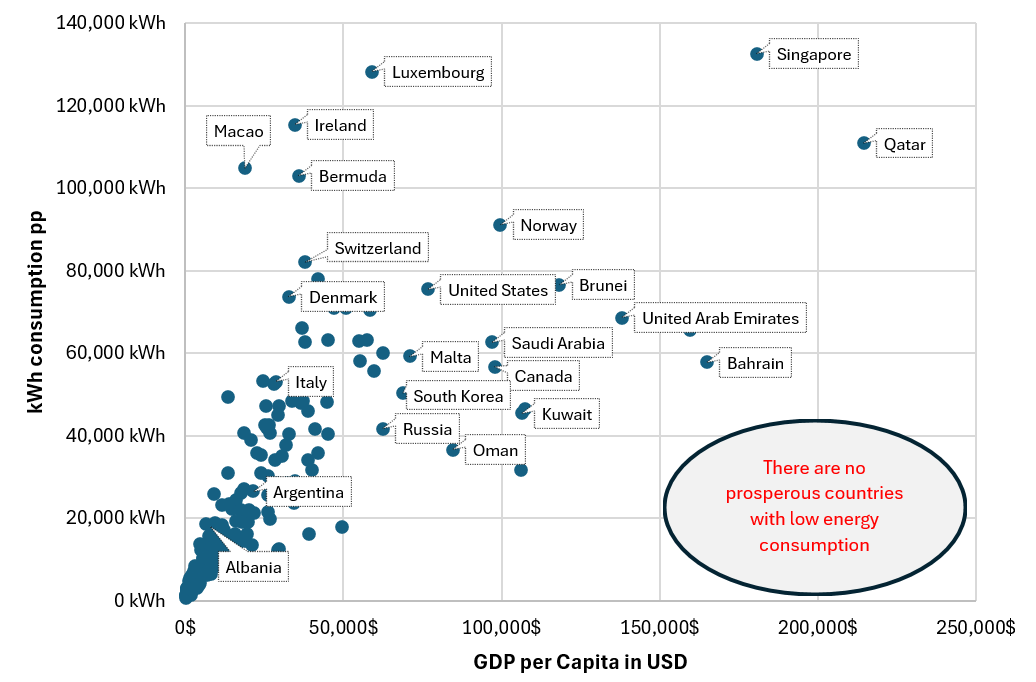
Source: Data source: Our World in Data. (2025). Energy use per person vs. GDP per capita [Data set]. Global Change Data Lab.
The scale of this transformation could be impressive. What was once incremental demand is now looking like exponential:
At the same time, energy consumption is scaling from household-level usage (kWh) to national and industrial systems (TWh), illustrating how quickly demand intensifies when entire sectors electrify. The result seems clear: the energy system is being pushed to its limits. This rapid increase in demand may place significant strain on existing energy infrastructure, including generation capacity, transmission networks, and storage systems. Potential risks include grid instability, delays in infrastructure development, and challenges in integrating intermittent renewable energy sources. In addition, the scaling of demand may be affected by regulatory and permitting hurdles, supply chain disruptions (particularly for critical components and materials), and evolving technological standards.
While much attention is placed on generating more energy, especially renewables, the real bottleneck lies elsewhere: infrastructure.
Electricity is unique. Unlike other energy forms, it must be:
Today’s infrastructure is not designed for this new reality. Evidence of this gap is already visible:
In other words we are not constrained by energy production potential, but by our ability to deliver it. The ability to deliver energy at scale is subject to a range of risks and uncertainties. These include limitations in transmission and distribution infrastructure, permitting and regulatory delays, and the complexity of upgrading and expanding existing grids.
Beyond capacity, efficiency is another critical dimension. The global energy system is profoundly inefficient:
These losses occur across production, transportation, and end-use. Grid modernization, storage systems, and smarter power management are therefore not just upgrades, they are economic recovery tools, capable of reclaiming enormous wasted value. However, their implementation may be constrained by regulatory delays, high upfront capital requirements, technological and integration challenges, and uncertainty around achieving the anticipated efficiency gains.
The implications go beyond economics. Electrification infrastructure is increasingly tied to:
Countries that invest early in grids, storage, and electrification technologies are positioning themselves to lead the next industrial cycle. Those that do not may risk structural disadvantage.
This is why capital is already moving at scale: global grid investments are expected to more than double, exceeding $1.5 trillion annually by the 2050s9.
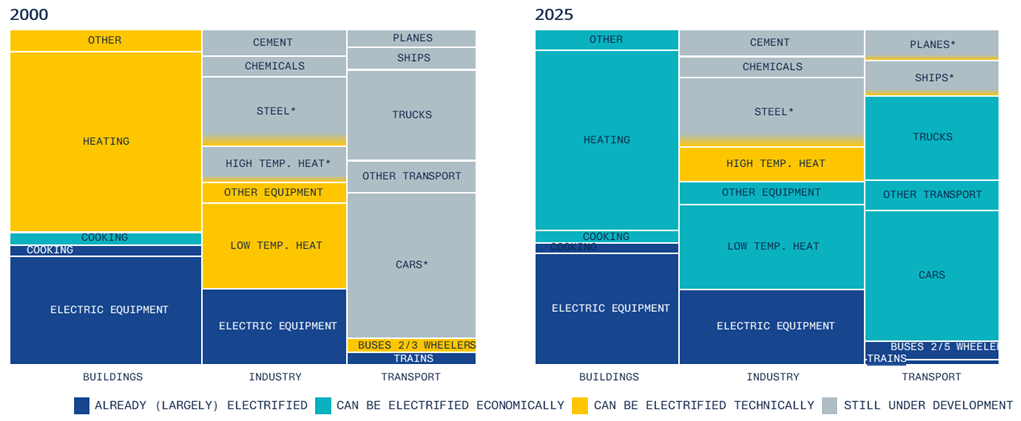
Source: Ember, sept 2025.
Electrification is not just about producing more energy, it is about building the system that can move, store, and optimize it.
Without modern grids, storage, and efficient energy management:
With them, however, electrification could become a powerful engine of productivity, innovation, and long-term growth. In this sense, infrastructure is no longer a supporting actor it is the central pillar of the energy transition. However, there is no assurance that these benefits will materialize, as outcomes depend on effective policy support, timely infrastructure deployment, and sustained investment.
1 International Energy Agency. (2026, February). Global electricity demand is set to grow strongly to 2030, underscoring need for investments in grids and flexibility.
2 DNV. (2025). Energy transition outlook 2025: Main report. DNV.
3 Ember. (2026). European electricity review 2026. Ember.
4 DNV. (2025). Energy transition outlook 2025: Main report. DNV
5 DNV. (2025). Energy transition outlook 2025: Main report. DNV.
6 Lawrence Berkeley National Laboratory (LBNL). (2024). Queued up: Characteristics of power plants seeking transmission interconnection.
7 Ember. (2025). The electrotech revolution
8 Ember. (2025). The electrotech revolution
9 DNV. (2025). Energy transition outlook 2025: Main report. DNV.
IMPORTANT INFORMATION
This is marketing communication.
This information originates from VanEck (Europe) GmbH, Kreuznacher Str. 30, 60486 Frankfurt, Germany, and has been appointed as distributor of VanEck products in Europe by the UCITS Management Company, VanEck Asset Management B.V (“ManCo”). The ManCo is incorporated under Dutch law and registered with the Dutch Authority for the Financial Markets (AFM).
For investors in Switzerland: VanEck Switzerland AG, with registered office in Genferstrasse 21, 8002 Zurich, Switzerland, has been appointed as distributor of VanEck´s products in Switzerland by the ManCo. The representative in Switzerland is Zeidler Regulatory Services (Switzerland) AG, Stadthausstrasse 14, CH-8400 Winterthur, Switzerland. Swiss paying agent: Helvetische Bank AG, Seefeldstrasse 215, CH-8008 Zürich.
For investors in the UK: This is a marketing communication targeted at FCA regulated financial intermediaries. Retail clients should not rely on any of the information provided and should seek assistance from a financial intermediary for all investment guidance and advice. VanEck Securities UK Limited (FRN: 1002854) is an Appointed Representative of Strata Global Limited (FRN: 563834), which is authorised and regulated by the Financial Conduct Authority (FCA) in the UK, to distribute VanEck´s products to FCA regulated firms such as financial intermediaries and Wealth Managers.
This material is only intended for general and preliminary information and does not constitute an investment, legal or tax advice. VanEck (Europe) GmbH and its associated and affiliated companies (together “VanEck”) assume no liability with regards to any investment, divestment or retention decision on the basis of this information. The views and opinions expressed are those of the author(s) but not necessarily those of VanEck. Opinions are current as of the publication date and are subject to change with market conditions. Information provided by third party sources is believed to be reliable and has not been independently verified for accuracy or completeness and cannot be guaranteed.
Investing is subject to risk, including the possible loss of principal. For any unfamiliar technical terms, please refer to ETF Glossary | VanEck.
No part of this material may be reproduced in any form, or referred to in any other publication, without express written permission of VanEck.
© VanEck (Europe) GmbH ©VanEck Switzerland AG © VanEck Securities UK Limited
This is a marketing communication. Please refer to the prospectus of the UCITS and to the KID before making any final investment decisions.
This information originates from VanEck (Europe) GmbH, which has been appointed as distributor of VanEck products in Europe by the Management Company VanEck Asset Management B.V., incorporated under Dutch law and registered with the Dutch Authority for the Financial Markets (AFM). VanEck (Europe) GmbH with registered address at Kreuznacher Str. 30, 60486 Frankfurt, Germany, is a financial services provider regulated by the Federal Financial Supervisory Authority in Germany (BaFin).
The information is intended only to provide general and preliminary information to investors and shall not be construed as investment, legal or tax advice VanEck (Europe) GmbH, VanEck Switzerland AG, VanEck Securities UK Limited and their associated and affiliated companies (together “VanEck”) assume no liability with regards to any investment, divestment or retention decision taken by the investor on the basis of this information. The views and opinions expressed are those of the author(s) but not necessarily those of VanEck. Opinions are current as of the publication date and are subject to change with market conditions. Certain statements contained herein may constitute projections, forecasts and other forward-looking statements, which do not reflect actual results. Information provided by third party sources is believed to be reliable and have not been independently verified for accuracy or completeness and cannot be guaranteed. Brokerage or transaction fees may apply.
All performance information is based on historical data and does not predict future returns. Investing is subject to risk, including the possible loss of principal.
No part of this material may be reproduced in any form, or referred to in any other publication, without express written permission of VanEck.
© VanEck (Europe) GmbH / VanEck Asset Management B.V.