
Welcome to VanEck
Select Investor Type
13 August 2026
Amazon, OpenAI, Google, Anthropic and NVIDIA are referenced to describe developments in artificial intelligence and life sciences. These companies are not held by the VanEck Genomics and Healthcare Innovators UCITS ETF at the time of writing. References to specific companies do not constitute investment advice or a solicitation to buy or sell any security.
Perhaps the most consequential shift in life sciences recently is not a single drug approval, a clinical trial readout, or a regulatory milestone. It is something more structural: artificial intelligence is no longer simply another software tool available to researchers. It is beginning to emerge as part of the research infrastructure through which genetic medicine is designed, validated and advanced.
Within less than three months - between April 14 and June 30, 2026 - four of the world's largest and most well-capitalised AI developers launched dedicated life sciences platforms: Amazon, OpenAI, Google and Anthropic. Amazon Bio Discovery arrived on April 14, 20261, an AI-powered cloud platform unifying biological data ingestion, AI model selection and laboratory workflow integration in a single environment. Two days later, OpenAI launched GPT-Rosalind2, a frontier reasoning model built specifically for biology, drug discovery and medical research. Google followed on May 20, 2026 with Gemini for Science3, a broader scientific research environment whose life sciences capabilities build on tools including AlphaFold, AlphaGenome and AlphaMissense. And on June 30, 2026, Anthropic launched Claude Science4, a dedicated AI workbench designed to help researchers analyse genetic, cellular, protein and chemical data using more than 60 scientific databases and NVIDIA’s BioNeMo Agent Toolkit.
NVIDIA itself had moved earlier still. BioNeMo - first launched in June 20235 and substantially expanded in 2025 and 2026 - occupies a distinct and arguably more durable competitive position than any of its application-layer rivals.
What makes this moment structurally different from previous waves of technology adoption in life sciences is not the sophistication of any individual platform. It is the simultaneity. These companies, with access to substantial capital, computing infrastructure and research talent, have independently concluded that life sciences represents a major strategic frontier for AI. That consensus is not coincidental. It reflects the convergence of three preconditions that have now been met simultaneously: biological datasets large enough to train meaningful models, AI architectures powerful enough to extract signal from those datasets, and a clinical and regulatory environment in which AI is increasingly being used across the drug development lifecycle, including in submissions supporting regulatory decision-making6. The competitive dynamics between these platforms will be significant and are still being determined.
The investment opportunity created by the AI platform race of 2026 extends well beyond identifying which single technology company will emerge as the dominant life sciences AI winner. That question - Google versus OpenAI or Anthropic versus Amazon - is genuinely open and may remain so for years. The more structurally interesting observation for investors is that every platform competing in this race draws on the same underlying ecosystem, and the VanEck Genomics and Healthcare Innovators UCITS ETF (Ticker: CURE) is built to capture multiple parts of that ecosystem, while simultaneously benefiting from the AI capabilities those platforms deploy.
The ETF tracks the MVIS® Global Future Healthcare ESG Index, which covers a broader range of healthcare innovation themes, including companies that derive revenues from genetics-based therapies, technology platforms that enable them, and related laboratory equipment and services7. That three-layer construction maps onto crucial parts of the broader infrastructure supporting AI-enabled life sciences, and onto areas where AI may deliver measurable commercial benefits.
Notably, the relationship between AI and genetics-based healthcare is not a linear value chain. It is a self-reinforcing cycle.
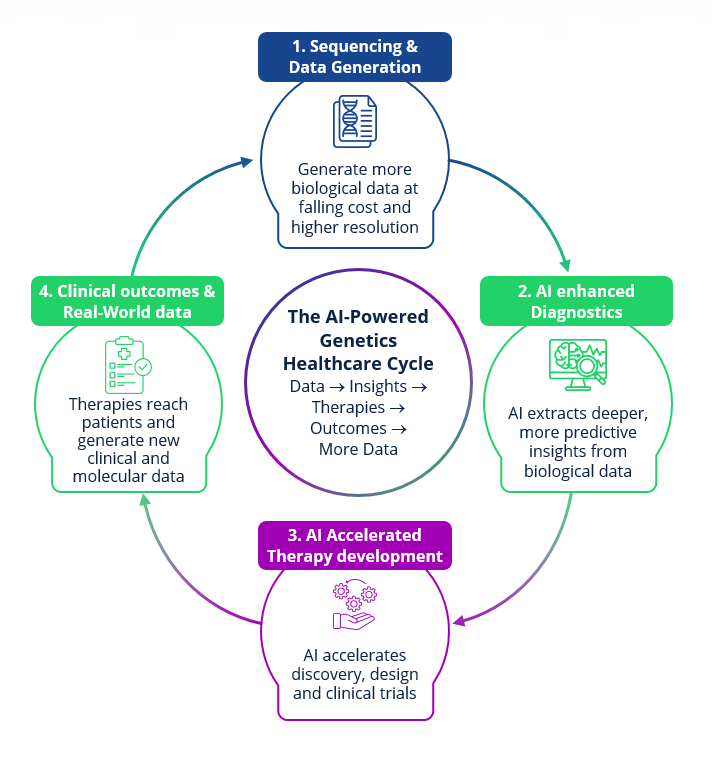
Source: VanEck internal data.
Eventually, what the VanEck Genomics ETF provides, in aggregate, is not a bet on any single AI platform, any single therapy modality, or any single clinical outcome. Instead, it offers diversified exposure across the value chain, where AI both depends on these companies to function and may also create commercial benefits for them in the process - a two-directional relationship that may allow the portfolio to participate in value creation across different parts of the cycle.
Based on current third-party estimates17, the market intersection of AI and genetics-based healthcare could expand significantly, although these are projections and actual growth may differ materially. The global AI in genomics market was valued at $1.2 billion in 2025 and is projected to reach $18.8 billion by 2033, growing at an estimated compound annual growth rate (CAGR) of 40.3%.
Source: grandviewresearch.com/industry-analysis/ai-genomics-market-report. Investing is subject to risk, including the possible loss of principal
That growth rate reflects the same structural forces the flywheel describes: expanding genomic datasets, accelerating AI model development, and rising demand for precision therapeutics. However, future growth will depend on factors including clinical success, regulation, data availability, adoption by healthcare providers and the ability of companies to convert scientific advances into commercially viable products.
More broadly, the global precision medicine market was valued at $116.6 billion in 2025 and is projected to reach $405.1 billion by 2033 at a CAGR of 17.0%18 according to third-party estimates. Together, these figures may suggest that AI is not simply accelerating an existing market - it is creating a distinct and faster-growing layer on top of it. Nevertheless, these projections are not guaranteed and may not materialize as anticipated, as external factors could materially influence the outcome.
At the same time, the regulatory environment is evolving in ways that may support this trajectory. Historically, one of the biggest obstacles to bringing gene therapies to patients has been the regulatory burden: developers were required to repeat costly foundational studies from scratch for each new product, even when the underlying science was well established. The FDA moved decisively to address this in 2026, issuing a connected series of guidances19 designed to streamline the development of gene-editing and RNA-based therapies. These guidances allow developers to build on existing scientific knowledge, use data across related programmes and avoid unnecessary repeat testing without compromising safety standards. Separately, the FDA’s draft guidance on artificial intelligence20 provides a risk-based credibility assessment framework for AI-generated information or data intended to support regulatory decision-making on safety, effectiveness or quality for drugs and biological products, reinforcing a clearer path for AI-enabled development across the life sciences lifecycle.
Artificial intelligence is unlikely to transform genetics-based healthcare overnight, and not every AI initiative will translate into commercial success. The history of technology adoption in life sciences is littered with tools that accelerated research without proportionally accelerating approvals - and the clinical, regulatory and manufacturing bottlenecks that have always defined this sector do not disappear because the discovery phase gets faster. Investors should be careful not to conflate research productivity gains with near-term revenue.
That said, the direction remains uncertain, although several structural conditions that could support further development continue to strengthen. Sequencing costs continue to fall. Biological datasets continue to expand. The regulatory environment is evolving. And four of the world's largest AI developers have committed dedicated platforms and significant capital to the life sciences domain within a three-month window - a convergence that reflects growing interest in the potential applications of AI across life sciences.
1 https://www.aboutamazon.com/news/aws/aws-amazon-bio-discovery-ai-drug-research
2 https://openai.com/index/introducing-gpt-rosalind/
3 https://blog.google/innovation-and-ai/technology/research/gemini-for-science-io-2026/
4 https://www.anthropic.com/news/claude-science-ai-workbench
7 https://www.marketvector.com/indexes/sector/mvis-global-future-healthcare-esg
8 https://www.genome.gov/about-genomics/fact-sheets/DNA-Sequencing-Costs-Data
9 https://www.illumina.com/systems/sequencing-platforms/novaseq-x-plus/applications/transition.html
10 https://www.10xgenomics.com/single-cell-technology
11 https://nanoporetech.com/platform/technology
14 adaptivebiotech.com/our-platform
16 biopharmadive.com/news/alnylam-inceptive-ai-drug-discovery-rna-deal-artificial-intelligence/822008
17 2025. grandviewresearch.com/industry-analysis/ai-genomics-market-report
18 2025. grandviewresearch.com/industry-analysis/precision-medicine-diagnostics-therapeutics-market
IMPORTANT INFORMATION
This is marketing communication.
This information originates from VanEck (Europe) GmbH, which is authorized as an EEA investment firm under the Markets in Financial Instruments Directive (“MiFiD”). VanEck (Europe) GmbH has its registered address at Kreuznacher Str. 30, 60486 Frankfurt, Germany, and has been appointed as distributor of VanEck products in Europe by the Management Company, VanEck Asset Management B.V.(“ManCo”), which is incorporated under Dutch law and registered with the Dutch Authority for the Financial Markets (AFM).
This material is only intended for general and preliminary information and does not constitute an investment, legal or tax advice. No representation or warranty is made as to the accuracy or completeness of the information and no liability is accepted to the fullest extent permitted by law.
The views and opinions expressed are those of the author(s) but not necessarily those of VanEck. Opinions are current as of the publication date and are subject to change with market conditions. Information provided by third party sources is believed to be reliable and has not been independently verified for accuracy or completeness and cannot be guaranteed.
Please refer to the Prospectus – in English language - and the KID/KIID - in local language - before making any final investment decisions and for full information on risks. These documents can be obtained free of charge at www.vaneck.com, from the ManCo or from the appointed facility agent.
VanEck Genomics and Healthcare Innovators UCITS ETF ("ETF") is a sub-fund of VanEck UCITS ETFs plc, a UCITS umbrella investment company, registered with the Central Bank of Ireland, passively managed and tracking an equity index. The product described herein aligns to Article 9 Regulation (EU) 2019/2088 on sustainability-related disclosures in the financial services sector. Information on sustainability-related aspects pursuant to that regulation can be found on www.vaneck.com. Investors must consider all the fund's characteristics or objectives as detailed in the prospectus, in the sustainability-related disclosures or related documents before making an investment decision.
The value of the ETF may fluctuate significantly as a result of the investment strategy. The ETF´s holdings are disclosed on each dealing day on www.vaneck.com under the ETF´s Holdings section and as per PCF under the Documents section and published via one or more market data suppliers. The indicative net asset value (iNAV) of the ETF is available on Bloomberg. For details on the regulated markets where the ETF is listed, please refer to the Trading Information section on the ETF page at www.vaneck.com. Investors must buy and sell units of the UCITS on the secondary market via an intermediary (e.g. a broker) and cannot usually be sold directly back to the UCITS. Brokerage fees may incur. The buying price may exceed, or the selling price may be lower than the current net asset value. Investing in the ETF should be interpreted as acquiring shares of the ETF and not the underlying assets. Tax treatment depends on the personal circumstances of each investor and may vary over time. The ManCo may terminate the marketing of the ETF in one or more jurisdictions. The summary of the investor rights is available in English at: summary-of-investor-rights.pdf.
MVIS® Global Future Healthcare ESG Index is the exclusive property of MarketVector Indexes GmbH (a wholly owned subsidiary of Van Eck Associates Corporation), which has contracted with Solactive AG to maintain and calculate the Index. Solactive AG uses its best efforts to ensure that the Index is calculated correctly. Irrespective of its obligations towards MarketVector Indexes GmbH (“MarketVector”), Solactive AG has no obligation to point out errors in the Index to third parties. VanEck’s ETF is not sponsored, endorsed, sold or promoted by MarketVector and MarketVector makes no representation regarding the advisability of investing in the ETF. It is not possible to invest directly in an index.
Investing is subject to risk, including the possible loss of principal. For any unfamiliar technical terms, please refer to ETF Glossary | VanEck.
No part of this material may be reproduced in any form, or referred to in any other publication, without express written permission of VanEck.
© VanEck (Europe) GmbH
This is a marketing communication. Please refer to the prospectus of the UCITS and to the KID before making any final investment decisions.
This information originates from VanEck (Europe) GmbH, which has been appointed as distributor of VanEck products in Europe by the Management Company VanEck Asset Management B.V., incorporated under Dutch law and registered with the Dutch Authority for the Financial Markets (AFM). VanEck (Europe) GmbH with registered address at Kreuznacher Str. 30, 60486 Frankfurt, Germany, is a financial services provider regulated by the Federal Financial Supervisory Authority in Germany (BaFin).
The information is intended only to provide general and preliminary information to investors and shall not be construed as investment, legal or tax advice VanEck (Europe) GmbH, VanEck Switzerland AG, VanEck Securities UK Limited and their associated and affiliated companies (together “VanEck”) assume no liability with regards to any investment, divestment or retention decision taken by the investor on the basis of this information. The views and opinions expressed are those of the author(s) but not necessarily those of VanEck. Opinions are current as of the publication date and are subject to change with market conditions. Certain statements contained herein may constitute projections, forecasts and other forward-looking statements, which do not reflect actual results. Information provided by third party sources is believed to be reliable and have not been independently verified for accuracy or completeness and cannot be guaranteed. Brokerage or transaction fees may apply.
All performance information is based on historical data and does not predict future returns. Investing is subject to risk, including the possible loss of principal.
No part of this material may be reproduced in any form, or referred to in any other publication, without express written permission of VanEck.
© VanEck (Europe) GmbH / VanEck Asset Management B.V.