
Welcome to VanEck
Select Investor Type
25 August 2026
Read Time 8 MIN
The hole took three decades to dig. After the Cold War, the West let its defense base wither — stockpiles sold off, NATO spending falling to 1.4% of GDP by 2014.1 Today the U.S. builds just 0.1% of the world’s ships and barely a third of its target submarines.2 The strain is live: in the 2026 Iran campaign it fired over 1,000 Tomahawk and 1,100 JASSM cruise missiles – munitions it cannot replace for years.3 China absorbed the capacity the West abandoned, leaving the F-35, Arleigh Burke destroyers, and Virginia-class submarines dependent on the very rival they were built to deter.
The reversal is abrupt. Global defense spending jumped 9.7% in real terms in 2024, and reached $2.9 trillion in 2025.4 Europe led the surge, with Germany crossing 2% of GDP for the first time since 1992.5
At NATO’s June 2025 Hague Summit, 31 of 32 members pledged 5% of GDP by 2035 — more than double today’s guideline.6
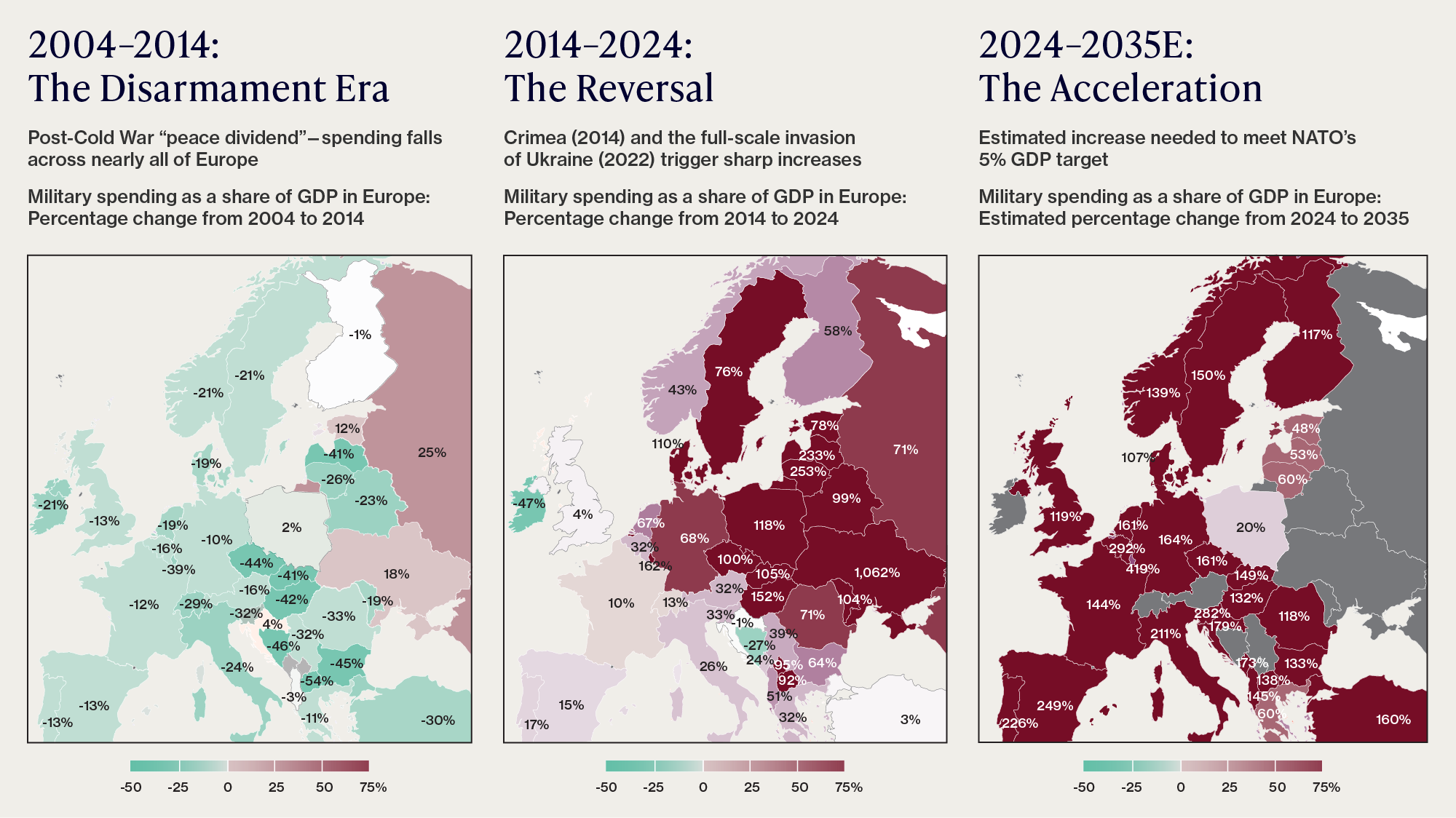

Source: VanEck calculations based on data from the Stockholm International Peace Research Institute (SIPRI, 2025), as published in Intereconomics (2026), “Can Europe Deliver NATO’s Five Percent?” For illustrative purposes only. Not a projection of future results.
The U.S. alone is requesting $1.5 trillion for 2027 — the largest military buildup since WWII, a 44% increase over 2026.7
The last great rearmament — WWII and Korea — drove one of history’s largest commodity supercycles. By 1950, shortages of copper, steel, aluminum, and tungsten so slowed U.S. arms production that Washington bartered wheat for foreign bauxite, chrome, and tin. The metals, not the armies, set the pace. They may again.
Sources: OSD Historical Office, Rearming for the Cold War; CSIS, Minerals at War (2026); Geopolitical Monitor.
This build-up is overwhelmingly equipment. NATO members now direct 32% of budgets to procurement, above the alliance’s 20% floor; if the 5% pledge is met, spending over the next decade could approach $30 trillion — with nearly $10 trillion on hardware alone.8
The Pentagon calls it the “Arsenal of Freedom” — not more troops, but a rebuilt production base, with more than half the money going to procurement and next-generation weapons.9
Much of this spending appears structural rather than cyclical, underpinned by legislation and multi-year commitments rather than by the market cycle. Budgets nonetheless remain political: future governments can revise, delay or reallocate them.
Every military platform draws from the same basket of metals — a fighter jet and a destroyer never share a battlefield, but they compete for the same aluminum, copper, tungsten, and rare earths.
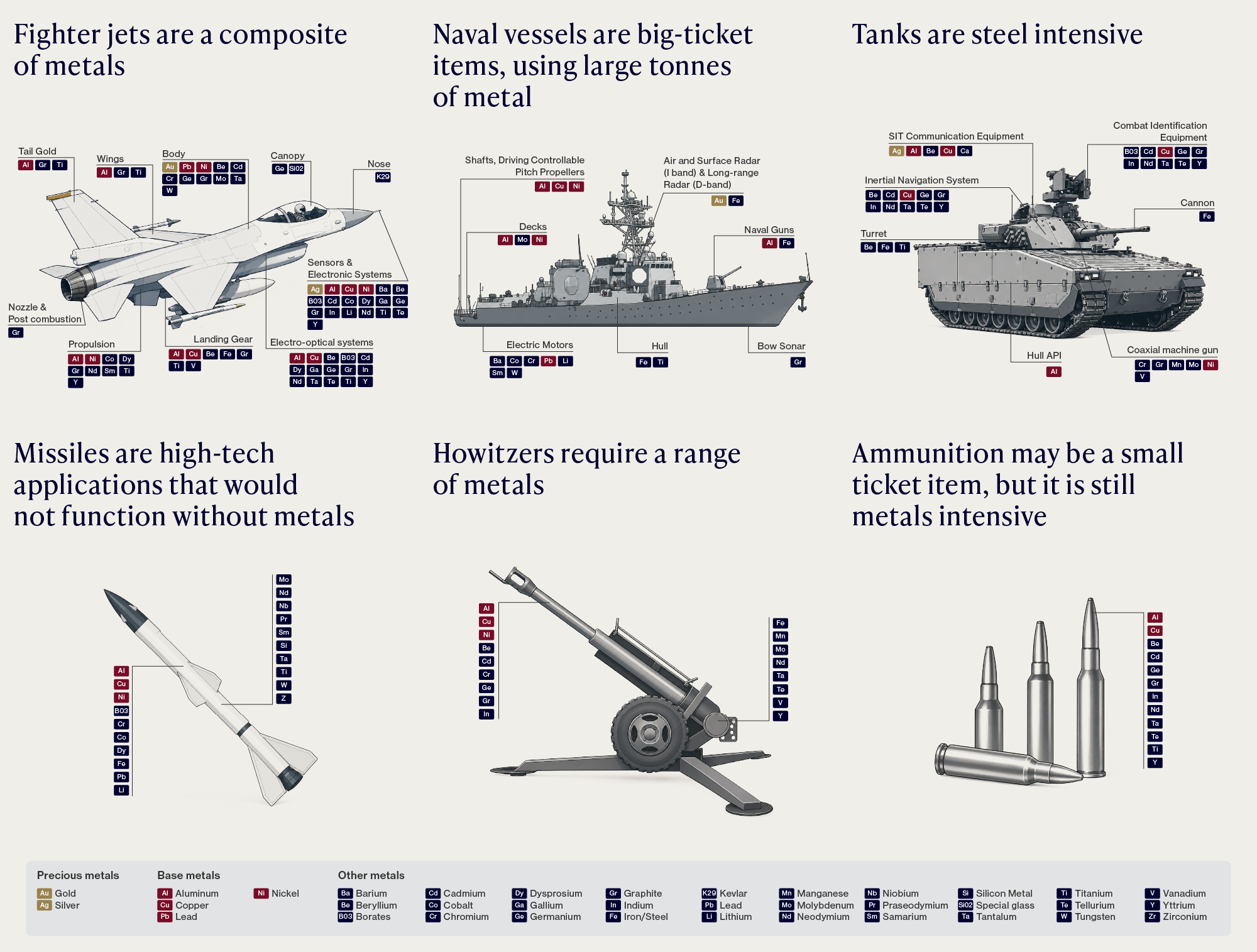

Source: Benedetta Girardi, Irina Patrahau, Giovanni Cisco and Michel Rademaker, “Strategic Raw Materials for Defence: Mapping European Industry Needs,” The Hague Centre for Strategic Studies (2020); via BofA Global Research. For illustrative purposes.
Defense is a relatively small share of those markets today, but it is a fast-growing, legally mandated source of demand — and it is accelerating into a market already tight and concentrated. Goldman Sachs estimates Europe’s rearmament alone will lift the region’s industrial-metals demand about 6% by 202710. Two forces then compound: that rising demand, and a scramble to secure supply outside China. For investors, that points to the miners and processors outside China — which could potentially benefit from rising demand and the premium on secure supply, an exposure that few portfolios currently hold. Higher metal prices do not automatically translate into higher profits, however, and mining equities can fall sharply even in periods of rising demand. What that means differs sharply by metal — so take them one at a time.
Steel is the most fundamental defense input by tonnage — a single aircraft carrier requires roughly 70,000 tonnes11. Defense is only ~2% of global steel demand, but it is climbing fast – and volume is not the story; grade is. That share is not fixed either: at the height of the Korean War build-up, defense claimed as much as 20% of U.S. steel output12. A sustained rearmament could lift that call again — a tightening we do not believe the market has priced. The platforms that define modern warfare run on specialty steel: submarine pressure hulls, that only a handful of mills can produce, the proprietary Eglin steel casing used in the bunker busters deployed in Iran, and a single Pennsylvania plant supplying up to 95% of the Navy’s armor plate13. As record FY2026 procurement ramps into these tight supply chains, pricing power may shift towards the few producers qualified to make it, though this is not assured.
Naval tonnage under construction has grown ~80% since 2014 and rises further under the Navy's plan
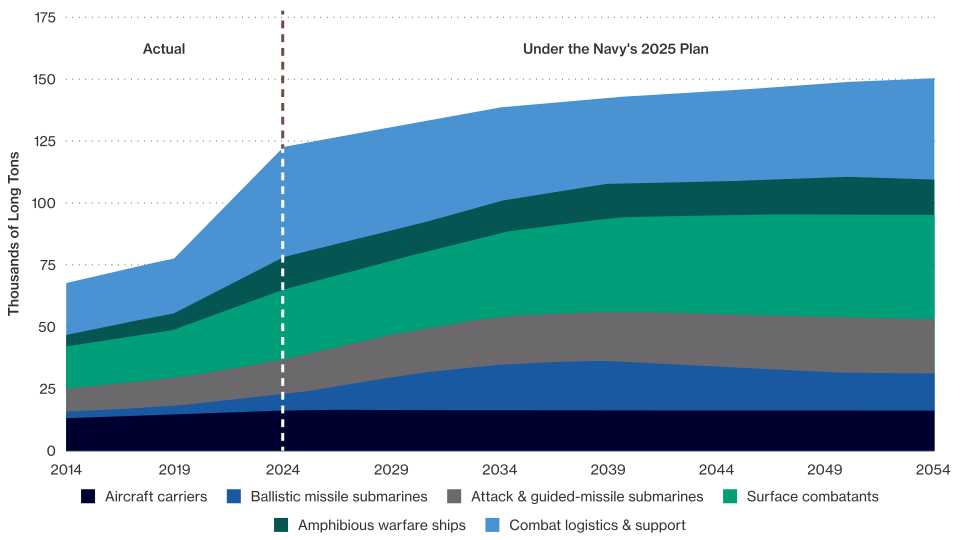
Source: Congressional Budget Office, Challenges Facing the Navy's and Coast Guard's Shipbuilding Programs, April 2026 (cbo.gov/publication/62258). Displacement (lightship) is a proxy for steel demand. Category splits recreated by VanEck from CBO Figure 4. For illustrative purposes only. Not a projection of future results.
Copper conducts the war — moving the power, carrying the data, and lining the munitions, from a warship’s miles of wiring to a Tomahawk’s guidance and the band that spins every artillery shell. In 2021, military production consumed 2.19 million tonnes — over 10% of the world’s refined output — and has compounded at roughly 14% a year since14. Growth has room to run: drone- and missile-heavy warfare consumes more copper per dollar than ever. And demand is hard to displace. Many forecasters expect copper to move into deficit, with mine supply barely growing; in a tight market the marginal tonne tends to set the price, and the producers able to supply it may capture the margin. Such forecasts are inherently uncertain, and copper prices have historically been highly cyclical.
Aluminum makes modern warfare. The drones, cruise missiles, and above all the kamikaze munitions swarming today’s battlefield are light and expendable — and light means aluminum. Fired and flown by the thousand and never recovered, aluminum becomes a recurring draw, not a one-time cost. Yet America has all but stopped smelting it: once the world’s largest primary aluminium producer, the U.S. has gone from 24 operating smelters to four15. Meanwhile defense demand has more than doubled since 2009 and is set to climb further by 203016. America now imports much of a metal without which it cannot fight — already on the national stockpile list. Rebuilding that supply at home is now a strategic priority, and in our view the scarce Western producers and fabricators left could be among the beneficiaries — although smelting economics remain challenging and depend heavily on power prices and continued policy support.
Rare earths steer the war. The magnets that guide a missile, aim a radar, and power the F-35 all run on them — above all samarium-cobalt, built to hold its magnetism in a battlefield’s heat, where ordinary magnets fail. The dependency is real: in 2022 the Pentagon halted F-35 deliveries over a Chinese-made magnet alloy, resuming only under a waiver.17 And demand is surging — mostly for a different magnet: the neodymium in EVs and robots, which has doubled since 2015 and rising ~30% more by 2030.18
For defense, this was never a volume story; it’s a control story — and China controls it. China produces 97% of the world’s samarium and has weaponized that grip, choking off anything bound for the military.19 Washington’s answer is force of capital: an equity stake in a domestic producer, a price floor at double the market. And from January 2027, U.S. law bars any defense magnet that has touched China at any step.20 The U.S. barely makes them — so Washington is underwriting the companies that will, the same producers riding the EV-and-robot boom.
Gallium makes the Patriot’s radar; germanium, the infrared optics in night-vision sights and heat-seeking missiles; antimony, the hardened bullet core and the tracers and flares that light the night; tungsten, the penetrators that punch through armor — the “war metal,” dense and unforgiving. None are needed in bulk; all are irreplaceable. And China controls the lot — 98% of gallium, 83% of tungsten, 68% of germanium, and 48% of antimony21. It has already pulled the trigger — cutting off gallium, germanium, and antimony in 2024, tightening tungsten in 2025 — and even after a 2025 truce, the block on military buyers remains in place. The risk here was never running low; it’s being cut off, one license at a time. The potential opportunity is the mirror image: the Western producers of what Beijing will not sell — scarce, and increasingly backed by government demand. That support is a policy choice, however, and could be reduced or withdrawn. Many of these are small companies, some pre-revenue, whose shares can be volatile and less liquid than the wider market.
Price increase for defense-critical minerals following Chinese export restrictions
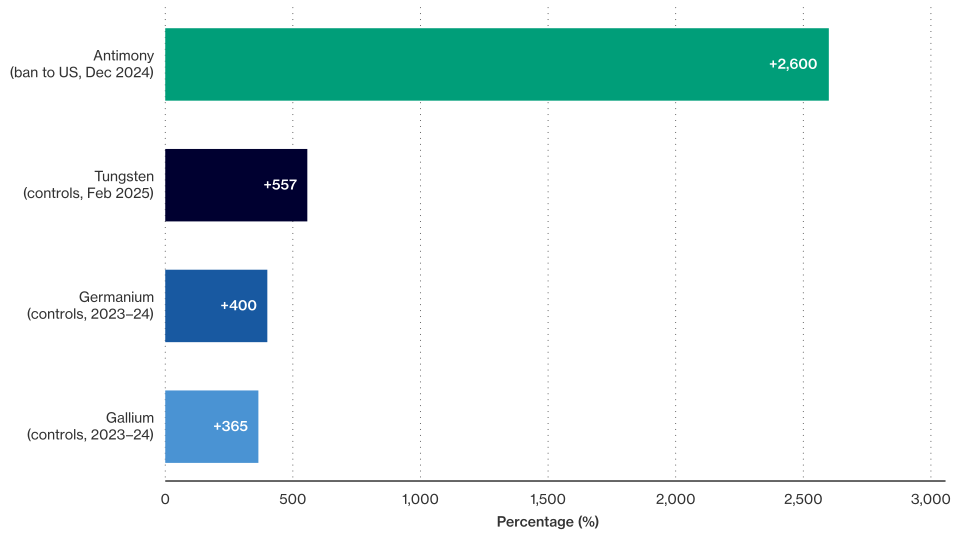
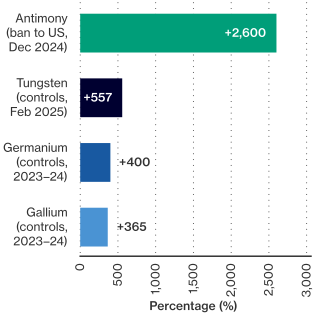
Source: Fastmarkets, USITC, OilPrice/Reuters (2024–2026). Increases measured from pre-control to peak/recent prices; windows differ by mineral. Chart by VanEck.
Strip away the platforms and the politics, and it comes down to one thing. Demand is committed — defense budgets are legislated, multi-year, and climbing. Supply is not — thin, concentrated, and, for the materials that matter most, controlled by the very adversary the West is arming against. Markets still price defense as a story about contractors and platforms; the deeper, more durable opportunity, in our view, lies in the metals beneath them — and the producers and fabricators that supply them. Once a metal becomes a national-security priority, the West has historically been prepared to pay a premium to secure it — price floors, stockpiles, reshoring. Rare earths already show it. The uplift itself — defense demand climbing off a low base — is, in our view, largely missing from where these producers trade today. Natural resources have always shaped economies, now they shape the balance of power, at the intersection of economic and national security. The question is whether markets have priced that in. We do not believe they have. We may of course be wrong. If defense budgets fall short of the pledges made, if export controls are relaxed, or if new supply arrives faster than expected, the tightness described here could ease quickly — and the equities discussed could underperform, potentially significantly.
We have taken the national-security half of that intersection. Economic security is next.
European investors who share the analysis above can approach the theme from three different points in the value chain. Each carries a different risk profile, and none is more suitable than the others in the abstract — that depends on the individual investor’s objectives, horizon and risk tolerance.
The VanEck Defense UCITS ETF passively tracks the MarketVector™ Global Defense Industry Index and gives exposure to the defense contractors and platform manufacturers themselves. As set out above, we believe a substantial part of the market’s enthusiasm for the rearmament theme is already reflected in the valuations of these companies. Investors should not assume that the share price re-rating of recent years will continue. Key risks include: Equity Market Risk, Liquidity Risks and Industry or Sector Concentration Risk.
The VanEck Rare Earth and Strategic Metals UCITS ETF passively tracks the MVIS® Global Rare Earth/Strategic Metals Index and sits further upstream, among the miners, refiners and processors that supply the raw material itself. This is the part of the value chain that, in our view, the market has been slower to re-price — the producers of rare earths and minor metals, whose supply is thin and, for the most critical inputs, concentrated outside the West. Key risks include: Risk of Investing in Natural Resources Companies, Risk of Investing in Emerging Markets Issuers, Risk of Investing in Smaller Companies.
The VanEck S&P Global Mining UCITS ETF passively tracks the S&P Global Mining Index and offers the broadest exposure of the three, spanning the diversified producers of the Iron Ore (needed for Steel), copper and aluminum inputs described above. Where the rare earth and strategic metals exposure is concentrated in the chokepoint materials, this sits across the bulk and base metals that carry the tonnage of a rearmament build-out — a more diversified, though also more cyclical, route into the same demand. Key risks include: Risk of Investing in Natural Resources Companies, Risk of Investing in Emerging Markets Issuers, Risk of Investing in Smaller Companies.
Please read the Prospectus and the KID before making any investment decision. Risk of capital loss.
To receive more insights, sign up to our newsletter.
1 U.S. Department of Defense, “Strategic and Critical Materials in the Defense National Stockpile,” Report to Congress, December 1998.
2 J.P. Morgan, “U.S. Defense Industrial Base,” Revised Edition, 2026; Congressional Budget Office, Challenges Facing the Navy’s and Coast Guard’s Shipbuilding Programs, April 2026.
3 CBS News, “Rapid pace of interceptor and precision-guided weapons use worries Trump administration,” July 23, 2026.
4 SIPRI, Trends in World Military Expenditure, 2025, April 2026.
5 NATO, Defence Expenditure of NATO Countries (2014–2025), August 2025; https://news.yahoo.com/germany-hits-2-gdp-nato-054459619.html
6 NATO Hague Summit Declaration, June 2025.
7 U.S. Department of Defense, FY2027 Budget Request Overview Book, April 2026; White House, “Rebuilding Our Military: FY2027 Budget Fact Sheet,” April 2026.
8 NATO, Defence Expenditure of NATO Countries (2014–2025), Table 8a, August 2025.
9 White House, “Rebuilding Our Military: FY2027 Budget Fact Sheet,” April 2026; Michael E. O’Hanlon, “A Better Way to Spend $350 Billion at the Pentagon,” Brookings Institution, June 24, 2026; U.S. Department of Defense, FY2027 Budget Request Overview Book, April 2026; White House, “Rebuilding Our Military: FY2027 Budget Fact Sheet,” April 2026.
10 Goldman Sachs (2025): Economic Research: Global Market daily: Defense: Another Boost to base Metals Demand (Struyven/ Dinsmore/ Waltham).
11 American Iron & Steel Institute, cited via the National Iron & Steel Heritage Museum.
12 U.S. Army War College, “U.S. Readiness for the Korean Conflict”; USNI Proceedings, “Industrial Mobilization in the U.S.,” October 1953.
13 https://www.steelmuseum.org/carrier_exhibit_2018/coatesville_steel.cfm
14 https://mwi.westpoint.edu/as-americas-military-rearms-it-needs-minerals-and-lots-of-them/
15 https://www.aluminum.org/PowerUp
16 BofA Global Research: From mine to missile: the metals behind modern defence, July 2025.
18 IEA, “Rare Earth Elements: Pathways to Secure and Diversified Supply Chains” (2025).
19 Center for Strategic and International Studies (G. Baskaran), October 2025.
21 U.S. Geological Survey and CSIS (2024–2026).
IMPORTANT INFORMATION
This is a marketing communication.
For investors in Switzerland: VanEck Switzerland AG, with registered office in Genferstrasse 21, 8002 Zurich, Switzerland, has been appointed as distributor of VanEck´s products in Switzerland by the Management Company VanEck Asset Management B.V. (“ManCo”). The representative in Switzerland is Zeidler Regulatory Services (Switzerland) AG, Stadthausstrasse 14, CH-8400 Winterthur, Switzerland. Swiss paying agent: Helvetische Bank AG, Seefeldstrasse 215, CH-8008 Zürich.
For investors in the UK: This is a marketing communication targeted at Professional Clients and Eligible Counterparties - wealth managers, FCA regulated financial intermediaries. This is not for distribution or reliance by Retail Clients. VanEck Securities UK Limited (FRN: 1002854) is an Appointed Representative of Strata Global Limited (FRN: 563834), which is authorised and regulated by the Financial Conduct Authority (FCA) in the UK, to distribute VanEck´s products to FCA regulated firms. The Funds are recognised in the UK under the Overseas Funds Regime but are not UK-authorised Fund. UK investors should note that complaints in relation to the Funds cannot be referred to the Financial Ombudsman Service, and any related claims for losses will not be covered by the Financial Services Compensation Scheme. The information contained in this communication is not a personal recommendation and does not take account of the investment objectives, financial situation or needs of any specific recipient.
This information originates from VanEck (Europe) GmbH, which is authorized as an EEA investment firm under the Markets in Financial Instruments Directive (“MiFiD”). VanEck (Europe) GmbH has its registered address at Kreuznacher Str. 30, 60486 Frankfurt, Germany, and has been appointed as distributor of VanEck products in Europe by the ManCo, which is incorporated under Dutch law and registered with the Dutch Authority for the Financial Markets (AFM).
This material is only intended for general and preliminary information and does not constitute an investment, legal or tax advice. VanEck (Europe) GmbH and its associated and affiliated companies (together “VanEck”) assume no liability with regards to any investment, divestment or retention decision on the basis of this information. All relevant documentation must be first consulted.
The views and opinions expressed are those of the author(s) but not necessarily those of VanEck. Opinions are current as of the publication date and are subject to change with market conditions. Information provided by third party sources is believed to be reliable and has not been independently verified for accuracy or completeness and cannot be guaranteed.
Please refer to the Prospectus – in English language - and the KID/KIID - in local language - before making any final investment decisions and for full information on risks. These documents can be obtained free of charge at www.vaneck.com, from the ManCo or from the appointed facility agent.
VanEck Defense UCITS ETF ("ETF") is a sub-fund of VanEck UCITS ETFs plc, a UCITS umbrella investment company with limited liability between sub-funds. The ETF is registered with the Central Bank of Ireland, passively managed and tracking an equity index.
The value of the ETF may fluctuate significantly as a result of the investment strategy. The ETF´s holdings are disclosed on each dealing day on www.vaneck.com under the ETF´s Holdings section and as per PCF under the Documents section and published via one or more market data suppliers. The indicative net asset value (iNAV) of the ETF is available on Bloomberg. For details on the regulated markets where the ETF is listed, please refer to the Trading Information section on the ETF page at www.vaneck.com. Investors must buy and sell units of the UCITS on the secondary market via an intermediary (e.g. a broker) and cannot usually be sold directly back to the UCITS. Brokerage fees may incur. The buying price may exceed, or the selling price may be lower than the current net asset value. Investing in the ETF should be interpreted as acquiring shares of the ETF and not the underlying assets. Tax treatment depends on the personal circumstances of each investor and may vary over time. The ManCo may terminate the marketing of the ETF in one or more jurisdictions. The summary of the investor rights is available in English at: summary-of-investor-rights.pdf.
Please refer to the Prospectus – in English language - and the Key Information Document (“KID”)/ Key Investor Information Document (“KIID”) - in local language - before making any final investment decisions and for full information on risks. These documents can be obtained free of charge at www.vaneck.com, from the ManCo or from the appointed facility agent.
VanEck S&P Global Mining UCITS ETF ("ETF") is a sub-fund of VanEck UCITS ETFs plc, a UCITS umbrella investment company, registered with the Central Bank of Ireland, passively managed and tracking an equity index.
The value of the ETF may fluctuate significantly as a result of the investment strategy. The ETF´s holdings are disclosed on each dealing day on www.vaneck.com under the ETF´s Holdings section and as per PCF under the Documents section and published via one or more market data suppliers. The indicative net asset value (iNAV) of the ETF is available on Bloomberg. For details on the regulated markets where the ETF is listed, please refer to the Trading Information section on the ETF page at www.vaneck.com. Investors must buy and sell units of the UCITS on the secondary market via an intermediary (e.g. a broker) and cannot usually be sold directly back to the UCITS. Brokerage fees may incur. The buying price may exceed, or the selling price may be lower than the current net asset value. Investing in the ETF should be interpreted as acquiring shares of the ETF and not the underlying assets. Tax treatment depends on the personal circumstances of each investor and may vary over time. The ManCo may terminate the marketing of the ETF in one or more jurisdictions. The summary of the investor rights is available in English at: summary-of-investor-rights.pdf.
Please refer to the Prospectus – in English language - and the KID/KIID - in local language - before making any final investment decisions and for full information on risks. These documents can be obtained free of charge at www.vaneck.com, from the ManCo or from the appointed facility agent.
VanEck Rare Earth and Strategic Metals UCITS ETF ("ETF") is a sub-fund of VanEck UCITS ETFs plc, a UCITS umbrella investment company, registered with the Central Bank of Ireland and tracking an equity index.
The value of the ETF may fluctuate significantly as a result of the investment strategy. The ETF´s holdings are disclosed on each dealing day on www.vaneck.com under the ETF´s Holdings section and as per the Portfolio Composition File (“PCF”) under the Documents section and published via one or more market data suppliers. The indicative net asset value (iNAV) of the ETF is available on Bloomberg. For details on the regulated markets where the ETF is listed, please refer to the Trading Information section on the ETF page at www.vaneck.com. Investors must buy and sell units of the UCITS on the secondary market via an intermediary (e.g. a broker) and cannot usually be sold directly back to the UCITS. Brokerage fees may incur. The buying price may exceed, or the selling price may be lower than the current net asset value. Investing in the ETF should be interpreted as acquiring shares of the ETF and not the underlying assets. Tax treatment depends on the personal circumstances of each investor and may vary over time. The ManCo may terminate the marketing of the ETF in one or more jurisdictions. The summary of the investor rights is available in English at: summary-of-investor-rights.pdf.
The MarketVector™ Global Defense Industry Index is the exclusive property of MarketVector Indexes GmbH (a wholly owned subsidiary of Van Eck Associates Corporation), which has contracted with Solactive AG to maintain and calculate the Index. Solactive AG uses its best efforts to ensure that the Index is calculated correctly. Irrespective of its obligations towards MarketVector Indexes GmbH (“MarketVector”), Solactive AG has no obligation to point out errors in the Index to third parties. VanEck’s ETF is not sponsored, endorsed, sold or promoted by MarketVector and MarketVector makes no representation regarding the advisability of investing in the ETF. It is not possible to invest directly in an index.
The S&P Global Mining Reduced Coal Index is a product of S&P Dow Jones Indices LLC and its affiliates (“SPDJI”). S&P®, is a trademark of S&P Global, Inc. or its affiliates (S&P) and has been licensed for use by VanEck. Dow Jones® is a registered trademark of Dow Jones Trademark Holdings LLC (“Dow Jones”). VanEck’s ETF is not sponsored or sold by SPDJI, Dow Jones, S&P, or their respective affiliates and none of such parties make any representation regarding the advisability of investing in such product(s) nor do they have any liability for any errors, omissions, or interruptions of the S&P Global Mining Reduced Coal Index. It is not possible to invest directly in an index.
MVIS® Global Rare Earth/Strategic Metals Index is the exclusive property of MarketVector Indexes GmbH (a wholly owned subsidiary of Van Eck Associates Corporation), which has contracted with Solactive AG to maintain and calculate the Index. Solactive AG uses its best efforts to ensure that the Index is calculated correctly. Irrespective of its obligations towards MarketVector Indexes GmbH (“MarketVector”), Solactive AG has no obligation to point out errors in the Index to third parties. VanEck’s ETF is not sponsored, endorsed, sold or promoted by MarketVector and MarketVector makes no representation regarding the advisability of investing in the ETF. It is not possible to invest directly in an index.
Investing is subject to risk, including the possible loss of principal. For any unfamiliar technical terms, please refer to ETF Glossary | VanEck.
No part of this material may be reproduced in any form, or referred to in any other publication, without express written permission of VanEck.
© VanEck (Europe) GmbH ©VanEck Switzerland AG © VanEck Securities UK Limited
This is a marketing communication. Please refer to the prospectus of the UCITS and to the KID before making any final investment decisions.
This information originates from VanEck (Europe) GmbH, which has been appointed as distributor of VanEck products in Europe by the Management Company VanEck Asset Management B.V., incorporated under Dutch law and registered with the Dutch Authority for the Financial Markets (AFM). VanEck (Europe) GmbH with registered address at Kreuznacher Str. 30, 60486 Frankfurt, Germany, is a financial services provider regulated by the Federal Financial Supervisory Authority in Germany (BaFin).
The information is intended only to provide general and preliminary information to investors and shall not be construed as investment, legal or tax advice VanEck (Europe) GmbH, VanEck Switzerland AG, VanEck Securities UK Limited and their associated and affiliated companies (together “VanEck”) assume no liability with regards to any investment, divestment or retention decision taken by the investor on the basis of this information. The views and opinions expressed are those of the author(s) but not necessarily those of VanEck. Opinions are current as of the publication date and are subject to change with market conditions. Certain statements contained herein may constitute projections, forecasts and other forward-looking statements, which do not reflect actual results. Information provided by third party sources is believed to be reliable and have not been independently verified for accuracy or completeness and cannot be guaranteed. Brokerage or transaction fees may apply.
All performance information is based on historical data and does not predict future returns. Investing is subject to risk, including the possible loss of principal.
No part of this material may be reproduced in any form, or referred to in any other publication, without express written permission of VanEck.
© VanEck (Europe) GmbH / VanEck Asset Management B.V.