January Market Recap: A Roadmap for a Gold Bull Market
12 February 2026
Read Time 6 MIN
Key Takeaways
- This is the third major gold bull market in modern history, and history suggests it’s still in progress.
- Structural forces including debt, geopolitics, and currency debasement, are driving gold, not short-term cycles.
- Despite strong long-term performance and diversification benefits, most investors remain materially under-allocated to gold.
Gold at Plaid Speed
The gold bull market has reached Plaid Speed. It started at Light Speed: Gold moved from $2,000 in early 2024 to $3,000 by March 2025. Then came Ludicrous Speed: $4,000 by October. Next was Plaid Speed: $5,400 as we entered 2026. And that changes the conversation around gold.
Gold’s Consistent Outperformance

Source: Morningstar, as of 1/31/2026. Past performance is no guarantee of future results.
Three Types of Gold Investors
We tend to speak with three types of investors. The first group has loved gold for a long time. They have owned it for years. This is a small but passionate group that warned about runaway government spending well before it became fashionable. They feel vindicated. They are not surprised.
The second group is newer to gold. They are not gold bugs. They simply recognize that the world has changed. Debt levels are extreme. Geopolitics matter again. Currency credibility can no longer be taken for granted. Gold now makes sense to them.
The third group is the most difficult. These investors avoided gold for most of their careers. They believe gold is dead money. They would rather invest almost anywhere else. This group remains uncomfortable. And it is large. We will come back to them.
Then It Happened
After reaching new highs, gold prices pulled back sharply. Crocodile tears followed.
This is usually the moment when investors lose perspective.
Now is the time to look backward for context. This commentary is meant to serve as a roadmap for the gold bull market.
This Is Not the First Gold Bull Market
This is the third major gold bull market in modern times.
The first occurred in the 1970s. The second unfolded in the 2000s.
Those two bull markets delivered returns of roughly 500% and 600%, respectively.
The current bull market, which began in 2022, has already returned 200%.
History does not suggest this move is over, rather, still in progress.
Bull Markets Include Pullbacks
Bull markets do not move in straight lines. None of them do.
During the prior two gold bull markets, there were five corrections of 10% or more. Said more simply, when you make a lot of money quickly, you should expect to give some of it back.
The current gold bull market has already experienced two corrections of 10% or more.
The takeaway is straightforward: Gold is acting like gold in a gold bull market.
Gold Historical Drawdowns

Source: Bloomberg. As of 2026.
Why We Believe This Bull Market is Structural
We have been vocal in our views on gold for years. We view this gold bull market as structural, not cyclical.
Debt levels are extreme. Future government spending tied to the global technology race is unavoidable. Together, these forces point toward persistent currency debasement.
At the same time, the United States has demonstrated that the dollar is not a neutral custodian. This has accelerated the global search for reserve assets outside the control of any single government.
Gold sits at the intersection of these forces. It is both a hedge against debasement and a neutral reserve asset in a fragmenting financial system.
A Critical Structural Asymmetry
There is another structural point that matters.
The ratio of the market capitalization of global equity markets to the gold market has exploded.
This matters because incremental reallocation demand does not need to be large to drive meaningful price moves in gold.
Small shifts have the potential to push gold to levels that would make even the gold bug’s blush.
That same dynamic also implies higher volatility.
Ratio of Market Cap/Gold
1996-2025

Source: USGS. As of 2025.
Everyone is Talking About Gold. Few Own It.
We speak with a lot of investors. Everyone is talking about gold. Few own it in size.
We believe a prudent gold allocation is around 5%. Many investors have far less. Many have none.
CNBC recently reported that nearly three quarters of family offices surveyed said they have zero gold exposure.
This is a good moment to revisit those three types of gold investors.
Gold’s Role in Your Asset Allocation
Before addressing the dead money argument, it is important to zoom out.
We like assets with strong long-term performance.
Gold is the second top performing asset over the long term. Not as strong as stocks. Far better than bonds.
Gold Performance vs. Other Asset Classes
1972-2026

Source: Bloomberg. As of 2025.
We really like assets with low correlations to other asset classes. Gold has virtually no correlation to stocks or bonds. And we love assets that perform when others do not. Gold just might be that asset, and it may be the only one.
Gold Correlation vs. Other Asset Classes
| US Stocks | US Bonds | Gold | |
| US Stocks | 1.00 | - | - |
| US Bonds | 0.11 | 1.00 | - |
| Gold | 0.02 | 0.06 | 1.00 |
Source: Bloomberg, as of 2026.
Gold Average Return During Drawdowns in US Stocks, Bonds and Commodities
1972-2026

Source: Bloomberg, as of 2026.
On the Myth of Dead Money
One of the most common arguments we hear is that gold is dead money and that this period is the exception.
As if the current gold bull market is random.
As if it offers no information about risk and opportunity.
We reject that idea.
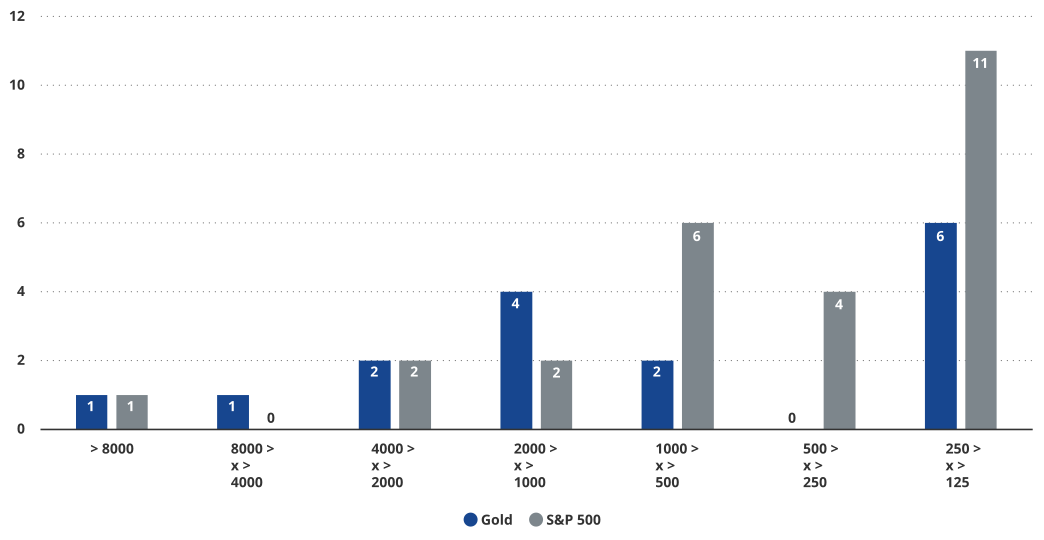
We define dead money as the number of calendar days required to surpass a previous high. In other words, the time spent clawing capital back from losses.
When we examine the historical distribution of dead money events for gold and the S&P 500, the results are instructive.
Stocks experience more short-term dead money events than gold.
Over medium and long horizons, the results are similar.
History does not justify this concern relative to equities (or bonds, but that’s a subject for another day).
Gold vs. S&P 500 Dead Money Events: Calendar Days to Surpass Previous High
1927-2025
Source: Bloomberg, as of 2025.
A Final Thought
We could be wrong.
It is possible that debt and deficits stop mattering. That heavily leveraged countries grow and save their way out of this cycle while funding massive investments in AI, automation, energy, and other critical infrastructure.
It is possible that wealth becomes more evenly distributed, that geopolitical tensions fade, that global leaders once again view the U.S. dollar as the most trusted and neutral custodian of wealth.
Afterall, anything is possible.
We will keep our gold just in case.
Macro themes we’re watching:
Today’s predominant macro forces are driving the key themes and exposures in VanEck’s models, including the core allocation of the VanEck Wealth Builder Plus Portfolios. The allocations below are representative of the Moderate Portfolio.
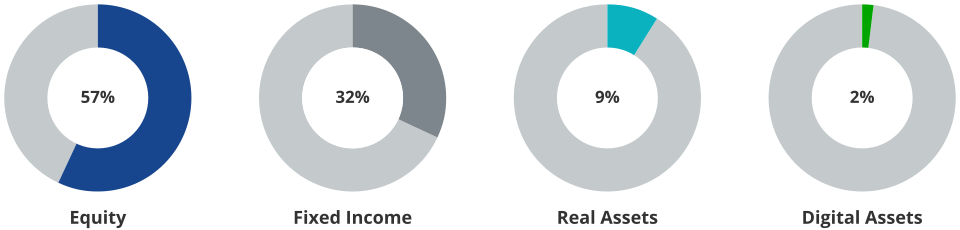
Source: VanEck, 11/30/2025. Not intended as a recommendation to buy or sell any securities or digital assets, or as investment or any call to action.
Related Insights

Related Insights
18 diciembre 2025
09 diciembre 2025

07 octubre 2025
09 septiembre 2025
18 diciembre 2025
Prepare su portafolio para 2026 con información detallada del equipo de inversiones de VanEck sobre los factores que determinarán el riesgo y los rendimientos en sus respectivas clases de activos.
09 diciembre 2025
La liquidez se redujo, Bitcoin mostró señales tempranas de estrés, la adopción de la IA ganó tracción y los activos reales continuaron liderando en un entorno de mercado cambiante.
09 septiembre 2025
El oro señala cautela, ya que los déficits, la deuda y la geopolítica ponen a prueba la confianza, mientras que la innovación en IA está remodelando el crecimiento para la próxima década.
09 junio 2025
El oro, el Bitcoin y la energía nuclear pueden ayudar a protegerse contra la deuda, la inflación y el riesgo energético, ofreciendo diversificación en medio del caos fiscal, la decadencia del fiat y el aumento de la demanda de energía.
23 mayo 2025
El riesgo geopolítico ha pasado al centro de la escena. Desde la escalada de las tensiones comerciales y los conflictos militares hasta las cambiantes políticas fiscales, el panorama mundial exige un enfoque proactivo e informado.