About Defaults - Russia and More?
25 May 2022
Read Time 2 MIN
U.S. Treasury closes the debt payment loophole for Russia. EM central banks keep an eye on the policy rate differential with the U.S. Fed.
Russia Sovereign Default
The U.S. Treasury closed the loophole (a special Office of Foreign Assets Control (OFAC) waiver) that allowed U.S. banks and individuals to receive bond payments from the Russian government. With Russia’s technical default looming, some commentators argued that this creates an international precedent that can complicate the lives of sovereign borrowers down the road. An aspect that might be more relevant in the near-term is the impact on Russia’s corporate debt, which is several orders of magnitude larger than sovereign debt. Yes, it is not huge as percentage of GDP, and it is very concentrated in several sectors, but broken financing and supply chains will push Russia’s potential growth trajectory lower in the coming years.
Frontier EM Spreads, Default Risks
Russia is not the only emerging markets (EM) where the default drumbeat is getting louder. Several low-income (or frontier) EMs are either in distressed territory or getting close, being hit by exogenous shocks and rising global rates. The current EM High Yield spread (J.P. Morgan’s EMBIG Diversified HY Index) is the widest since 2002/03 (with the exception of the global financial crisis and the pandemic crisis – see chart below). By contrast, EM Investment Grade spread (J.P. Morgan’s EMBIG Diversified IG Index) is still close to historic lows. Of course, individual countries’ circumstances are different (EM is not a monolith), but if the current trends continue, we expect to hear more calls to extend the G20 Common Framework for debt treatment. From the investment perspective, it is also important that several countries in this group are talking to the IMF about new programs and loans – disbursements and news about structural reforms tend to improve sentiment and compress spreads.
EM Central Banks And U.S. Fed Decoupling
And talking about rising global rates, the U.S. Federal Reserve’s (Fed’s) minutes will be scrutinized this afternoon for signs of either confirming the +50bps pace of rate hikes or perhaps expanding it to +75bps. It’s not just “we the market” who are watching the Fed – many EM central banks do the same (despite being way ahead in the current tightening cycle). Mexico’s deputy governor, Jonathan Heath, said yesterday that they cannot decouple from the Fed and might need to widen the policy rate differential in order to maintain restrictive stance. Stay tuned!
Chart at a Glance: “Fragile” EM Spreads Are Widening
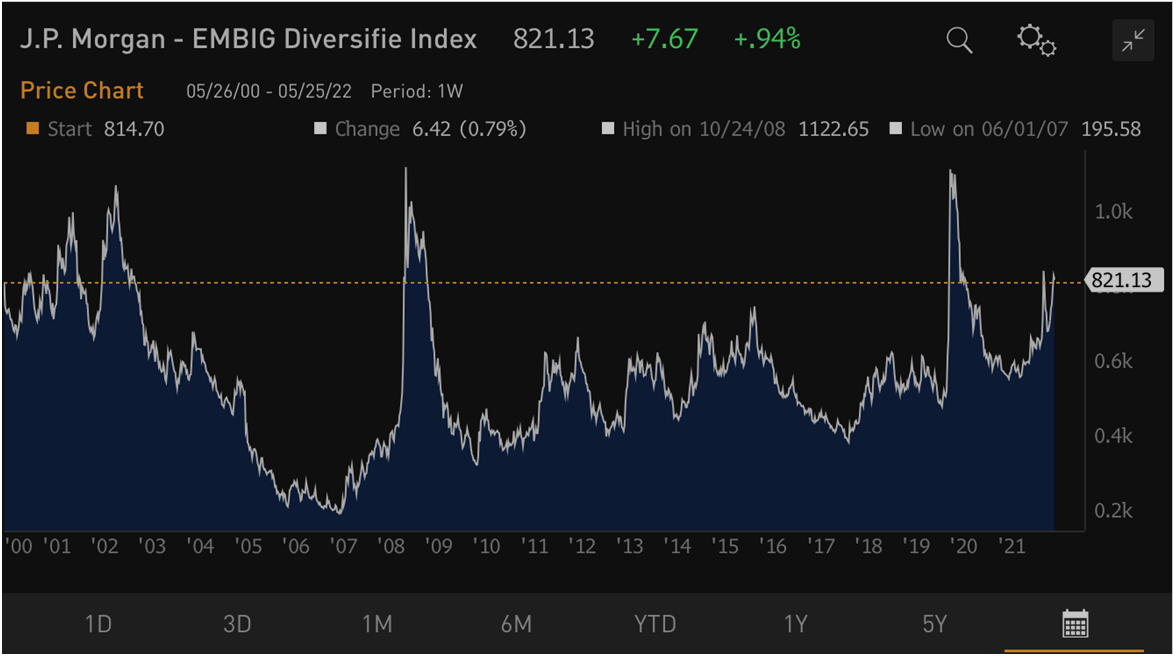
Source: Bloomberg LP
Related Insights

Related Insights
07 April 2025
06 March 2025
20 February 2025
10 February 2026
Debasement is back in focus. Here’s what’s driving it, what could reverse it and how we’re positioning portfolios for both scenarios.
07 April 2025
Trump’s tariffs spark trade war fears, fueling market volatility, inflation risk, and recession threats. With global retaliation likely, near-term growth is clearly at risk.
06 March 2025
Trump’s tariffs, AI’s next phase, and a potential U.S. gold revaluation could shake markets—investors who stay ahead of these transitions will be best positioned.
20 February 2025
China's AI breakthrough, persistent inflation, gold’s outperformance, and rising energy demand underscore a shifting investment landscape.
16 January 2025
In 2025, navigating turbulence means balancing tech innovation, inflation hedges, energy shifts, and risks from spending cuts and inflation.