China Rebound – V-Shape?
31 January 2023
Read Time 2 MIN
China Growth Outlook
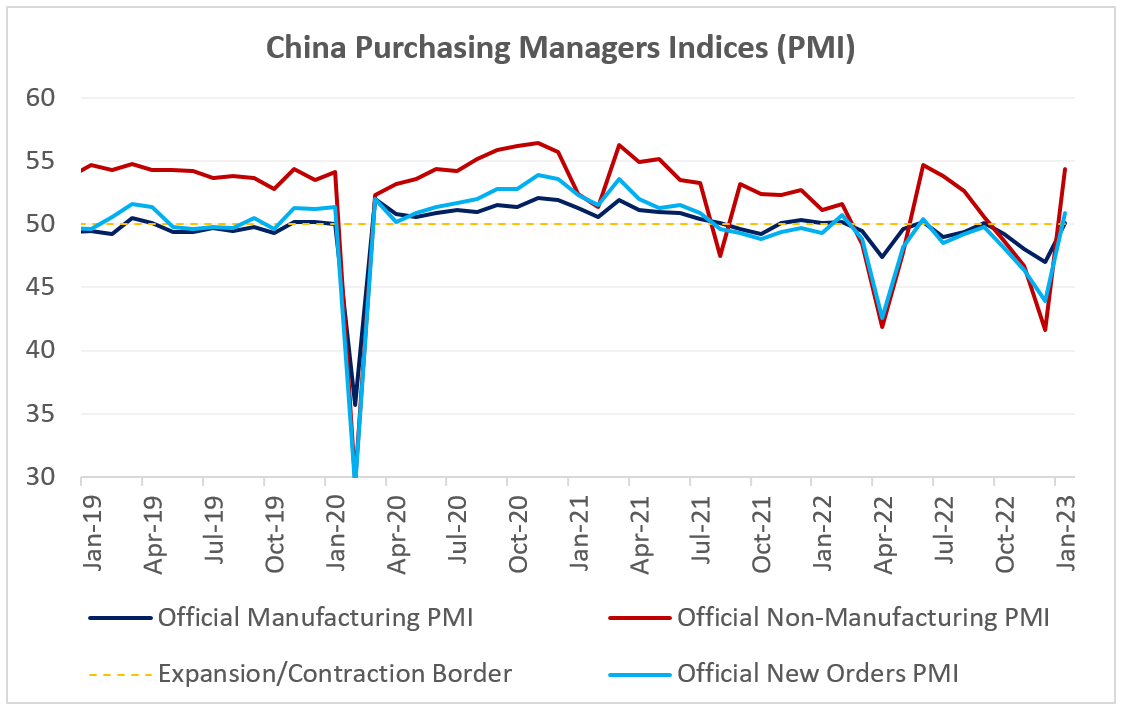
China’s rebound, which has boosted emerging markets (EM) asset prices, is real, and it is led by consumption – these are the main takeaways from the latest set of domestic activity gauges (Purchasing Managers Indices1). Both the manufacturing and the services PMIs moved back to expansion zone in January (respectively, 50.1 and 54.4 – see chart below), paving the way for further 2023 growth upgrades (currently 5.1%, according to the Bloomberg consensus forecast). Details show that China’s external environment remains challenging – the new export orders PMI is still contractionary (46.1) – and that small privately-owned companies are still struggling (47.2). These are good reasons to keep stimulus flowing for now. A sharp improvement in the services PMI (by nearly 13 points) is, however, an encouraging signal for those of us who have been complaining about China’s unbalanced growth since the onset of the pandemic. This is also a reason why the consensus sees higher inflation pressures in China down the road, expecting some policy tightening in the second half of the year.
China Rebound and EM
The market (both bonds and equities) has been anticipating improvements in China’s activity indicators for some time now – given the U-turn in the housing sector policies and the removal COVID restrictions. An important question now is what China’s growth rebound means for the rest of EM, which have been plagued by higher inflation and rising interest rates for most of 2022, but had a very good start to the year (so far). The TTC approach – China’s impact on trade (T), tourism (T) and commodity prices (C) – gives us a broad idea where to look for potential winners in 2023 (both in EM Asia and beyond). Thailand, South Korea and Indonesia are definitely on the list – as are commodity exporters (Chile).
Disinflation and Rate Cuts
It is not entirely clear, though, how China’s reopening will affect the pace of global disinflation and various central banks’ ability to cut rates in the coming months. Market expectations continue to price in H2 rate cuts across major EMs and in the U.S., setting a potentially positive stage for lower interest rates. But China-related growth tailwinds, as well as a new inflationary impulse, can potentially thwart these plans, leading to a longer pause rather than outright easing. If the U.S. Federal Reserve falls into this category, the market might become more discriminating in its assessment of the 2023 prospects for EM. Stay tuned!
Chart at a Glance: China Activity Gauges – A Nice Rebound
Source: Bloomberg LP.
1 We believe PMIs are a better indicator of the health of the Chinese economy than the gross domestic product (GDP) number, which is politicized and is a composite in any case. The manufacturing and non-manufacturing, or service, PMIs have been separated in order to understand the different sectors of the economy. These days, we believe the manufacturing PMI is the number to watch for cyclicality.
Related Insights

Related Insights
07 April 2025
06 March 2025
20 February 2025
16 January 2025
07 April 2025
Trump’s tariffs spark trade war fears, fueling market volatility, inflation risk, and recession threats. With global retaliation likely, near-term growth is clearly at risk.
06 March 2025
Trump’s tariffs, AI’s next phase, and a potential U.S. gold revaluation could shake markets—investors who stay ahead of these transitions will be best positioned.
20 February 2025
China's AI breakthrough, persistent inflation, gold’s outperformance, and rising energy demand underscore a shifting investment landscape.
16 January 2025
In 2025, navigating turbulence means balancing tech innovation, inflation hedges, energy shifts, and risks from spending cuts and inflation.
05 December 2024
"Trump Trade 2.0" fueled U.S. equity and digital asset rallies, while real assets faltered under a strong dollar, with global markets reacting unevenly to pro-growth policies.