Disinflation – Bumps, Twists, and Turns
23 December 2022
Read Time 2 MIN
DM Policy Tightening
The global disinflation narrative has shifted from “whether/when” to “how fast,” – but the slowing trend does not mean “smooth sailing.” We get an occasional upside surprise – including the Eurozone’s November revision or today’s U.S. Personal Consumption Expenditure Core Price Index (core PCE). And sometimes inflation peaks remain elusive, downside surprises notwithstanding – like in Japan, where November’s inflation drew extra attention this morning after the central bank’s hawkish yield curve control adjustment a few days ago. These developments explain why the market now expects 44bps of rate hikes in Japan in 2023.
EM Asia Rate Hikes
Emerging Markets (EM) disinflation is on firmer ground – and with lower (tentative) peaks in the case of EM Asia. However, today’s inflation releases in Malaysia and Singapore showed no further progress (in year-on-year terms) in November (contrary to expectations). Further, Malaysia’s core inflation continued to grind higher, challenging the market expectation of the peak policy rate and an extended policy rate pause in 2023. Some sell-side commentators suggested that the central bank might err on the side of caution in January and raise the policy rate one more time – which would be a prudent move, given that the policy rate differential between EM Asia and the U.S. Federal Reserve is very slim now.
LATAM Disinflation
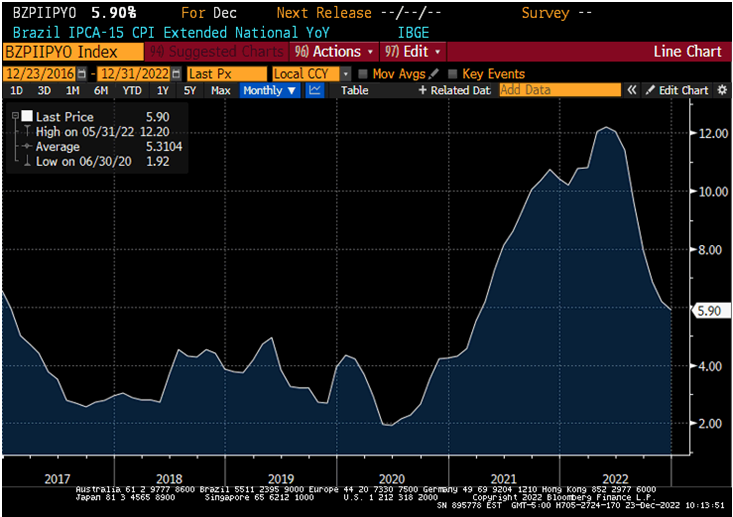
Yesterday, Mexico’s bi-weekly inflation print was another illustration of the “bumpy road” price trajectory in EM. However, Brazil reaffirmed its “disinflation poster kid” status this morning, with a nice downside surprise and further moderation in mid-month inflation, which is now below 6% year-on-year (vs 12.2% back in May, see chart below). Easing price pressures mean that Brazil’s real policy rate is among the highest in the world – and this leaves ample room for rate cuts in 2023. Whether or not the central bank would be able to use this policy space is a different question though – due to fiscal concerns. The fact that the incoming administration’s spending waver was approved only for one year is a big plus, but the new cabinet’s lineup signals that we might see more populist policy surprises in the coming months. Stay tuned!
Chart at a Glance: Brazil Disinflation – Nice and Steady
Source: Bloomberg LP.
Related Insights

Related Insights
07 April 2025
06 March 2025
20 February 2025
10 February 2026
Debasement is back in focus. Here’s what’s driving it, what could reverse it and how we’re positioning portfolios for both scenarios.
07 April 2025
Trump’s tariffs spark trade war fears, fueling market volatility, inflation risk, and recession threats. With global retaliation likely, near-term growth is clearly at risk.
06 March 2025
Trump’s tariffs, AI’s next phase, and a potential U.S. gold revaluation could shake markets—investors who stay ahead of these transitions will be best positioned.
20 February 2025
China's AI breakthrough, persistent inflation, gold’s outperformance, and rising energy demand underscore a shifting investment landscape.
16 January 2025
In 2025, navigating turbulence means balancing tech innovation, inflation hedges, energy shifts, and risks from spending cuts and inflation.