Cushion Rate Increases with EM High Yield
02 September 2022
Read Time 3 MIN
Emerging markets corporate bonds’ strong fundamentals help to cushion the impact of rising U.S. interest rates as recessionary risk grows.
Since the beginning of 2022, emerging markets fixed-income investors have experienced negative returns as interest rates and credit spreads both moved higher due to several macro factors such as rate hikes, weaker local currencies, and downward GDP growth revisions. Despite the stiff headwinds, certain mitigating factors may make emerging markets corporates relatively resilient going forward.
First, emerging markets high yield USD bonds can offer higher yields without direct local currency risk. The higher yield provides a significant cushion against rising U.S. interest rates and the impact of potentially wider spreads if recessionary risks grow. As shown in the chart below, at the end of July, emerging markets high yield corporate USD bonds, represented by the ICE BofA Diversified High Yield US Emerging Markets Corporate Plus Index (the “Index”), yielded 11.3%, the highest among major fixed income asset classes and 3.5% higher than U.S. high yield bonds. The spread was 853 bps, higher than the 10-year average of 612 bps. Excluding China’s real estate sector, the yield (9.53% vs a 10-year average of 7.60%) and spread (679 bps) on the asset class are still at historically attractive levels in absolute terms and relative to U.S. high yield. New issuance of emerging markets corporate debt has been extremely low during the first eight months of the year, providing additional technical support. Net issuance (excluding coupons) among emerging markets corporates year-to-date is negative at -$63 billion, more than offsetting fund outflows.
Yield Comparison
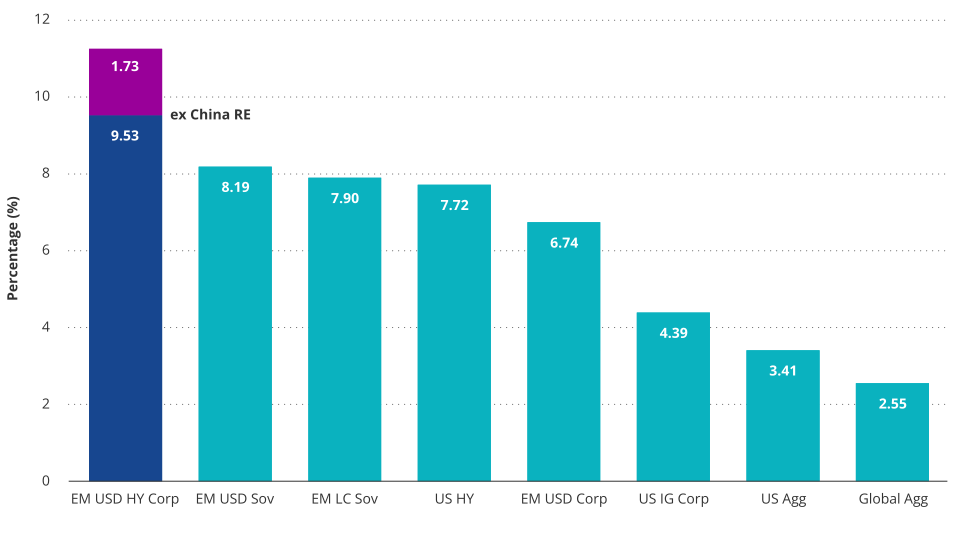
Source: ICE Data Indices, LLC and J.P. Morgan as of 7/31/2022. EM High Yield Corp: ICE BofA Diversified High Yield US Emerging Markets Corporate Plus Index; Local Currency EM Sovereign: J.P. Morgan GBI-EM Global Diversified; USD EM Sovereign: J.P. Morgan EMBI Global Diversified; U.S. High Yield Corp: ICE BofA U.S. High Yield Index; US IG Corp: ICE BofA Corporate Bonds Index; US Agg: ICE BofA US Broad Market Index; Global Agg: ICE BofA Global Broad Market Index. Yield to Worst measures the lowest of either yield-to-maturity or yield-to-call date on every possible call date. See important disclosures and index definitions at the end of the presentation. ICE BofA composite ratings are simple averages of various ratings, and are not intended to be a credit opinion. Past performance is no guarantee of future results.
Emerging markets corporates still have relatively strong fundamentals to cushion the impact of the headwinds. A strong Q1 earnings result shows emerging markets corporates had 25% EBITDA growth year-on-year, excluding China’s real estate sector, while leverage was stable. Not surprisingly, companies in commodity-related businesses had better results than other sectors. The high yield default rate has increased to 8.1% so far this year, significantly higher than the historical average and the rate for U.S. high yield. But much of the default story has made its way through the index, as China Real Estate and Russian corporates combined represent more than 90% of the default volumes. At the end of July, the Index held 9.6% Chinese corporate bonds, 3.6% of which are in the real estate sector. The Index has not held any Russian bonds since the end of March.
Emerging markets commodity-related businesses have benefitted from the commodity boom in the first half of 2022. The Index has approximately 35% allocation to bonds issued by commodity-related companies. Commodity prices have come down during the summer but the global supply-demand picture for commodities remains very supportive.
Some emerging markets gain exporting competitiveness due to a strong dollar, lifting local business activities. Emerging markets countries with depreciating currencies have increased exports this year, which helps local economies in general through increasing business activities and corporate earnings. The Index has close to 40% of its holdings allocated to exporting economies, such as China, Mexico, Brazil, South Africa and Indonesia. China’s exports posted robust growth in July and jumped 18% in dollar terms from a year ago.
China has shown a slow recovery after the government took a series of steps to restore the economy early this year and more recently loosened up the COVID restrictions. Although the looming risk within the property sector still exists, China’s recent accommodative policies are supportive of its economy in the near term and could provide a boost to other emerging markets economies as well. The Index has about 10% allocation to China and less than 3.75% in the real estate sector. However, the recent tension between China and Taiwan has heightened global geopolitical risk.
Related Insights

Related Insights
06 March 2026

11 February 2026
11 March 2026
Iran-driven risks are reshaping EM debt markets. EMBX reduced Gulf exposure as valuations failed to reflect rising conflict risk and shifted toward resilient Latam and SSA commodity exporters.
06 March 2026
EM bonds outperformed in 2025 and the case of allocating continues to be supported by a weaker US dollar and stronger EM fundamentals in 2026.
18 December 2025
Get your portfolio ready for 2026 with detailed insights from VanEck’s investment team about the factors driving risk and returns in their respective asset classes.
05 December 2025
EM local-currency bonds offer high real yields, strong 2025 returns, and resilience to shocks, driven by credible policy and solid fundamentals.
04 December 2025
EM high yield has extended its 2025 momentum, delivering strong carry and compelling yields. With higher credit quality and lower defaults, the segment offers a more attractive risk profile than US high yield.