EM Bonds Are In Good Shape for 2024
08 December 2023
Read Time 5 MIN
Compared to U.S. core fixed income asset classes, emerging markets (EM) fixed income has had a relatively strong 2023. High carry has driven returns, and less exposure to U.S. duration risk has continued to be a positive contributor. Looking to 2024, slowing growth, the Fed’s policy direction and geopolitical risk are sources of uncertainty. However, with yields providing substantial cushion amid the possibility that the Fed can orchestrate a soft landing, we expect conditions to remain supportive for various segments within EM debt.
Emerging Markets Fixed Income Has Had a Relatively Strong 2023
Yield & Duration as of 11/30/2023
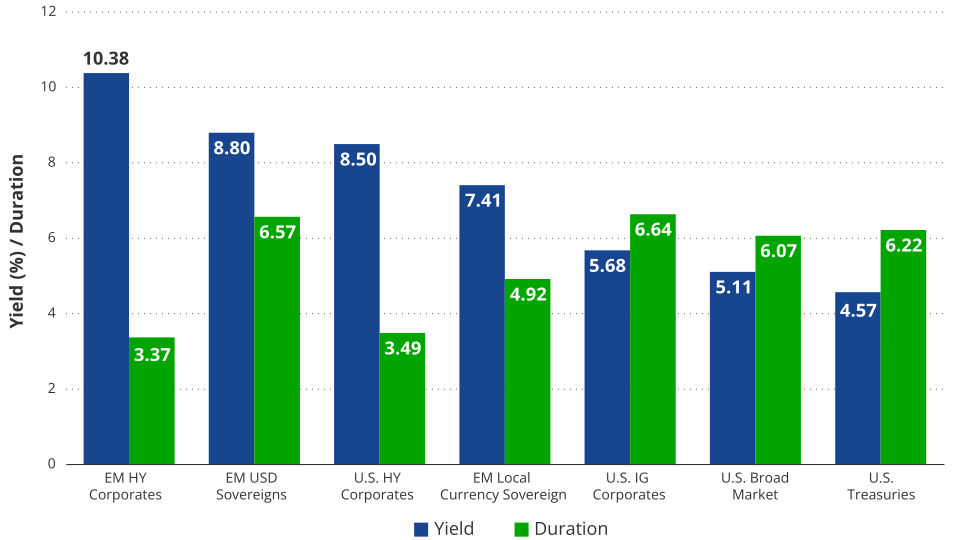
Source: J.P. Morgan and ICE Data Indices as of 11/30/2023. EM HY Corporates is represented by ICE BofA Diversified High Yield US Emerging Markets Corporate Plus Index; EM USD Sovereigns is represented by the J.P. Morgan EMBI Global Diversified Index; US HY Corporates is represented by the ICE BofA US High Yield Index; EM Local Currency Sovereign is represented by the J.P. Morgan GBI-EM Global Core Index; US IG Corporates is represented by the ICE BofA US Corporate Index; US Broad Market is represented by the ICE BofA US Broad Market Index; US Treasuries is represented by the ICE BofA US Treasury Index.
Local Currency Sovereigns:
The U.S. macro and rate environment, and how that impacts Fed policy, may have a significant impact on emerging markets local currency sovereign bonds in 2024. If the market consensus for a soft landing materializes we expect a fairly benign environment for the asset class. Continued declines in U.S. inflation may lead to rate cuts by the Fed at some point next year, and could keep longer term U.S. yields from rising significantly (although we do not expect significant declines from current levels). This may benefit EM currencies (EMFX) as dollar weakness continues, but EMFX has rarely been the key driver of positive returns in EM local debt. For instance, EMFX has rallied over the past two months as U.S. bond yields have declined, but has contributed only approximately +1.3% to a total return of approximately +8.4% this year. We believe a similar dynamic could play out next year, with EMFX supported but carry being the primary driver of total return. Although there is certainly a case for a more bearish view on the U.S. dollar, EMFX strength may be tempered by rate cuts by many EM central banks. If the Fed cuts rates sooner or deeper than expected, we would expect that to be accompanied by a sell-off in risk assets, which may not favor EMFX.
Another rationale for an EM allocation is that sovereign fundamentals remain in good shape. EM inflation has continued to moderate and will likely hit target levels in many countries next year. EM central banks have remained vigilant, providing support for currencies and generating attractive real interest rates. Although the rate differential versus U.S. rates has declined below historical averages, we believe the fundamental story in EM versus DM make such comparisons less relevant.
High Yield Corporates:
Within EM corporates, high yield bonds may be an attractive alternative or complement to U.S. high yield in 2024 in a soft landing scenario. With yields currently over 10%, we believe they offer attractive income potential given the higher quality of universe compared to U.S. high yield in terms of credit quality exposure. The asset class also enters 2024 with less exposure to the troubled Chinese property sector compared to prior years, with 1.3% exposure as of 11/30/2023 versus nearly 7% at the beginning of 2022. Similar to most credit asset classes, spreads are currently tighter than their historical average, although to a much lesser degree than U.S. high yield. With resilient fundamentals and net issuance that is expected to remain muted next year, we see continued support for spreads which may help balance against macro uncertainty. Notably, although most U.S. investment grade bond indexes include emerging markets borrowers, U.S. high yield bond indexes and associated products do not and so EM high yield bond allocations can add significant diversifications at the borrower level.
ICE BofA Diversified High Yield US Emerging Markets Corporate Plus Index: is comprised of U.S. dollar-denominated bonds issued by non-sovereign emerging markets issuers that are rated below investment grade and that are issued in the major domestic and Eurobond markets.
ICE BofA US Broad Market Index: tracks the performance of US dollar denominated investment grade debt publicly issued in the US domestic market, including US Treasury, quasi-government, corporate, securitized and collateralized securities.
ICE BofA US Corporate Index: tracks the performance of US dollar denominated investment grade rated corporate debt publicly issued in the US domestic market.
ICE BofA US High Yield Index: tracks the performance of U.S. dollar-denominated below investment grade corporate debt publicly issued in the U.S. domestic market. Qualifying securities must have a below investment grade rating. Original issue zero coupon bonds, 144a securities, both with and without registration rights, and pay-in-kind securities, including toggle notes, qualify for inclusion.
ICE BofA US Treasury Index: tracks the performance of US dollar denominated sovereign debt publicly issued by the US government in its domestic market.
J.P. Morgan EMBI Global Diversified Index: tracks USD-denominated emerging markets sovereign bonds. The weighting scheme provides additional diversification by more evenly distributing weights among the countries in the index.
J.P. Morgan GBI-EM Global Core Index: tracks bonds issued by emerging markets governments and denominated in the local currency of the issuer. The weighting scheme provides additional diversification by more evenly distributing weights among the countries in the index. Countries are capped at 10% and floored between 1% to 3%.
Related Insights

Related Insights
06 March 2026
05 December 2025
11 March 2026
Iran-driven risks are reshaping EM debt markets. EMBX reduced Gulf exposure as valuations failed to reflect rising conflict risk and shifted toward resilient Latam and SSA commodity exporters.
06 March 2026
EM bonds outperformed in 2025 and the case of allocating continues to be supported by a weaker US dollar and stronger EM fundamentals in 2026.
18 December 2025
Get your portfolio ready for 2026 with detailed insights from VanEck’s investment team about the factors driving risk and returns in their respective asset classes.
05 December 2025
EM local-currency bonds offer high real yields, strong 2025 returns, and resilience to shocks, driven by credible policy and solid fundamentals.
04 December 2025
EM high yield has extended its 2025 momentum, delivering strong carry and compelling yields. With higher credit quality and lower defaults, the segment offers a more attractive risk profile than US high yield.