Why Investors Should Consider an Emerging Markets Bonds Allocation in 2026
06 March 2026
Read Time 6 MIN
Key Takeaways:
- Emerging markets bonds beat US and global bonds in 2025 despite tariffs and China growth concerns.
- EM Bonds yield 6.9%, vs Global and US Bonds which yield 3.6% and 4.2%, respectively.i
- A weakening US dollar and stronger EM balance sheets create supportive conditions.
- Combining local- and hard-currency EM bonds can help diversify returns across cycles.
In 2025, emerging markets faced headwinds from the Trump administration’s tariff policies, which expected to weigh on EM economies, as well as consumer and corporate weakness in China that was feared would spill over across Asia.
Instead, emerging markets thrived, challenging outdated perceptions of political and economic instability.
As shown in Table 1, emerging markets bonds outperformed global developed markets bonds by 8.71% in 2025 and US bonds by 9.64%.
Table 1: EM Bonds Outperformed Global and US Bonds in 2025
| Asset Class | 2025 Return |
| Emerging Market Bonds | 16.79 |
| Global Bonds | 8.08 |
| US Bonds | 7.15 |
Source: VanEck. Emerging market bonds are represented by the 50% J.P. Morgan Emerging Market Bond Index Global Diversified and 50% J.P. Morgan Government Bond-Emerging Market Index Global Diversified. Global Bonds is represented by the ICE BofA Global Broad Market Index. US Bonds is represented by the ICE BofA US Broad Market Index. Past performance is no guarantee of future results. Index performance is not representative of fund performance. It is not possible to invest directly in an index.
Average Annual Total Returns* (%) (In USD)
| Month End As of February 28, 2026 | 1 Mo | 3 Mo | YTD | 1 Yr | 3 Yrs | 5 Yrs | 10 Yrs |
| EMBX (NAV) | 1.20 | 4.90 | 3.43 | 18.86 | 11.41 | 4.89 | 5.74 |
| EMBX (Market Price) | 1.46 | 4.88 | 3.72 | 19.06 | 11.47 | 4.92 | 5.76 |
| 50% GBI-EM/50% EMBI | 1.34 | 3.92 | 2.79 | 16.69 | 10.75 | 2.82 | 4.30 |
Average Annual Total Returns* (%) (In USD)
| Quarter End As of December 31, 2025 | 1 Mo | 3 Mo | YTD | 1 Yr | 3 Yrs | 5 Yrs | 10 Yrs |
| EMBX (NAV) | 1.41 | 3.15 | 19.04 | 19.04 | 10.84 | 3.87 | 5.49 |
| EMBX (Share Price) | 1.12 | 3.03 | 18.91 | 18.91 | 10.80 | 3.85 | 5.48 |
| 50% GBI-EM/50% EMBI | 1.11 | 3.32 | 16.80 | 16.80 | 10.08 | 1.50 | 4.20 |
* Returns less than one year are not annualized.
EMBX Gross Expense Ratio: 0.76%
The performance data quoted represents past performance. Past performance is not a guarantee of future results. Investment return and principal value of an investment will fluctuate so that an investor's shares, when redeemed, may be worth more or less than their original cost. Performance may be lower or higher than performance data quoted. Please call 800.826.2333 or visit vaneck.com for performance current to the most recent month ended.
Prior to 10/06/2025, the Fund operated as the VanEck Emerging Markets Bond mutual fund; performance shown before that date is that fund’s NAV performance (Class I, unadjusted for today’s ETF expenses).
Many investors missed this opportunity, but it’s not too late.
Why Emerging Markets Bonds Were Ignored, and Why That’s Changing in 2026
The fundamental case for investing in emerging markets bonds has been building for some time, but investors have shown little interest in the asset class over the past several years. Many investors view emerging markets bonds as risky. However, we believe that is changing. emerging markets bonds are now entering a favorable phase. Despite heightened geopolitical noise and renewed trade tensions, emerging markets bonds rallied in 2025.
Exhibit 1: Emerging Markets Bonds Rallied in 2025

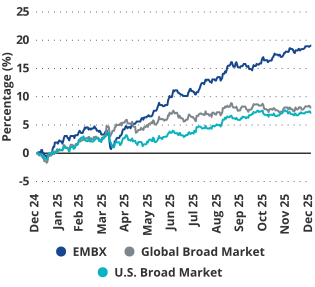
Source: Morningstar as of 31/12/2024 to 31/12/2025. Global Broad Market is represented by the ICE BofA Global Broad Market Index. US Broad Market is represented by the ICE BofA US Broad Market Index. Past performance is no guarantee of future results. Index performance is not representative of fund performance. It is not possible to invest directly in an index.
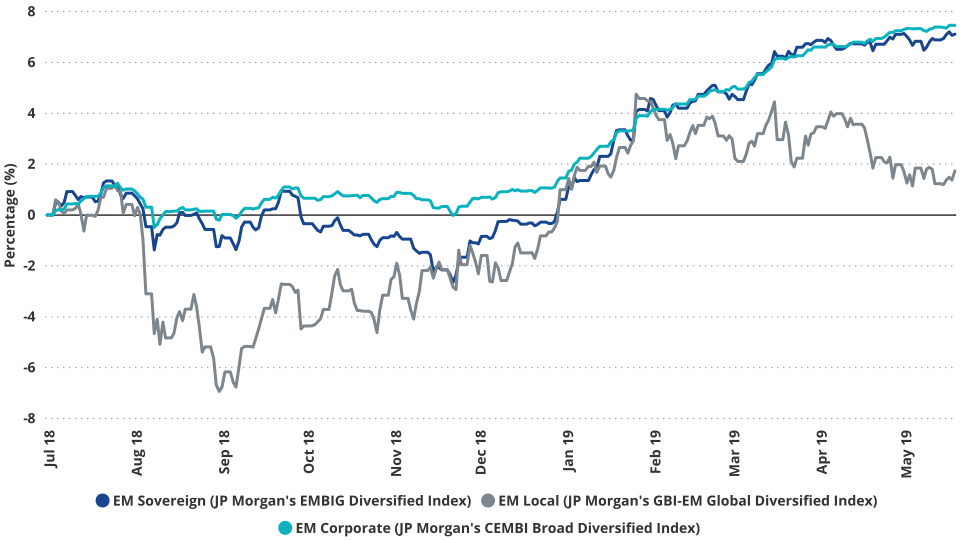
This mirrors the early stages of the 2018 trade war (between US and China), but with a key difference: the US dollar is weakening, and markets are increasingly positioning for this shift. Actual performance, rather than headlines, is driving investor outcomes.
Exhibits 2 and 3: EM Bonds Under Trump’s Tariffs in 2018 and 2025 Differ
EM Fixed Income in Early Stages of Trade War 1.0 (2018/19)

EM Fixed Income in Early Stages of Trade War 2.0 (2025/26)
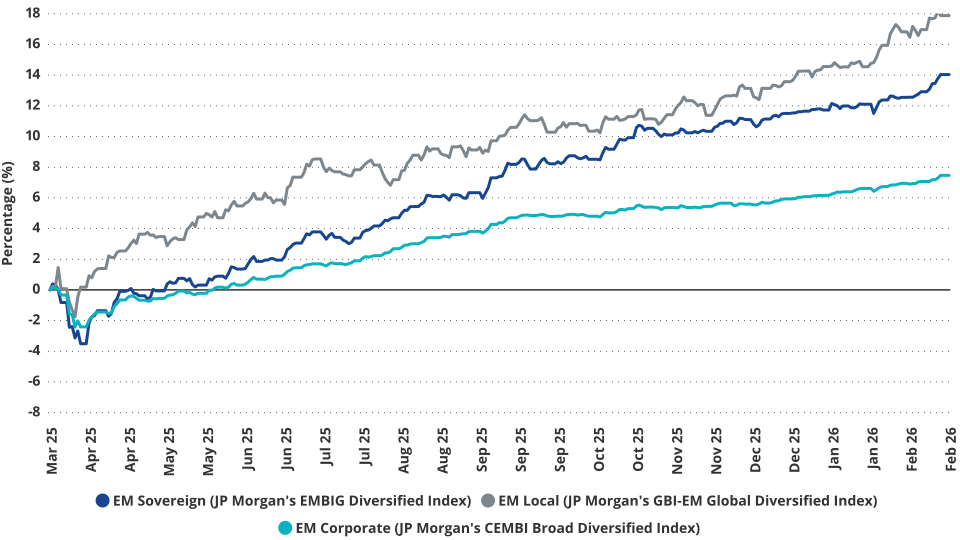
Source: VanEck Research. Data as of February 2026. EM Corporate is represented by the J.P. Morgan CEMBI Broad Diversified Index which tracks the performance of US dollar-denominated bonds issued by emerging market corporate entities.; EM Local is represented by the J.P. Morgan GBI-EM Global Core which tracks local currency bonds issued by emerging markets governments. The index weighting methodology limits the weight of countries with larger debt stocks, with a maximum of 10% and a minimum of 1% to 3% depending on the amount of the country’s eligible debt outstanding.; EM Sovereign is represented by the J.P. Morgan EMBI Global Diversified Index which is comprised of U.S. dollar-denominated Brady bonds, Eurobonds, and traded loans issued by emerging markets sovereign and quasi-sovereign entities. The index weighting methodology limits the weight of countries with larger debt stocks. Past performance is no guarantee of future results. Index performance is not representative of fund performance. It is not possible to invest directly in an index.
US Stagflation Risk is a Structural Tailwind
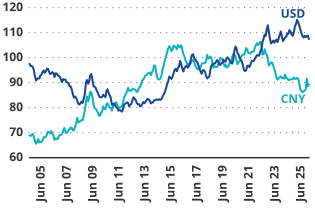
One of the reasons the US dollar is depreciating is that the US currently faces rising stagflation risk. Inflation is remaining elevated relative to growth. In contrast, inflation across many emerging markets, particularly China, has been structurally lower. Historically, such inflation differentials point to currency weakness in higher-inflation economies, reinforcing the case for US dollar depreciation. Valuation measures support this view, with the US dollar appearing overvalued and the Chinese yuan undervalued on a real effective basis.
Exhibit 4: The US Dollar Appears Overvalued vs. the Chinese Yuan
USD and CNY - Real Effective Exchange Rates

Source: VanEck Research; Bloomberg LP. Data as of January 2026. Not intended as a prediction of future results. For illustrative purposes only. Past performance is not indicative of future performance.
External Balance Sheets Advantage; Compelling Yields
Net international investment position (NIIP) data show that many emerging markets countries, particularly in Asia, are net external creditors, while the US remains a large net debtor. These accumulated surpluses of emerging markets are significant and enhance fundamental quality. In addition, many accumulated surpluses may be re-shored to home or other non-US shores. This dynamic implies either a weaker US dollar or structurally higher US rates; both outcomes are supportive for emerging market bonds.
Exhibit 5: NIIP Projects a Weaker USD
Net International Investment Position (NIIP)


Source: Deutsche Bank. Data as of December 2025. Not intended as a prediction of future results. For illustrative purposes only. Past performance is not indicative of future performance.
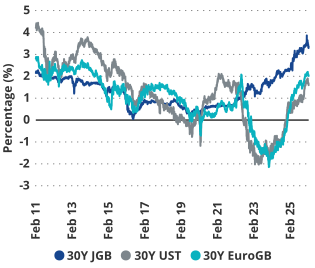
In addition, when hedged into Asian currencies, US Treasuries now offer low or unattractive yields, while onshore Asian and emerging markets bonds remain compelling on a relative basis. Exhibit 6 shows 30-year government bond yields hedged back into Japanese yen. When Japanese (or other Asian) investors hedge US Treasuries or European government bonds back into their home currency, the hedging cost wipes out most of the yield. As a result, hedged US Treasuries deliver low returns compared with domestic bonds such as Japanese government bonds (JGBs). This highlights a structural shift: for global investors who manage currency risk, holding US Treasuries is no longer compelling, while local Asian bonds look relatively more attractive. The chart also points out that as this reality sinks in, hedging behavior is evolving, reinforcing capital flows away from USD assets and supporting non-USD bond markets, including emerging market local-currency bonds.
Exhibit 6: Yields Wiped Out by Hedging Costs
30-Year Government Bonds Hedged Back into JPY

Source: VanEck Research; Bloomberg LP. Data as of February 2026. Past performance is not indicative of future performance.
We believe an allocation to emerging markets bonds is supported by the above. It is important to take the right approach.
Why Active, Blended?
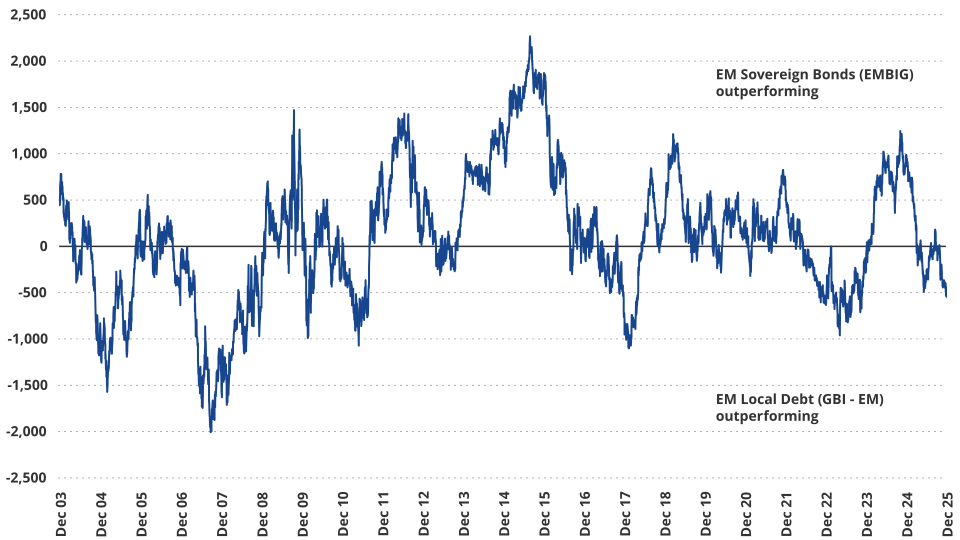
Over the past 20 years, local currency was the best performing category within emerging markets bonds for 7 years, while the US dollar (emerging markets sovereign) took the spot for 13 years. A blended approach allows for less extreme results while capturing potential outperformance.
Exhibit 7 plots the 12-month rolling return difference between emerging markets US dollar sovereign bonds (EMBIG) and emerging markets local currency bonds (GBI-EM). When the line is above zero, US dollar emerging markets bonds outperformed. When it is below zero, local currency emerging markets bonds outperformed. Over the past 20 years, leadership has rotated frequently and sharply between the two.
This variability means that allocating to only one segment requires strong and often uncertain macro calls. A blended emerging markets bond approach helps smooth outcomes across market cycles, reduces reliance on forecasting currency or rate moves, and allows investors to capture diversified sources of return from both credit and local market dynamics.
Exhibit 7: Leadership Between Local and US Dollar Denominated EM Bonds Rotate Frequently and Sharply
EMBIG-GBI EM Total Return Differential, (12m rolling, bps)
Source: VanEck Research, Bloomberg LP. Data as of December 2025. EMBIG is represented by J.P. Morgan Emerging Market Bond Index Global Diversified, GBI-EM is represented by the JPMorgan Government Bond Index-Emerging Markets Global Diversified Index. Past performance is no guarantee of future results. Index performance is not representative of fund performance. It is not possible to invest directly in an index.
Ready to Allocate? We Recommend an Active Blended Approach
In addition, due to the idiosyncrasies between the countries included in the emerging markets bond universe and the nuances between the different types of bonds available, we believe an active, unconstrained, blended approach, like the one employed by the VanEck Emerging Markets Bond ETF (EMBX) is an ideal way for investors to access this important asset class.
VanEck’s unconstrained approach offers several benefits, including greater diversification versus approaches limited to only hard or local currency. We believe an optimal portfolio of EM bonds is unconstrained by indices and invests in bonds that offer the best value relative to their fundamentals while actively managing risk.
i Data as of February 2026. EM Bonds are represented by the 50% J.P. Morgan Government Bond Index - Emerging Markets Global Diversified (GBI-EM) and 50% J.P. Morgan Emerging Markets Bond Index (EMBI). Global bonds are represented by the ICE BofA Global Broad Market Index. US Bonds are represented by the ICE BofA US Broad Market Index.
Related Insights

Related Insights

11 February 2026
05 December 2025
11 March 2026
Iran-driven risks are reshaping EM debt markets. EMBX reduced Gulf exposure as valuations failed to reflect rising conflict risk and shifted toward resilient Latam and SSA commodity exporters.
18 December 2025
Get your portfolio ready for 2026 with detailed insights from VanEck’s investment team about the factors driving risk and returns in their respective asset classes.
05 December 2025
EM local-currency bonds offer high real yields, strong 2025 returns, and resilience to shocks, driven by credible policy and solid fundamentals.
04 December 2025
EM high yield has extended its 2025 momentum, delivering strong carry and compelling yields. With higher credit quality and lower defaults, the segment offers a more attractive risk profile than US high yield.
28 October 2025
The EM Debt team just returned from the Fall IMF Annual Meeting, here are their takeaways.