VEFA ETF: Question & Answer
01 April 2026
Read Time 7 MIN
Most investors access international developed market equities through passive index funds that make no distinctions between companies, or through active managers whose process can be difficult to evaluate. The VanEck MSCI EAFE Analyst Sentiment ETF (VEFA) offers a third option: a rules-based ETF that systematically tilts toward stocks where professional analysts are most actively raising their expectations, while keeping risk anchored to the MSCI EAFE benchmark. This blog is intended to answer frequently asked questions about analyst sentiment as an investment signal and, more specifically, the VanEck MSCI EAFE Analyst Sentiment ETF (VEFA).
- What is the VanEck MSCI EAFE Analyst Sentiment ETF (VEFA)?
- What is Analyst Sentiment?
- Why Does Analyst Sentiment Work as an Investment Signal?
- How Does the MSCI EAFE Analyst Sentiment Index work?
- How is the Index Constructed Step by Step?
- Why is Tracking Error Important in VEFA?
- Why Invest in International Developed Markets Now?
- Are Sell-Side Analysts Biased and Does It Matter?
- How Does VEFA Fit in a portfolio?
- How to Buy VanEck ETFs?
What is the VanEck MSCI EAFE Analyst Sentiment ETF (VEFA)?
VEFA is a passively managed ETF that tracks the MSCI EAFE Analyst Sentiment Select Index. The fund provides exposure to large- and mid-cap companies across 21 developed markets outside the U.S. and Canada, with a systematic tilt toward stocks where sell-side analysts are becoming more optimistic. It is designed to serve as an enhanced core international equity allocation, not a concentrated tactical bet.
What is Analyst Sentiment?
Analyst sentiment captures how the views of professional sell-side analysts are changing over time. When analysts raise their earnings estimates, lift their price targets, or upgrade their ratings on a stock, that reflects a shift in their view of the company's forward outlook. The opposite is also true: falling estimates and downgrades signal deteriorating expectations.
VEFA's underlying index tracks these shifts systematically. Rather than relying on a single data point, the signal equally weights five distinct analyst revision types:
- Earnings per share revisions: Changes in analyst EPS forecasts, the most widely followed measure of a company's profitability outlook.
- Sales forecast revisions: Shifts in revenue expectations, which capture top-line momentum before it flows through to earnings.
- Cash flow per share revisions: Changes in cash flow estimates, reflecting how analysts view a company's ability to generate real cash.
- Price target adjustments: Moves in the price analysts believe the stock should trade at, representing their overall valuation view.
- Buy/sell recommendation changes: Upgrades or downgrades in analyst ratings, the most direct expression of whether an analyst thinks the stock is worth owning.
By aggregating across all five equally weighted inputs, the signal captures a more complete picture of how professional opinion is shifting. Stocks showing broad improvement across multiple inputs receive the strongest positive signal, identifying companies where the analyst community is broadly becoming more optimistic, not just selectively.
Why Does Analyst Sentiment Work as an Investment Signal?
There is a clear, well-documented relationship between analyst sentiment and future stock returns. Stocks in the highest decile of analyst sentiment have consistently outperformed those in the lowest decile, with a near-monotonic return gradient from bottom to top across the MSCI EAFE universe.
Analyst Sentiment Exposure-Return Relationship
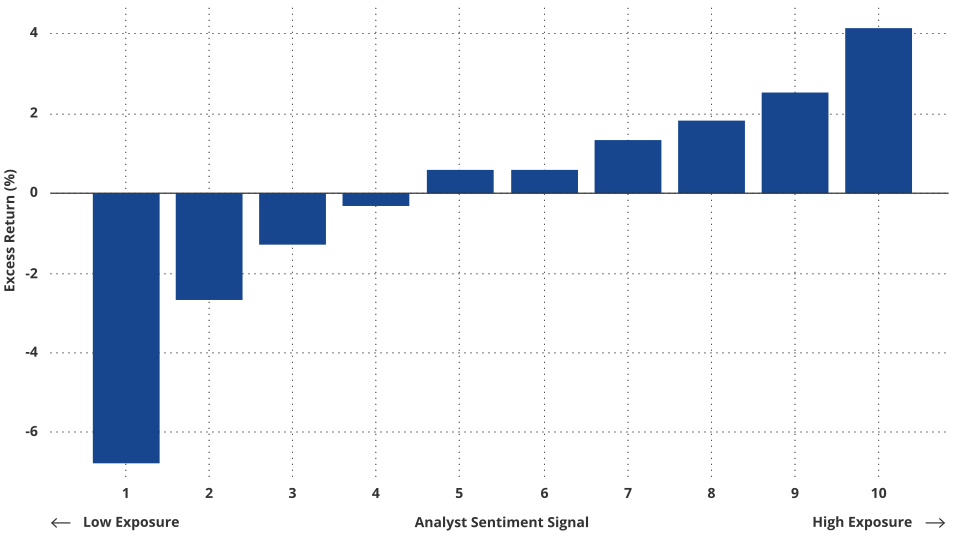
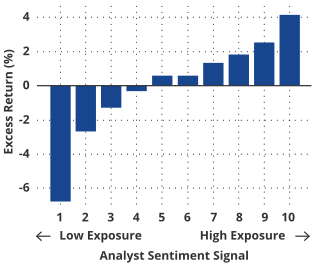
Source: MSCI. Returns based on MSCI ACWI IMI Index from Dec. 30, 1994, to June 30, 2025. Past performance is no guarantee of future results. Index performance is not representative of fund performance. It is not possible to invest directly in an index. The data shown prior to June 5, 2007 reflects pre-inception, hypothetical performance based on the historical returns of the securities that comprised the index during that period, and not actual index returns. Please see important disclosures regarding hypothetical performance at the end disclosure section.
What makes analyst sentiment distinct from other factors comes down to four properties:
- Forward looking. It captures changes in earnings expectations rather than relying on backward-looking data like most traditional factors.
- Fundamentally driven. It reflects actual shifts in business outlooks, unlike price-based signals that tend to revert.
- Resilient across cycles. Improving fundamentals have driven returns through rising rate periods, growth slowdowns, and periods of elevated volatility.
- Systematic. It is applied through a rules-based process that removes discretionary judgment from stock selection.
How Does the MSCI EAFE Analyst Sentiment Index work?
The MSCI EAFE Analyst Sentiment Select Index starts with the full MSCI EAFE universe of roughly 800 large- and mid-cap developed market stocks across 21 countries. Each stock is scored on the sentiment signal every quarter. The index then uses an optimization process to build a portfolio that maximizes exposure to high-sentiment stocks while staying within strict risk constraints.
Those constraints are a core design feature. Sector and country weights are anchored to the benchmark, individual security positions are capped and the index targets an ex-ante tracking error of 4% or less versus the MSCI EAFE Index. The portfolio is rebalanced quarterly in line with MSCI's standard review calendar, with sentiment scores refreshed at each rebalance.
How is the Index Constructed Step by Step?
The MSCI EAFE Analyst Sentiment Select Index follows a disciplined, repeatable process to translate analyst revisions into a systematic portfolio. It moves through five stages:
- MSCI EAFE Universe: The starting point is the full MSCI EAFE Index, covering large- and mid-cap developed market stocks across 21 countries (excluding the U.S. and Canada), roughly 800 constituents.
- Sentiment Ranking: Each stock is scored on the analyst sentiment signal. Higher-ranked stocks, those where analysts are most actively raising expectations, receive greater emphasis. Scores are updated every quarter.
- Optimization: Portfolio weights are determined through a formal optimization process designed to maximize the overall tilt toward high-sentiment stocks while keeping the portfolio investable and diversified.
- Risk Constraints: Tracking error is targeted ex-ante at 4% or less versus the MSCI EAFE Index. Sector and country weights are anchored to the benchmark, and individual security positions are capped to limit concentration.
- Quarterly Rebalance: The portfolio is rebalanced in line with MSCI's standard index review calendar. Sentiment scores are refreshed and portfolio adjustments are made as conditions change.
The result is a portfolio of approximately 100 securities that systematically overweights stocks with improving analyst sentiment while staying close to the benchmark in terms of overall risk profile.
Why is Tracking Error Important in VEFA?
High-tracking-error factor portfolios can look very different from their benchmark, which creates uncertainty about what is driving returns and increases the risk of disappointing results versus expectations. That makes them harder to hold through periods of underperformance and harder to use as a core allocation.
VEFA's underlying index is designed to keep tracking error constrained, so the fund behaves like an enhanced version of an EAFE core holding rather than a standalone factor bet. Portfolio weights stay aligned with benchmark sectors and factors, with relative limits on individual positions, country weights and sector weights to control active risk. The goal is to add value from the sentiment signal without introducing the kind of drift that can undermine investor confidence.
Why Invest in International Developed Markets Now?
There are two reasons to pay attention to international developed equities right now.
First, diversification. U.S. equities have become increasingly concentrated in a small number of large technology companies. International developed markets offer a broader, more balanced sector mix and significantly less single-stock concentration, which can help reduce overall portfolio risk.
Second, the trend is starting to shift. After more than a decade of U.S. dominance, international stocks are beginning to gain ground. The performance gap between U.S. and ex-U.S. developed markets peaked in late 2024 and has started to narrow, and there are growing tailwinds for international equities heading into 2026. For investors who have been underweight international stocks, this may be a favorable time to revisit that allocation.
MSCI EAFE Index versus S&P 500 Index
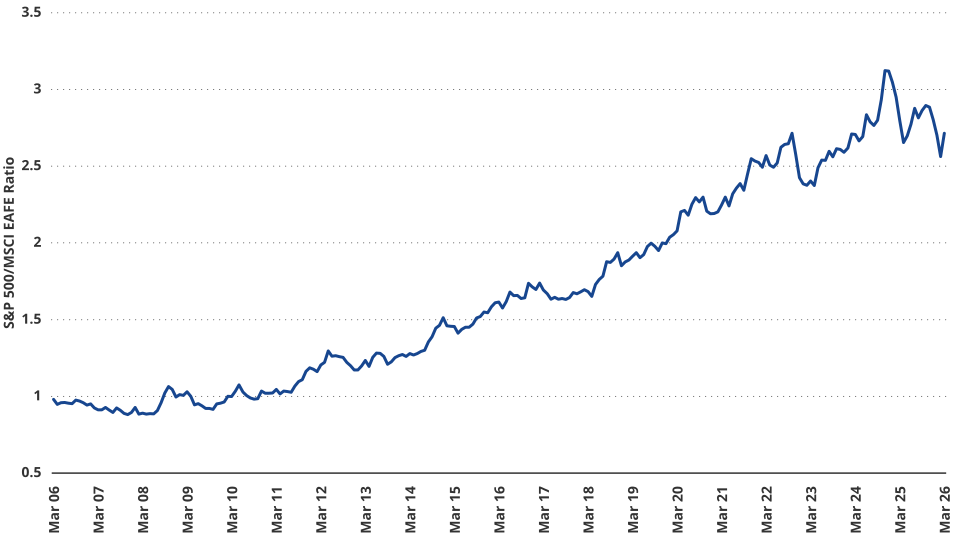
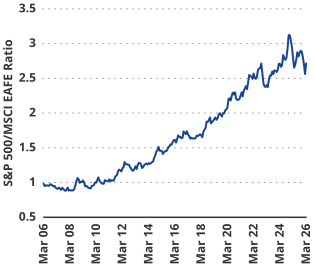
Source: Morningstar as of 02/28/2026. Past performance is no guarantee of future results. Index performance is not representative of fund performance. It is not possible to invest directly in an index.
Are Sell-Side Analysts Biased and Does It Matter?
The question of whether sell-side analysts are structurally biased is a fair one, but it targets the wrong metric. VEFA does not rely on analyst ratings or absolute opinion. It tracks the direction of revisions, which means the question of whether analysts skew optimistic is not the relevant one. The relevant question is whether their views are improving or deteriorating, and on that dimension the signal has been consistent.
A stock being upgraded by its analyst coverage tells you something different than one sitting at a longstanding consensus buy with no recent activity. VEFA captures that directional shift across five metrics simultaneously: earnings estimates, price targets, sales forecasts, cash flow projections and ratings changes. Whether any individual analyst is optimistic or pessimistic in absolute terms is not the variable that drives the strategy.
It is also worth noting that analyst estimates are public, timestamped and tracked against outcomes by independent data providers. Analysts who miss consistently tend to lose institutional votes and coverage mandates over time. That creates a degree of accountability that reinforces the integrity of the underlying signal, even if it does not guarantee accuracy in any individual case.
How Does VEFA Fit in a portfolio?
VEFA is designed to serve as a core international developed market equity allocation. Because the index is built with risk constraints that keep sector, country and factor exposures close to the MSCI EAFE benchmark, it can replace or complement a standard EAFE allocation with the added benefit of a systematic sentiment tilt.
For investors who currently hold passive EAFE exposure and are looking for a way to potentially enhance returns without significantly changing their risk profile, VEFA offers a straightforward path. It can also serve as a complement alongside active international managers, providing a transparent, rules-based layer of factor exposure.
How to buy VanEck ETFs?
Past performance is not an indication, or guarantee, of future results. Hypothetical or model performance results have certain inherent limitations. Unlike an actual performance record, simulated results do not represent actual trading, and accordingly, may have undercompensated or overcompensated for the impact, if any, of certain market factors such as market disruptions and lack of liquidity. In addition, hypothetical trading does not involve financial risk and no hypothetical trading record can completely account for the impact of financial risk in actual trading (for example, the ability to adhere to a particular trading program in spite of trading losses). Hypothetical or model performance is designed with benefit of hindsight.
Related Insights


Related Insights
01 April 2026
A new approach to international investing, VEFA uses analyst sentiment to target companies with improving outlooks, offering a rules-based, risk-aware alternative to passive and active EAFE strategies.
24 March 2026
India's digital economy is shifting from IT exports to domestic consumption. DGIN's index rebalances toward fintech, e-commerce, and telecom to capture that growth.
19 March 2026
VanEck has over three decades of experience in emerging markets spanning equity and fixed income. Explore our full suite of broad EM and targeted single-country solutions.
13 March 2026
China’s next growth phase is driven by advanced manufacturing, electrification and AI infrastructure. The ChiNext Index provides targeted exposure to these industrial innovators.
18 December 2025
Get your portfolio ready for 2026 with detailed insights from VanEck’s investment team about the factors driving risk and returns in their respective asset classes.