VNM ETF: Question & Answer
28 December 2021
Read Time 6 MIN
Vietnam’s economy has grown rapidly over the past three decades, driven by a series of gradual reforms that have liberalized its markets and opened the doors to foreign investment, driving GDP growth of approximately 6.4% per year since 1985.1 Known for its relatively young population and strong manufacturing sector, the country has been a primary beneficiary of increased globalization, with multiple international free trade agreements with global trade blocs. Economic growth, a burgeoning middle class and attractive stock market returns have made Vietnam an attractive investment for foreign investors. This blog is intended to answer frequently asked questions about investing in Vietnam, why investors might consider adding exposure to the country within an emerging markets portfolio and the VanEck Vietnam ETF (VNM).
- What is the equity capital market structure in Vietnam?
- How big is the Vietnamese stock market?
- What is driving economic growth in Vietnam?
- How do trade tensions between the U.S. and China impact Vietnam?
- Is Vietnam an emerging market?
- What are foreign ownership limits?
- How can foreign investors access the Vietnamese market?
- How to buy VanEck ETFs?
What is the equity capital market structure in Vietnam?
Vietnam has two official stock exchanges: Ho Chi Minh Stock Exchange (HOSE) and the Hanoi Stock Exchange (HNX). Before becoming stock exchanges, these were stock trading centers up until 2007 and 2009, respectively. In addition the unlisted Public Companies Market (UPCoM) was founded in 2009, and it was set up to encourage unlisted firms to participate in the securities market, with a view that those on UPCoM may later transfer onto the main markets.
HNX currently has 344 listed securities and HOSE has 415. The HOSE drives most of the trading in Vietnam despite only having a little over 70 more listed securities. Over the last 12 months, HOSE comprised an average of 82% of the total volume traded between both exchanges. Foreign participation, defined as the volume of buys and sells by foreign investors, is relatively low. The main reason can be attributed to foreign ownership limits (FOL) that restricts the amount of certain shares foreigners can purchase.
| Hanoi Stock Exchange | Ho Chi Minh Stock Exchange | |||||||
| Date | Mkt Cap ($bn) |
Volume | Foreign Buy Volume as % of HNX Volume | Foreign Sell Volume as % of HNX Volume | Mkt Cap ($bn) |
Volume | Foreign Buy Volume as % of HOSE Volume | Foreign Sell Volume as % of HOSE Volume |
| 11/30/2021 | 19.47 | 3,740,000,000 | 0.44% | 0.89% | 253.14 | 22,320,000,000 | 3.26% | 4.24% |
| 10/29/2021 | 17.20 | 2,700,000,000 | 0.74% | 1.08% | 246.17 | 14,470,000,000 | 4.79% | 5.61% |
| 9/30/2021 | 18.31 | 3,400,000,000 | 0.78% | 1.09% | 225.60 | 13,470,000,000 | 4.20% | 5.14% |
| 8/31/2021 | 17.43 | 3,550,000,000 | 1.38% | 1.42% | 220.38 | 14,710,000,000 | 4.21% | 4.84% |
| 7/30/2021 | 18.02 | 2,520,000,000 | 1.44% | 1.10% | 214.04 | 12,500,000,000 | 6.33% | 5.29% |
| 6/30/2021 | 16.93 | 3,430,000,000 | 0.71% | 1.64% | 229.62 | 15,250,000,000 | 4.48% | 5.41% |
| 5/31/2021 | 16.45 | 2,720,000,000 | 0.66% | 1.15% | 215.97 | 13,210,000,000 | 4.03% | 5.70% |
| 4/30/2021 | 14.67 | 3,300,000,000 | 0.85% | 0.90% | 201.57 | 13,760,000,000 | 4.78% | 5.11% |
| 3/31/2021 | 14.11 | 3,650,000,000 | 0.47% | 0.78% | 193.50 | 13,640,000,000 | 5.23% | 7.60% |
| 2/26/2021 | 11.85 | 1,660,000,000 | 1.16% | 0.96% | 189.66 | 7,820,000,000 | 5.67% | 7.90% |
| 1/29/2021 | 10.40 | 3,100,000,000 | 0.93% | 1.30% | 171.18 | 14,050,000,000 | 5.44% | 6.08% |
| 12/31/2020 | 8.33 | 2,120,000,000 | 0.75% | 1.34% | 176.68 | 12,470,000,000 | 4.59% | 6.16% |
Source: Bloomberg, HNX and HOSE.
How big is the Vietnamese stock market?
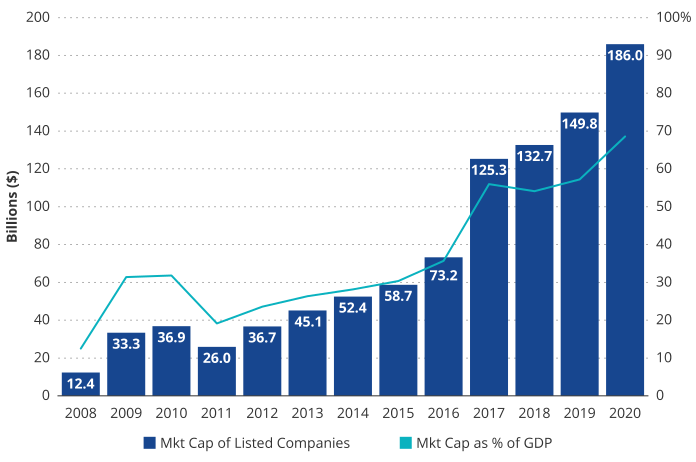
The stock market in Vietnam is relatively young and small compared to other economies. The stock market capitalization of listed domestic companies as a percent of GDP increased rapidly from 12.5% in 2008 to 69.6% in 2020, according to the World Bank. Despite a high growth rate, the relative size of Vietnam’s stock market is still much smaller than that of other much larger economies such as Japan (135.0% in terms of 2020 market cap to GDP %), Malaysia (129.7%), South Korea (133.5%) and Thailand (104.2%).2
Vietnam Stock Market Growth
Source: World Bank.
Vietnam has been growing at a much higher rate than its peers since 2008, as seen in the below table, and is the only frontier market on this list.
| Countries | Market cap of listed domestic companies (% of GDP) 2008-2020 Change |
Market capitalization of listed domestic companies (current US$) 2008-2020 Change |
| Japan | 121% | 116% |
| Korea | 197% | 362% |
| Malaysia | 58% | 131% |
| Thailand | 206% | 427% |
| Vietnam | 450% | 1404% |
Source: World Bank.
What is driving economic growth in Vietnam?
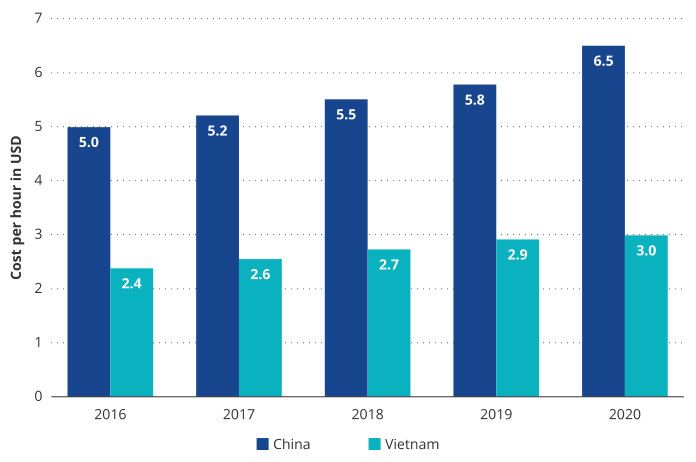
Several long term dynamics that have kept Vietnam’s GDP growing at approximately 6.4% per year since 1985. Its economic growth may be linked to the country’s abundant natural resources and strong manufacturing base, which has led to a robust export-based economy that is also supported by healthy domestic demand. As China’s economy has matured into a more consumer-led, services oriented economy with greater focus on higher value manufacturing, Vietnam has been a primary beneficiary, thanks in part to its lower labor costs.
Manufacturing Labor Costs Per Hour: China vs. Vietnam
Source: Statista.com.
Vietnam also announced earlier this year major plans to improve its infrastructure, committing $119 billion for infrastructure investment over the next four years.3 Demographics are also helping fuel the long-term, sustained growth as businesses have the opportunity to take advantage of the young labor force to push its economic growth.
How do trade tensions between the U.S. and China impact Vietnam?
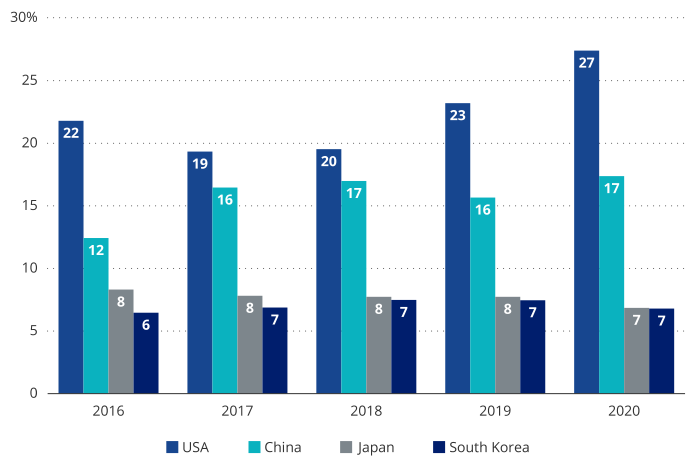
Vietnam is generally considered a beneficiary of the trade tension between the U.S. and China as it adapted and ramped up manufacturing, attracting foreign investors and increasing exports to the U.S. Over the last several years, Vietnam’s exports have experienced high growth as it exported 45% to these two countries in 2020, compared to about 34% in 2016, with the U.S. being its #1 export partner.
Vietnam's Primary Exports Relationships
Source: United Nations COMTRADE database.
Not only are exports a good measurement of what Vietnam has been doing as U.S./China tensions continues, but it has also resulted in businesses working with suppliers to find alternate countries (like Vietnam) to bypass some of the tariffs. Vietnam has clearly benefitted from the trade war and is emerging as an alternative preferred location for companies.
Is Vietnam an emerging market?
Vietnam is considered, by most global indices, a frontier market. It has a small but growing equity market, as shown above, that has been trying to transition from frontier to emerging market status. The Vietnamese government has been keen on pushing for that transition as it already meets some of the criteria for being an emerging market and continues working on attracting foreign capital to maintain its long-term growth. The government expects to be upgraded to emerging market status by 2025 and has been actively cooperating with global index providers to find a solution for a possible upgrade, as it is the largest market within the frontier market universes and one of the best structural growth stories.
What are foreign ownership limits?
Vietnam’s government opened its economy to foreign investment in 1986, and has continued to maintain a level of control over how much foreigners can invest in local businesses, although restrictions have gradually been eased over time. Foreign ownership limits (FOL) restrict the level of foreign ownership in a particularly company. If a company has reached its FOL, no further investment can be made by foreigners until the level of foreign ownership decreases. These companies are generally excluded from global indices as a result.
The market calculates total foreign ownership in a security as the aggregate holdings of foreign investors and locally incorporated institutions that have more than 50% of capital owned by foreign investors. In general, foreign investors may, in aggregate, own up to 100% of a public company. However, FOLs may be lower in certain instances. For example, companies in certain sectors or industries specified by the government, such as banking, are subject to lower FOLs.
How can foreign investors access the Vietnamese market?
The VanEck Vietnam ETF (VNM) provides access to the largest, most liquid companies that are locally listed in Vietnam. It also provides exposure to companies that generate over 50% of their revenues from Vietnam, including offshore names that have high exposure to the Vietnamese economy.
How to buy VanEck ETFs?

To receive more Emerging Markets Equity insights, sign up in our subscription center.
Related Insights

Related Insights
06 October 2025
18 December 2025
Get your portfolio ready for 2026 with detailed insights from VanEck’s investment team about the factors driving risk and returns in their respective asset classes.
06 October 2025
Vietnam is advancing ambitious market reforms and economic integration. These changes may accelerate its path to emerging market status and broaden global investor interest.
31 July 2025
Portfolio Manager Ola El Shawarby shares firsthand insights from her multi-city China trip, exploring innovation, shifting consumer trends, and the forces reshaping China’s economy.
26 June 2025
Amid global uncertainty, Brazil stands out for its macro resilience and strong domestic sectors, offering attractive opportunities for selective investors despite ongoing risks.
14 May 2025
India is accelerating in 2025—soaring consumption, fintech disruption, and record infrastructure spending are turning it into the hottest emerging market.