Gold in 2025: A New Era of Structural Strength and Enduring Appeal
07 November 2025
Read Time 9 MIN
Key Takeaways:
- Central banks are buying gold at record levels, signaling long-term diversification away from the USD.
- Gold miners surged 120% YTD but remain undervalued, with strong margins and improved capital discipline.
- Structural trends point to gold potentially reaching $5,000/oz by 2030 as demand and uncertainty grow.
A Brief Historical Context
Gold has always been more than a commodity. Across centuries, it has functioned as a universal store of value, a hedge against uncertainty, and a symbol of enduring wealth. Historically, gold’s role in global portfolios has evolved alongside monetary regimes — from the classical gold standard to today’s fiat-dominated system. Each transition, whether marked by inflationary pressures, financial crises, or geopolitical turbulence, has reaffirmed the metal’s resilience.
Over the past decade, gold has transitioned from a cyclical safe haven to what many analysts now describe as a structural necessity in diversified portfolios. Its performance through multiple economic cycles — the global financial crisis, pandemic-era stimulus, and post-2020 inflationary pressures — has underscored its ability to preserve value when conventional assets falter.
The Current Landscape: Record Highs and Renewed Demand
Gold and gold equities have dominated 2025 performance, outpacing all asset classes.
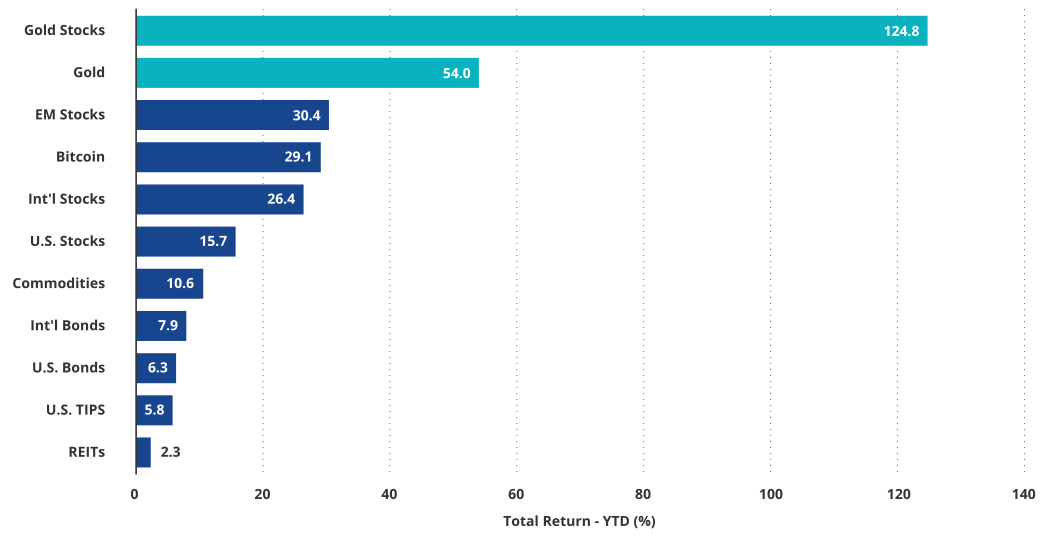
Source: Morningstar. Data as of October 9, 2025. Past performance is not indicative of future results. “Gold Stocks” represented by NYSE Arca Gold Miners Index. “U.S. Stocks” represented by the S&P 500 Index. “EM Stocks” represented by MSCI Emerging Markets Index. “REITs” represented by FTSE NAREIT All Equity REITs Index. “International (Int’l) Stocks” represented by MSCI AC World ex USA Index. “Commodities” represented by Bloomberg Commodity Index. “U.S. TIPS” represented by Bloomberg U.S. TIPS (1-3 Year) Index. “U.S. Bonds” represented by Bloomberg U.S. Aggregate Bond Index. “International (Int’l) Bonds” represented by Bloomberg Global Aggregate ex U.S. Index. Index performance is not representative of strategy performance. It is not possible to invest directly in an index.
As of late 2025, gold trades above $4,000 per ounce, having gained over 50% year-to-date, making it a top-performing major asset class worldwide.
This rally, while remarkable, is not without historical precedent—similar surges occurred in the 1970s and 1980s during periods of currency debasement and heightened geopolitical stress.
Gold’s recent ascent is fueled by the convergence of two dominant forces:
- Persistent central bank accumulation, particularly from emerging markets, marking one of the strongest official buying streaks in modern history.
- A resurgence of Western investor participation, after years of under-allocation to precious metals.
Together, these sources of demand have created a structurally stronger market base than in previous bull cycles.
What’s Driving the Price of Gold
Several key themes define the current gold narrative:
1. Central Bank Buying and De-dollarization
Central banks have become consistent net buyers of gold, marking one of the strongest buying streaks in modern history.
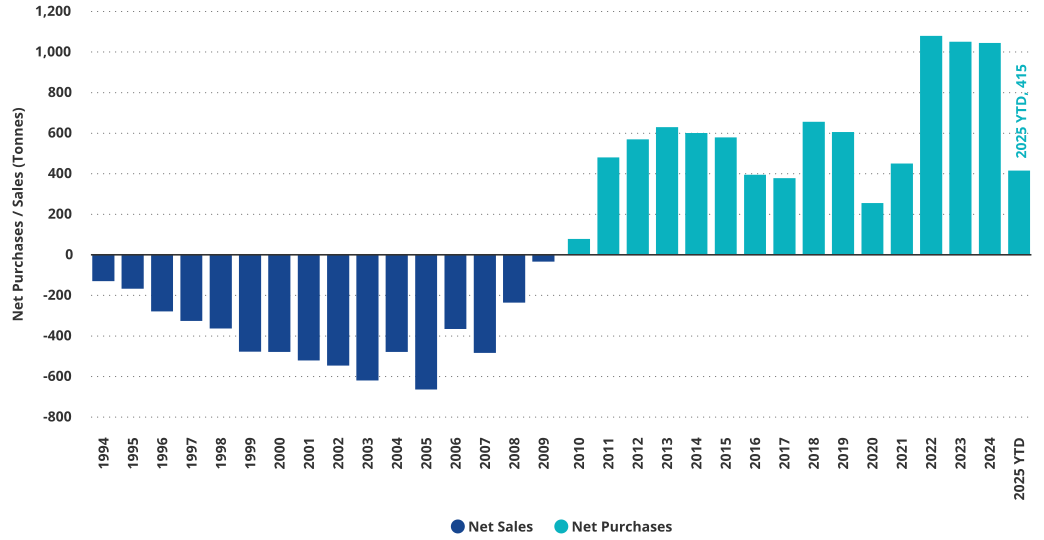
Source: World Gold Council. Data as of June 2025. For illustrative purposes only.
Since 2022, central banks have purchased over 1,000 tonnes of gold annually — roughly twice the decade-long average. Emerging economies — notably China, Turkey, Poland, and India — are leading this trend, signaling a long-term diversification away from the U.S. dollar. This behavior underscores a global realignment in currency reserves: as the dollar’s share of official reserves declines, gold’s share continues to rise as a neutral, non-sovereign store of value.
Gold’s rise parallels a gradual de-dollarization trend as central banks diversify reserves.

Source: Deutsche Bank. Data as of June 30, 2025. For illustrative purposes only. Past performance is no guarantee of future results.
2. The Return of Western Investors
After several years of ETF outflows, Western investment demand for gold has decisively returned in 2025, with inflows into gold ETFs strengthening month over month. Gold ETF holdings remain well below previous peaks, suggesting that investor engagement with the asset class has room to normalize relative to historical levels.
After years of outflows, gold ETF holdings are rising again, signaling renewed Western demand.
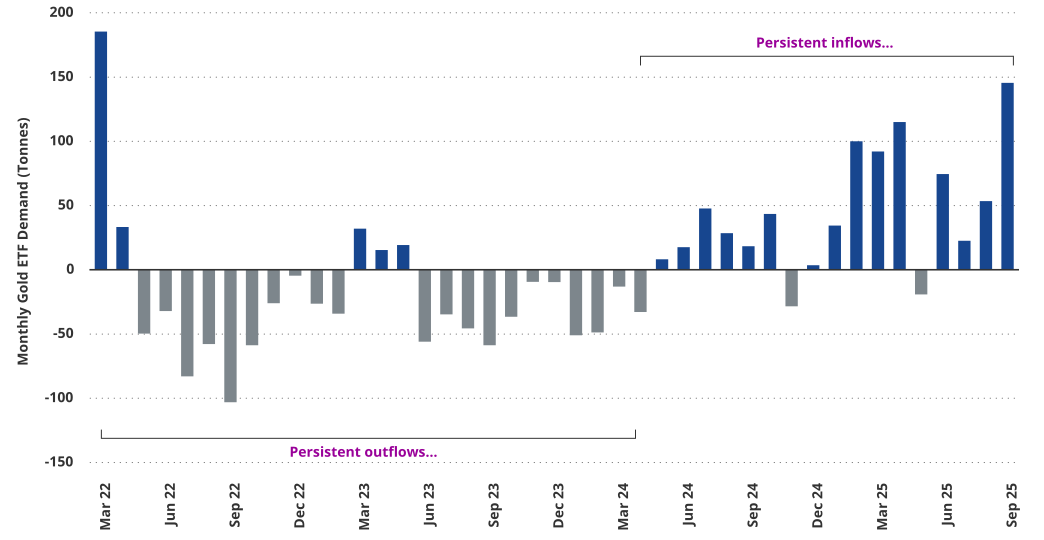
Source: World Gold Council. Data as of September 2025. For illustrative purposes only.
3. Geopolitical and Macroeconomic Catalysts
Geopolitical tension, rising global debt burdens, and policy uncertainty have contributed to a “catalyst-rich environment” for gold. Investors are responding not just to episodic crises, but to a longer-term structural erosion of confidence in fiat systems. As one strategist put it, we are witnessing “a shift in currency regime unlike anything in a century” — echoing the transition from the British pound to the U.S. dollar as the global reserve currency.
Gold Equities and Miners: Undervalued Leverage
Gold miners have staged a spectacular rebound in 2025, rising over 120% year-to-date, and yet remain fundamentally undervalued relative to the metal itself.
Gold’s strength keeps nearly all producers profitable.
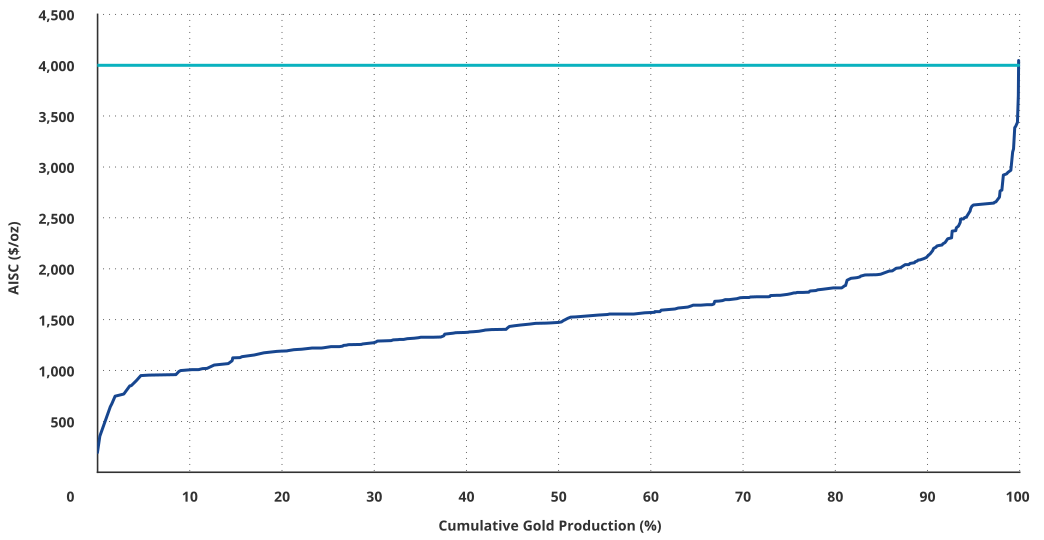
Source: World Gold Council. Data as of June 30, 2025. For illustrative purposes only.
With all-in sustaining costs averaging around $1,600/oz, nearly every producer remains profitable at current prices near $4,000/oz, resulting in record margins across the industry. Miners are displaying improved capital discipline and stronger balance sheets—a key differentiator from previous cycles when high prices often led to overspending.
Portfolio Perspective: Gold as a Core Allocation
Gold’s low correlation to equities and bonds reinforces its role as a powerful portfolio diversifier. Historically, gold has generated positive returns during every major risk event of the past 25 years — from the Global Financial Crisis to the 2025 tariff wars.
Over the past 25 years, gold has delivered cumulative returns exceeding 1,300%, outpacing global bonds and rivaling major equity indices. The metal’s resilience across cycles underscores its role as both a diversifier and long-term store of value.
25-Year Cumulative Returns of Gold vs. Other Asset Classes

Source: FactSet, VanEck. Data as of September 2025. Gold ($/oz) represented by LBMA PM Gold Price; U.S. Stocks represented by S&P® 500 Index; Global Stocks represented by MSCI World Index; Global Bonds represented by Bloomberg Global Aggregate Index. Past performance is no guarantee of future results. Index performance is not representative of strategy performance. It is not possible to invest directly in an index.
While allocations vary by investor type, some investment professionals view a modest allocation to gold—often cited in the 5–10% range — as one potential way to enhance diversification by balancing bullion and gold equities for both defensive stability and growth exposure.
Gold Investing Outlook and Why Gold Could Go Higher in 2026
Recent developments are evaluated for their potential impact on gold prices through 2025 and in the longer term, based on prevailing and emerging market conditions.
Short-term Forecast: 2026 Gold Predictions
Gold has the potential to trade even higher in 2026. In recent years, strong rallies, such as the one gold has recently been enjoying, have often been followed by periods of consolidation around an established, higher level, with the metal trading in a sideways pattern until a new catalyst emerges to drive prices even higher. 'Gold tends to outperform during later phases of inflationary cycles, when investors seek protection from social, geopolitical, and financial instability.
Dividing the Bull Market into Two Halves
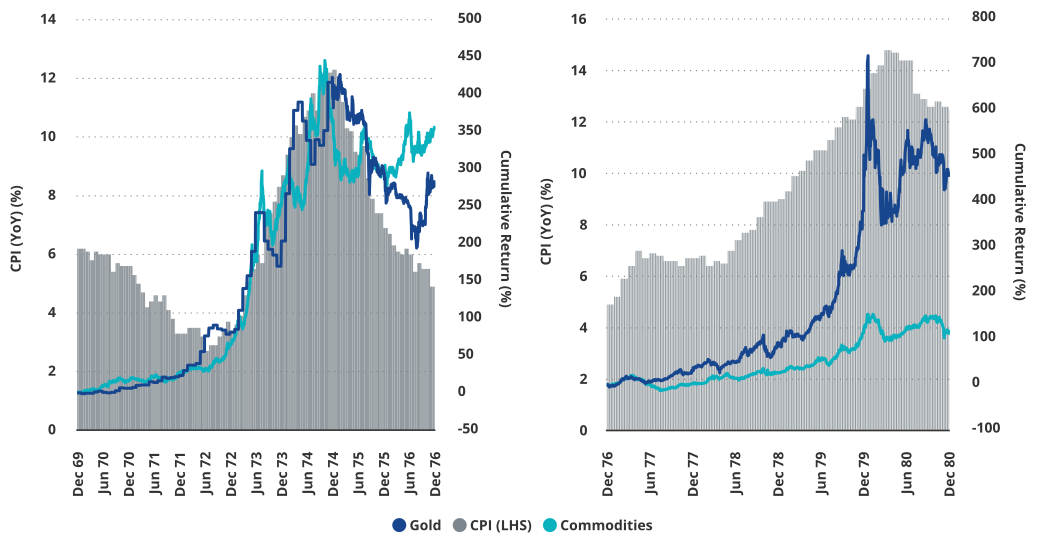
Source: Bloomberg, VanEck. “Commodities” represented by the Bloomberg Commodity Index. Past performance is no guarantee of future results. Any projections, forecasts and other forward-looking statements are not indicative of actual results, are for illustrative purposes only, are valid as of the date of this communication, and are subject to change without notice. Past performance is no guarantee of future results. Index performance is not representative of strategy performance. It is not possible to invest directly in an index.
Looking forward, gold is well positioned to continue its rally, especially as more Western investors continue their return to the market. The ongoing uncertainty surrounding tariffs, along with continued inflationary pressures and geopolitical risks, are likely to further bolster gold's appeal as a hedge against global market volatility. With this backdrop, gold prices could break through their inflation-adjusted highs and climb to new trading ranges above $4,000 per ounce in the near term.
However, as our CEO recently noted, gold’s long-term case stays strong as central bank demand, fiscal strain, and inflation risk continue to support the metal.
Side Note: For Miners, It’s About More Than Just the Gold Price
A rising gold price environment has historically been accompanied by strong performance by gold equities. The sector outperformers must also demonstrate that they are fundamentally positioned and have a sound strategy that will translate higher gold prices into improved cash flow and higher returns, which will deliver growth. Organic growth does not come easy in the gold sector. Finding new gold deposits, or defining/expanding existing ones, is a difficult, lengthy, and capital-intensive process. Most senior and mid-tier companies struggle to simply replace their annual production. To significantly expand their depleting reserve and resource base, companies generally must acquire other companies or assets. All things equal, the more advanced a project is, the higher its valuation and the faster the company can deliver growth.
Gold stocks’ leverage to the gold price, combined with their attractive valuations relative to the broader equity markets, and their low correlation with most other asset classes, should lead to a re-rating of the sector as investors look for a safer place to rotate capital to and as they look to diversify their portfolios.
5 Year Forecast: Gold Price Forecast for 2026-2030
Gold was built for the shifting trends currently unfolding in the global economy: inflation, war, uncertainty and growing financial instability. 'As of late 2025, gold continues to outperform major equity benchmarks, including the S&P 500, over multiple time horizons. In the past 12 months alone, gold has more than doubled the returns of the S&P 500 Index.
As these trends continue to play out and reshape the global economic order in the coming years, gold has the potential to ascend toward $5,000 per ounce.
Long-term Gold Forecast: 2030 & Beyond
Longer term, investors should expect gold to continue to act as a hedge against broader market volatility and uncertainty. Since 2008, gold has outperformed U.S. stocks and Treasuries during the most notable of market crises. This reflects gold’s role as a hedge against financial risks and safe haven amid uncertainty. Some of VanEck’s own experts suggest that the case for gold may grow stronger due to the U.S. dollar’s reserve status potential decline, and emerging market central bank’s gold holdings continue to rise.
Gold’s Renaissance
Gold’s 2025 performance is not a speculative anomaly — it’s a reflection of shifting global fundamentals. In an era defined by currency realignment, fiscal excess, and geopolitical volatility, gold has reasserted its historic role as the ultimate store of value and a cornerstone of prudent portfolio construction.
For investors still asking, “Did I miss it?” — the answer remains clear:
The gold story is far from over.
