A Golden Year, with More Leverage Ahead
14 January 2026
Read Time 7 MIN
Monthly gold market and economic insights from Imaru Casanova, Portfolio Manager, featuring her unique views on mining and gold’s portfolio benefits.
Key Takeaways:
- Gold posted its strongest annual gains in decades, driven by central banks and investors.
- Gold stocks surged in 2025 but remain undervalued versus history and bullion.
- Strong margins and low allocations support continued gold stock outperformance in 2026.
A Banner Year for Gold
What a year for gold! The metal closed at an all-time high of $4,533.21 on December 26. Some profit taking was not surprising, given gold’s spectacular performance in 2025, which pushed prices lower during the final week of the year to close at $4,319.37 per ounce on December 31. Gold finished the year up 64.58%.
The drivers behind this strength were twofold: central banks around the world continued net purchases of gold near record levels as they advance their de-dollarization agenda; and investors more broadly increasing their gold exposure to hedge against market uncertainty, volatility, and geopolitical risk. Gold also benefited from a growing need to diversify and protect portfolios globally, particularly as real rates declined and gold became a more attractive investment.
Gold Stocks Steal the Spotlight
Gold performance in 2025 was impressive—its best annual gain since 1979. But gold stocks stole the spotlight, more than doubling bullion’s gains. The MarketVector Global Gold Miners Index (MVGDXTR)1 and the NYSE Arca Gold Miners Index (GDMNTR)2 were up 163.2% and 158.3%, respectively, during the year.
After years of underperformance, gold mining stocks finally benefited from a gold rally that included the Western investor as one of the main driving forces—unlike recent years, when central bank demand was largely behind gold’s strength. As investors returned to gold, their appetite extended to gold stocks in search of a leveraged play. This flow of capital, while still modest relative to the broader equity markets, had a significant impact on the deeply oversold and comparatively tiny gold equity universe, which we estimate increased to just around $1 trillion of combined market cap at the end of 2025.
Valuations Still Compelling After the Re-Rating
Despite triple digit gains in 2025, we believe gold stocks could continue to outperform gold in 2026. Gold companies remain at historically low valuations based on most metrics. While stocks experienced a re-rating in the second half of 2025, this came after almost two decades of persistent de-rating.
Gold stocks are rebounding from very oversold levels, so even after last year’s rally, valuations remain attractive.
Gold Miners Price/Earnings Ratio
Gold miners’ price-to-earnings ratios remain below historical averages, even after the strong performance seen in 2025.
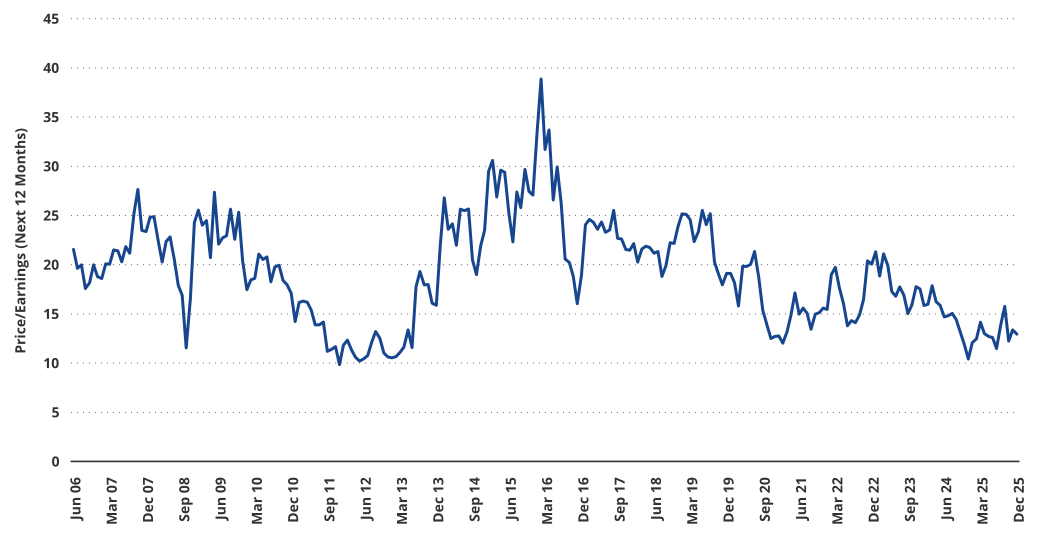
Source: FactSet. Data as of December 2025. "Gold Miners" represented by the NYSE Arca Gold Miners Index.
Gold & Precious Metals Miners versus Gold
Gold and precious metals mining equities continue to trade at lower levels relative to gold.
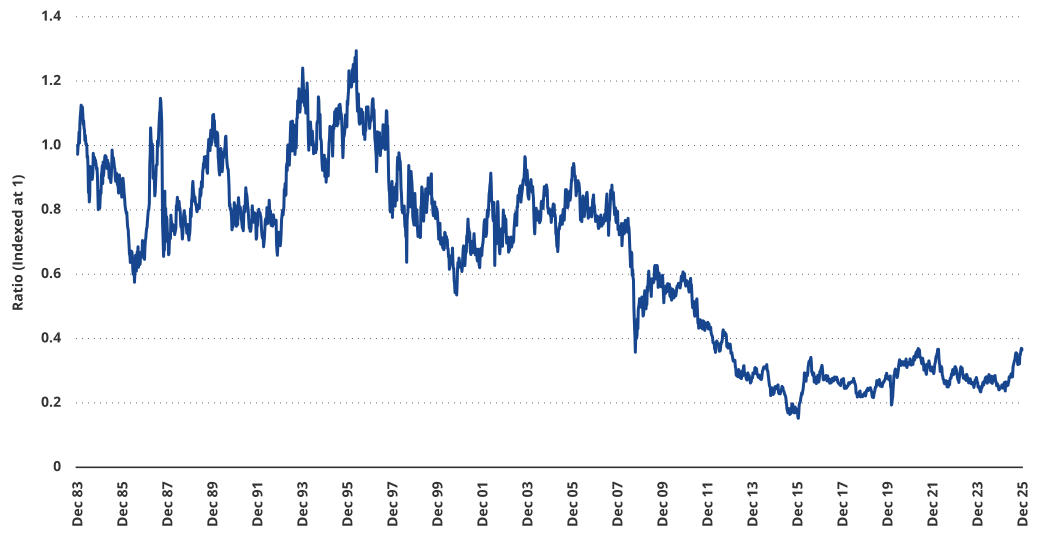
Source: Bloomberg. Data as of December 2025. “Gold & Precious Metals Miners” represented by the Philadelphia (PHLX) Gold/Silver Miners Index (TR)3. Past performance is not indicative of future results. It is not possible to directly invest in an index.
Room for Capital Rotation
Our outlook for higher gold prices in 2026 is supported by increasing investment demand for gold, which should also translate into investment demand for gold stocks.
As shown in the chart below, gold and precious metals remain a relatively small allocation within global portfolios. With only an estimated 1–2% of assets globally currently allocated to gold and gold stocks, there is plenty of room for increased gold exposure across global portfolios.
U.S. Precious Metals Fund Allocations (MF + ETF, Gold Equity + Gold Bullion)
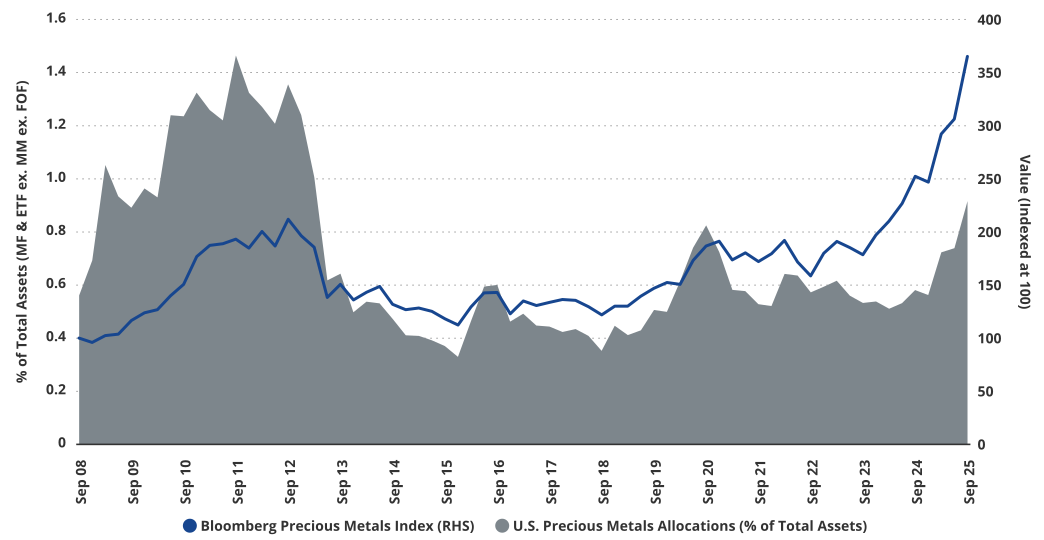
Source:Morningstar, VanEck. Data as of December 2025. Bloomberg Precious Metals Index (BCOMPR) tracks the performance of futures contracts for precious metals like gold and silver. Past performance is not indicative of future results. It is not possible to directly invest in an index.
While gold bullion may be the first stop for many investors, as they search for excess returns and look for alternatives to sectors with richer valuations, the gold stocks should emerge as a solid option. It won’t take much capital rotation to get gold stocks moving again in 2026. In addition, strong fundamentals should support further re-rating of the sector.
Leverage Works—Both Ways
In a rising gold price environment, the case for gold equities will be easy to make, especially after a firm demonstration of leverage in 2025. If gold goes up, gold stocks should go up even more—most market participants would agree. Historically, gold stocks have outperformed gold when the gold price increases and underperformed gold when the gold price decreases or is trading sideways/rangebound.
There is a case to be made, however, that even in an environment where gold prices are sustained—perhaps rangebound around or even slightly below these record levels, the gold stocks have the potential to continue to re-rate and outperform the metal.
Gold Price Assumptions Remain Conservative
We estimate that senior gold producers are trading at valuations that imply, on average, a gold price assumption of around $3,400 per ounce. This leaves ample room for valuations to increase as markets grow more confident that gold prices will remain near current spot levels of around $4,400 per ounce and as stocks progressively price in higher long-term gold price assumptions.
In this scenario, even if gold stays at current levels, the stocks could continue to post gains.
Record Margins Provide a Strong Cushion
Gold miners are enjoying record margins, by a long shot. For reference, at the peak of the last gold bull market in 2011, when the gold traded around $1,800 per ounce, average all-in-sustaining costs (AISC) were about $1,200 per ounce. In 2025, AISC for the sector was around $1,600 per ounce, compared to an average gold price of $3,440 per ounce.
Even the highest-cost producers are profitable at current spot prices, with more than 90% of all global gold production at AISC below $2,500 per ounce. This provides considerable runway for miners to maintain record levels of cash flow generation, even if gold prices were to decline.
Costs Likely to Rise—but Discipline Remains
We have a very positive outlook on gold prices, which is why we expect margins won’t compress materially in 2026. That said, we do anticipate higher AISC for the industry. Miners continue to focus on cost control and operational optimization to offset industry cost inflation. Another factor that can increase unit costs is the processing of lower grade ores leads to higher unit costs.
However, processing plants at major producers are operating at capacity, and as a group, the companies don’t appear to have plans to drop their cutoff grade. These cost control initiatives and production discipline give us comfort that costs won’t begin to spiral out of control. In addition, mine plans, reserve assumptions and project economics are being done at conservative gold price assumptions, significantly below spot prices.
Gold Price Itself Is a Cost Driver
With that said, certain elements of the cost structure remain outside of the miners’ control most significantly the gold price itself. Higher gold prices can contribute to higher demand for equipment, consumables, services, and labor, leading to industry-wide cost inflation. Higher gold prices can also strengthen foreign currencies in gold-producing countries, which in turn leads to higher U.S. dollar-denominated costs.
Beyond that, some costs are directly linked to the gold price such as royalties, production taxes, and profit-sharing agreements. The higher the gold price, the higher these costs will be. While the impact varies greatly from company to company, we estimate ballpark figures of about $100/oz increase in costs for every $1,000/oz increase in the gold price.
The gold price today is about $1,000/oz higher than the average price in 2025; this alone suggests costs in 2026 to be about $100/oz higher. Combined with industry-guided cost inflation of 3–5% annually, we expect total costs to rise approximately 10–12% versus 2025.
Outlook: Still Exceptionally Attractive
Companies will be providing 2026 annual production and cost guidance when they report their fourth-quarter 2025 results, starting at the end of February. The production cost sensitivity to the gold price appears to us to be well telegraphed. In our view, the sector remains exceptionally attractive.
Even if realized gold price doesn’t fully offset the costs increases this year, gold mining companies’ margins and free cash flow generation should be very robust and remain significantly above historical levels—while their stocks still trade at historically low multiples.
1 MarketVector Global Gold Miners Index (MVGDXTR) tracks the overall performance of companies involved in the gold mining industry.2 NYSE Arca Gold Miners Index (GDMNTR) is a modified market capitalization-weighted index comprised of publicly traded companies involved primarily in the mining for gold.3 Philadelphia (PHLX) Gold/Silver Miners Index tracks the performance of major companies involved in gold and silver mining.
Related Insights


Related Insights
10 March 2026
Gold miners are generating record margins and free cash flow as prices remain elevated. With disciplined capital allocation and costs below $2,000 per ounce, the sector appears well positioned for 2026.
10 February 2026
Gold price swings in January highlighted volatility, not weakness. Strong demand, central bank buying and improving miner fundamentals continue to support a durable long-term bull market in 2026.
18 December 2025
Get your portfolio ready for 2026 with detailed insights from VanEck’s investment team about the factors driving risk and returns in their respective asset classes.
09 December 2025
Gold rallied above $4,200 as markets shifted rate expectations. Record prices are driving disciplined mining-sector M&A, with the strongest opportunities in targeted regional consolidation.
18 November 2025
Gold’s rally above $4,000 shows strength amid tight supply and steady demand. Miners remain undervalued, offering potential opportunities if current market trends persist.