Gold Holds Firm as Junior Miners Regain Momentum
11 July 2025
Read Time 5 MIN
Monthly gold market and economic insights from Imaru Casanova, Portfolio Manager, featuring her unique views on mining and gold’s portfolio benefits.
Flight to Safety Drives Gold to New Highs
Investors once again sought shelter in gold during turbulent times. On June 13, gold prices climbed to a new all-time high, $3,432.34 per ounce, driven by escalating geopolitical tensions following Israeli strikes on Iranian nuclear sites.
As tensions around the conflict eased and U.S. trade negotiations evolved throughout the month, equity markets rebounded, supported by strong corporate earnings that bolstered investor confidence. The S&P 500,1 Nasdaq Composite2 and Dow Jones Industrial Average3 indices all closed at record highs on June 30. While gold was pressured by this shift in sentiment, it remained resilient, closing at $3,303.14 per ounce on June 30, a modest monthly gain of $13.89 per ounce (0.42%).
Gold Stocks Outperform Despite Flat Metal Prices
Gold mining equities, as represented by the NYSE Arca Gold Miners Index (GDMNTR),4 once again managed to post a gain (up 3.03% in June), despite gold’s flat performance and the broader equities’ strong recovery. In both 2023 and 2024, whenever gold prices drifted sideways without much momentum, gold equities tended to experience sharp declines (see charts below). This downturn also corresponded with declining investor interest in gold, as evidenced by outflows out of the gold bullion ETFs.

Source: Bloomberg. Past performance is no guarantee of future results. Index performance is not representative of strategy performance. It is not possible to invest in an index.
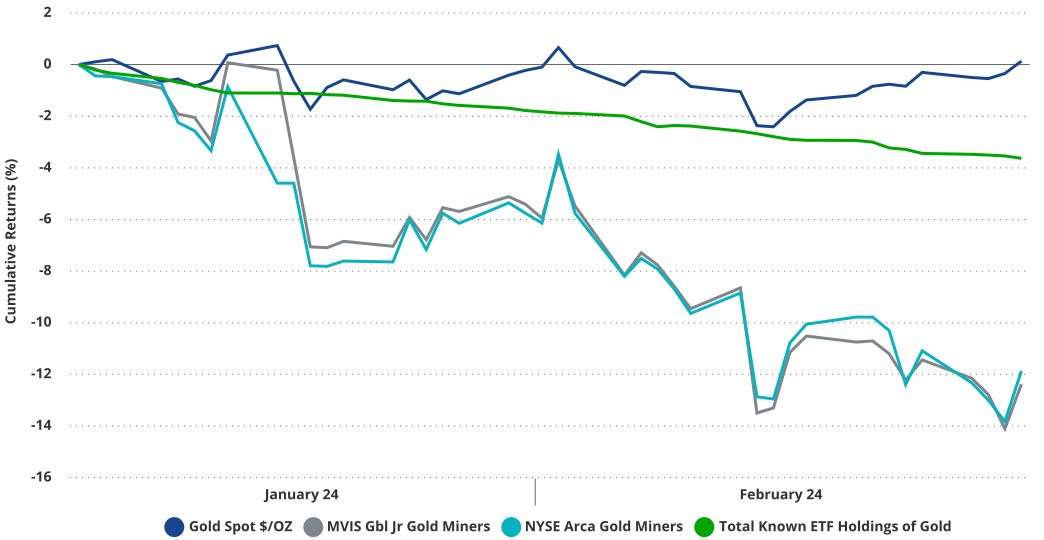
Source: Bloomberg. Past performance is no guarantee of future results. Index performance is not representative of strategy performance. It is not possible to invest in an index.
It is encouraging to see gold equities outperforming the metal since mid-April, despite relatively flat gold prices over the same period.
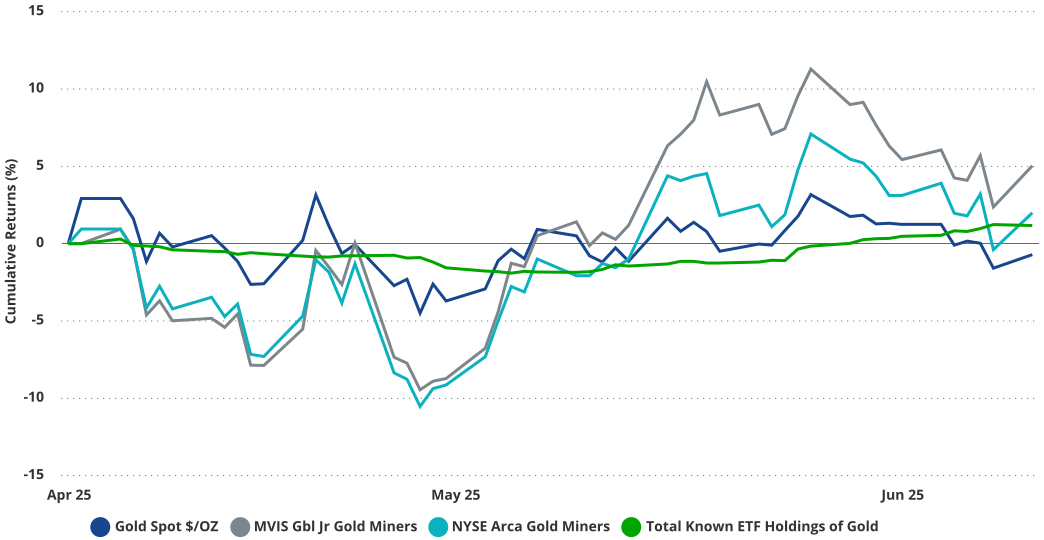
Source: Bloomberg. Past performance is no guarantee of future results. Index performance is not representative of strategy performance. It is not possible to invest in an index.
Why Gold Equities Are Gaining Momentum
Gold equities’ outperformance makes sense to us. Gold companies are realizing record margins at current gold prices – they don’t require higher gold prices to continue to deliver strong free cash flow, and with average all-in sustaining costs for the sector at around $1,600 per ounce, they can in fact stay profitable at a gold price much lower than the spot price today.
We believe another factor providing support for gold equities this year is western investment demand once again acting as an important driver of gold prices—unlike in 2023 and 2024 when central bank demand acted as the main driver. Central banks and Asian investors don’t typically buy gold equities, but western investors do; their return to the gold markets should continue to support a re-rating of the gold mining sector.
Despite their strong performance so far this year, gold equities are still trading at historically low valuations. Scotiabank estimates that for their universe of senior gold producers, current stock prices, on average, reflect a 30% discount to spot gold prices. Thus, continued outperformance of gold stocks relative to the metal, even in a flat gold price environment, is justified in our view. Meanwhile, the small-cap or junior gold mining companies, which have lagged gold and the larger companies in recent years, appear to be staging a comeback.
Our Approach to Investing Across the Gold Spectrum
We invest across the full spectrum of gold companies, seeking quality properties and capable management teams. Our top positions consistently execute well on their operations and growth strategies. However, there is also significant value to be found in companies that rarely show up in our top holdings. Junior developers, companies in early stages of development ranging from early drilling to detailed engineering, don’t have any mines in production or generate revenues. There are hundreds of such companies listed mainly on Canadian and Australian stock exchanges with projects scattered around the world. They are credited with 60% to 70% of all significant gold discoveries globally.
A junior developer becomes investable for us when it demonstrates the potential to either:
- Become an attractive acquisition for a mid- to large-cap producer, or
- Develop a mine that forms the core of a newly emerging producer.
We prefer companies with at least two-million ounces of mineable gold and favorable geology, metallurgy and engineering characteristics, as well as a sound geopolitical setting. We maintain smaller portfolio positions in these companies because they are not as liquid and are more speculative than their larger producing peers.
Valuation and M&A Tailwinds for Junior Developers
Currently, there are 25 junior developers that meet our investment criteria. While we have frequently commented on the attractive valuations of the producers, it is noteworthy that the developers look even cheaper. One metric we use in our evaluation of these companies is Total Acquisition Cost (TAC) which is calculated as the sum of the estimated construction capital, life-of-mine operating and sustaining costs and market cap per ounce of mineable resource. We estimate that the companies in our junior developer universe carry an average TAC of $1,608 per ounce. Once built, they will make money at gold prices above $2,000 per ounce and become cash machines at current prices north of $3,000.
Total Acquisition Cost/Ounce
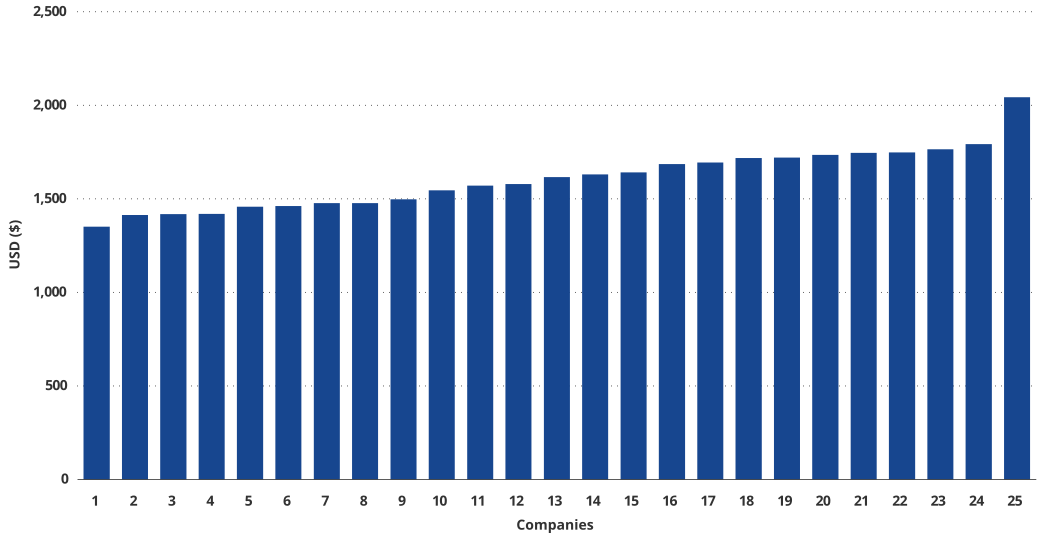
Source: VanEck, June 2025.
Whether we hold such companies in our portfolio depends on their relative valuations and how they rank on a number of factors, with their development timeline increasingly becoming more important for our selection. Investors and acquirors today appear to have little patience for the long permitting times that, unfortunately, have become common across the mining industry. The stocks seem to perform best early when drilling new ounces and later when reaching permitting/ financing/construction milestones.
Notably, sentiment seems to be shifting. From 2021 to 2023, junior developers underperformed the GDMNTR by 3.2% annually, with only one or two acquisitions per year. In 2024, there were four acquisitions at premiums ranging from 29% to 67% and the group of 25 outperformed by 36%. So far in 2025, they are up 14%, with two acquisitions already completed.
This momentum, combined with plenty of free cash flow and higher valuations, should support increased M&A activity in the gold mining industry as companies are much better equipped to advance their growth strategies. Junior companies could be the main beneficiaries in the current gold cycle.
1S&P 500 Index is widely regarded as the best single gauge of large-cap U.S. equities. The index is a float-adjusted, market-cap-weighted index of 500 leading U.S. companies from across all market sectors including information technology, telecommunications services, utilities, energy, materials, industrials, real estate, financials, health care, consumer discretionary, and consumer staples. 2NASDAQ Composite Index is a broad-based market index that includes more than 3700 stocks listed on the Nasdaq stock exchange. 3Dow Jones Industrial Average® is a price-weighted measure of 30 U.S. blue-chip companies. The index covers all industries except transportation and utilities. 4NYSE Arca Gold Miners Index (GDMNTR) is a modified market capitalization-weighted index comprised of publicly traded companies involved primarily in the mining for gold.
Related Insights

Related Insights
09 December 2025
10 February 2026
Gold price swings in January highlighted volatility, not weakness. Strong demand, central bank buying and improving miner fundamentals continue to support a durable long-term bull market in 2026.
14 January 2026
Gold hit record highs in 2025 as central banks and investors boosted demand. Mining stocks outpaced bullion, and despite sharp gains, attractive valuations and strong margins point to more upside in 2026.
18 December 2025
Get your portfolio ready for 2026 with detailed insights from VanEck’s investment team about the factors driving risk and returns in their respective asset classes.
09 December 2025
Gold rallied above $4,200 as markets shifted rate expectations. Record prices are driving disciplined mining-sector M&A, with the strongest opportunities in targeted regional consolidation.
18 November 2025
Gold’s rally above $4,000 shows strength amid tight supply and steady demand. Miners remain undervalued, offering potential opportunities if current market trends persist.