Green Bonds 101: What Are Green Bonds and How Do They Work?
24 September 2026
Read Time 10+ MIN
Key Takeaways:
- Green bonds function like conventional bonds but require proceeds to fund qualified environmental projects, allowing investors to invest sustainably in their core bond portfolios without materially altering their portfolio's risk and return profile.
- The global green bond market has surpassed $4 trillion in cumulative issuance across governments, development banks, and corporations.
- United States ranks as the largest single-country issuer with $657 billion in cumulative issuance since 2007.
Green bonds are issued by governments, development banks, and corporations to raise capital for projects with defined environmental benefits. The proceeds often flow to long-duration physical assets. Examples include power generation and transmission infrastructure, energy-efficient grids, clean transportation networks, water treatment facilities, and green buildings.
The scale of the green bond market reflects the scale of need: decarbonizing energy systems, expanding urban infrastructure, and building climate resilience require sustained long-term capital investment that public budgets alone cannot provide. Green bonds have become an important avenue for directing private capital toward infrastructure with measurable environmental outcomes through an instrument that institutional investors can hold, trade, and benchmark like any other bond.
What Is a Green Bond?
A green bond is a bond whose proceeds are committed in advance to qualified projects with an environmental benefit. Unlike a regular corporate bond, where proceeds go towards general corporate purposes, the issuer of a green bond reports on how the money was used and whether the intended environmental outcomes were delivered. In most cases, the credit risk sits with the issuer; repayment depends on the issuer's creditworthiness rather than on the performance of the individual project.
Most green bonds carry the same credit risk profile as a conventional bond from the same issuer. This structural similarity is the practical point for investors because the risk and return drivers are the same as those of a conventional bond from the same issuer. Green bonds may allow investors to “green” their fixed income allocation without significantly altering the risk and return profile of their portfolio.
- Purpose. Proceeds are earmarked in advance for qualified environmental projects, and the issuer reports on how the money was spent and what it delivered.
- Structure. A green bond is structured similarly to a conventional bond from the same issuer, but it includes a commitment to use the raised funds exclusively for eligible green projects.
- Issuers. Supranational organizations, banks, corporations, and governments have increasingly recognized green bonds as an essential tool to finance climate-related and other environmental projects.
A bond earns the green label through a framework published before issuance: the issuer sets out eligible project categories, how proceeds will be held until spent, and what it will report annually. Most issuers also commission a second-party opinion confirming the framework aligns with the ICMA Green Bond Principles, and many map their projects to the Climate Bonds Initiative (CBI) taxonomy, which defines which assets qualify as green.
“A green bond works like a regular bond with one key difference: the proceeds must be spent on qualified environmental projects, and the issuer must report back on how the money was used.”
How Big Is the Green Bond Market in 2026?
The global sustainable debt market has passed $8 trillion in cumulative issuance. Green-labelled bonds remain the dominant segment of the sustainable debt market, accounting for 64% of aligned GSS+ (green, social, sustainability, and sustainability-linked) issuance in 2025 and surpassing $4 trillion in cumulative issuance. In 2025 alone, green bonds totaled $653.5 billion, making it the second-highest annual volume on record.1
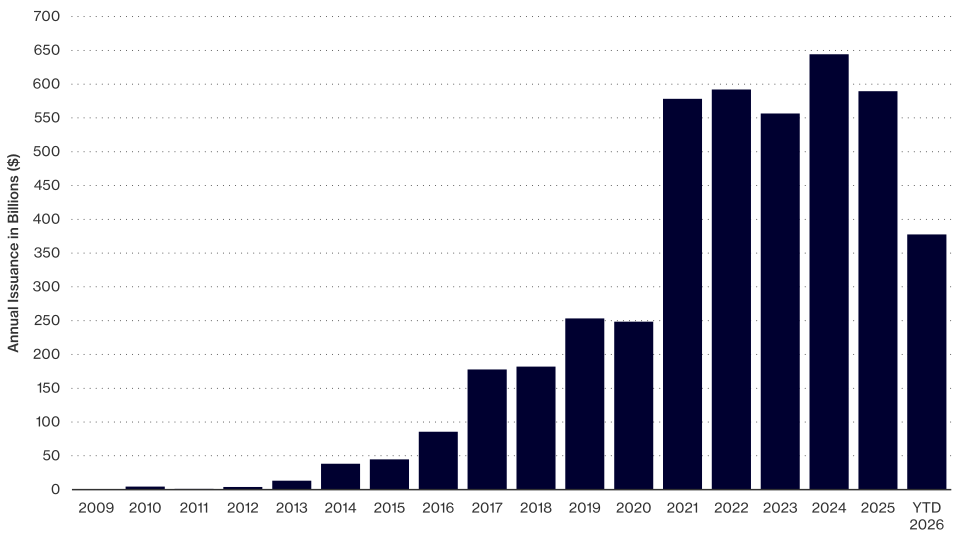
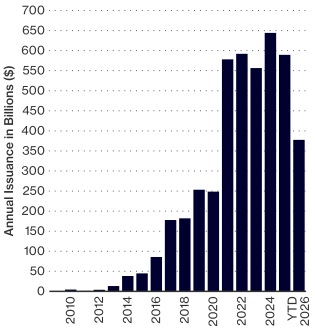
Source: Climate Bonds Initiative. Data as of 7/31/2026.
What Do Green Bonds Finance?
- Renewable energy: Wind and solar farms, battery storage facilities, and grid upgrades that carry renewable electricity to consumers.
- Energy efficiency: Insulation retrofits, smart building systems, LED lighting, and heating and cooling system upgrades that reduce energy use in commercial and residential buildings.
- Clean transportation: Electric bus fleets, rail infrastructure, EV charging networks, and low-emission transit systems.
- Water and waste management: Water treatment plants, flood defense systems, and sustainable irrigation infrastructure.
- Green buildings and data centers: Data centers built to high energy efficiency standards and powered by renewable energy contracts.
Green bonds generally finance projects within eight themes, or multiple projects across themes. The table below shows the themes and the kinds of projects that sit inside each.
| Theme | Representative projects |
| Energy | Solar, wind, transmission |
| Buildings | Efficient buildings, low-carbon materials, urban development |
| Industry | Resource production, fuel production, carbon capture |
| Transport | Rail, charging infrastructure, sustainable shipping |
| Information technology | Power management, connectivity, broadband |
| Waste and pollution | Waste to energy, material recovery, recycling |
| Land use and marine resources | Agricultural production, sustainable fisheries, commercial forestry |
| Water | Monitoring, flood defense, storage, and treatment |
Source: Climate Bonds Initiative.
Energy remains the largest single use of proceeds, led by solar, wind, and the transmission infrastructure needed to move that power to market. Clean transportation and green buildings historically represented the next largest categories, collectively accounting for a substantial share of annual proceeds alongside energy. The eligible use of proceeds, however, reaches well beyond those three categories. Broadband infrastructure, sustainable fisheries, flood defense, and recycling all qualify under current green bond frameworks.
The underlying portfolio of the VanEck Green Bond ETF, GRNB, reflects this diversity across themes.
GRNB Use of Proceeds
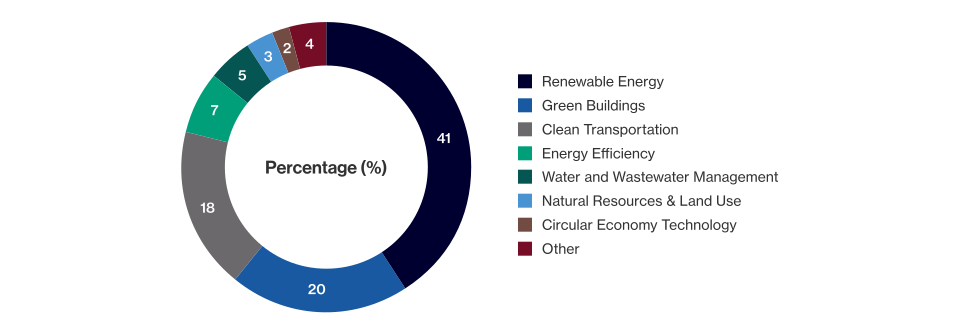
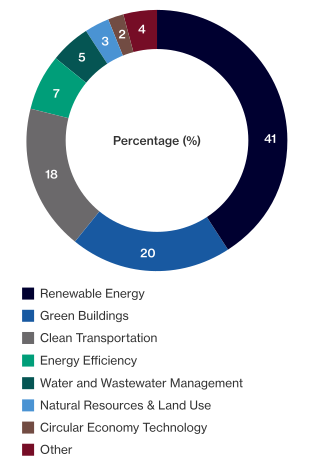
Source: VanEck. Data as of 9/30/2025. Portfolio composition is subject to change.
For the full breakdown and underlying methodology, see the GRNB Impact Report.
For example, energy-efficient data centers illustrate how those categories can intersect: a single issuance may draw on both the green buildings and information technology themes depending on how the issuer structures the use of proceeds.
Who Issues Green Bonds?
Four issuer types dominate the market, and each brings a different credit profile to a green bond portfolio.
- Supranational institutions. These include major development banks around the world. The World Bank and the European Investment Bank were the first major green bond issuers and remain among the largest, typically with the highest credit ratings.
- Governments. Sovereign green bonds are now issued by France, Germany, the UK, Saudi Arabia, China, and many other countries following green bond standard detailed allocation reporting.
- Corporations. Companies issue green bonds to finance specific capital projects. For example, a utility building a solar farm, a real estate owner retrofitting office buildings, or a data center operator constructing an energy-efficient facility.
- Financial institutions. Banks issue green bonds to fund portfolios of green mortgages, renewable energy loans, and energy efficiency lending, channeling capital to borrowers who could not otherwise access the green bond market directly.
Cumulative Global Green Bond Issuance by Entity Type:
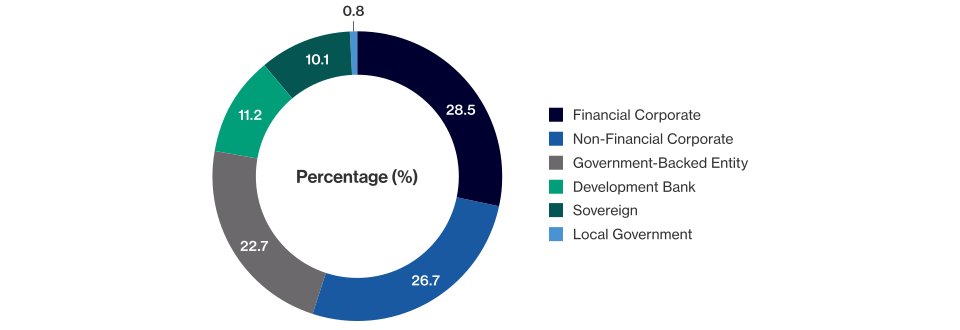
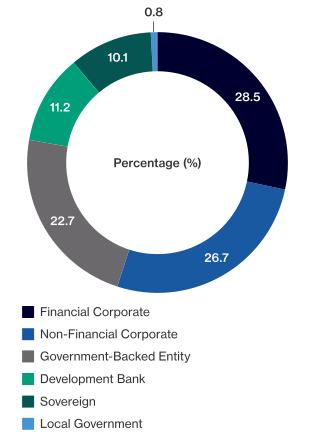
Source: Climate Bonds Initiative. Data as of 7/31/2026.
Which Countries Issue the Most Green Bonds?
Europe accounts for approximately 49% of the roughly $4.6 trillion in cumulative green bond issuance since 2007, with Germany, France, and the Netherlands alone representing around 24% of global total issuance.1 European issuers came to market early, and European investors built dedicated mandates for the asset class before most other regions, advantages that compounded over time into a structural lead. Asia-Pacific ranks second at approximately 25% of cumulative issuance, followed by North America and supranational issuers.1
On a country basis, the United States has been the largest single issuer of green bonds, with $657 billion issued since 2007. More than 800 issuers have brought over 21,000 deals to market, split roughly evenly between government and corporate issuance. Nearly 95% of that U.S. issuance is denominated in USD, the segment of the market VanEck Green Bond ETF (GRNB) is built to capture.1
Emerging markets represent a smaller but growing share of cumulative issuance. Since 2020, emerging market countries have collectively issued $688 billion in green bonds, with China accounting for $498 billion, or approximately 67% of that total, and India contributing $42 billion.1 Green bonds are financing clean energy buildouts and climate adaptation infrastructure in economies most exposed to physical climate risk.
Why Has the Green Bond Market Grown So Fast?
The growth of the green bond market is primarily driven by capital demand. Financing the energy transition requires trillions of dollars of new investment in generation, grids, transport, and buildings at a scale that public balance sheets alone cannot provide. Bond markets have historically been the primary mechanism for financing long-duration infrastructure investment, and green bonds extended that function to projects with defined environmental objectives.
Investor demand has reinforced that dynamic from the other side. Green bonds give investors measurable environmental impact alongside a market rate of return. Regulation has also played a structural role, particularly in Europe, where the EU Taxonomy and the EU Green Bond Standards have pushed corporations and governments alike to organize financing around defined environmental frameworks.
The market has also deepened structurally. Standards have tightened, second-party opinions and post-issuance reporting have become routine, and the investor base has broadened well beyond specialist ESG funds into mainstream fixed income allocations.
What Are the Risks of the Green Bond Market?
Greenwashing
Greenwashing is the most widely cited risk in the green bond market. Some bonds carry a green label without rigorous use-of-proceeds restrictions or adequate post-issuance reporting, making independent screening essential for investors who require verifiable environmental outcomes. Independent third-party verification through organizations such as the Climate Bonds Initiative (CBI) can help mitigate this risk. The Climate Bonds Initiative (CBI), an international non-governmental organization, offers certification for green bonds that meet the criteria of its Climate Bonds Taxonomy. The taxonomy is grounded in climate science, developed through a multi-stakeholder process with technical and industry experts. It is updated regularly to reflect new data and technologies emerging to address the climate challenge.
CBI evaluates each bond's stated use of proceeds against the taxonomy; bonds with 100% of net proceeds aligned are designated "green," and bonds that fail to meet the criteria are excluded. VanEck Green Bond ETF (GRNB) tracks the S&P Green Bond U.S. Dollar Select Index, which relies on CBI's taxonomy and classification process to determine which bonds qualify for index inclusion.
Interest rate risk
Green bonds carry the same interest rate risk as conventional bonds. When rates rise, prices fall, and a green label provides no protection against duration risk.
Credit risk
Green bonds carry the same credit risk as conventional bonds. A green label says nothing about the issuer's ability to repay, and default risk depends on the underlying borrower's financial strength, not the use of proceeds.
Investors accessing the green bond market through the VanEck Green Bond ETF (GRNB) may benefit from structural solutions to several of these risks. A rules-based index applies a consistent green screen across every holding, so the greenwashing question is handled by the index methodology rather than left to the individual investor. Diversification across hundreds of issuers and regions dilutes the credit and definitional risk attached to any single deal. The fund itself trades on an exchange; investors may access intraday liquidity in a wrapper even when individual underlying bonds trade thinly. Interest rate risk, however, is not diversifiable as duration exposure remains a fundamental characteristic of any fixed income instrument, green or otherwise.
How to Invest in Green Bonds
Having surpassed $4 trillion in cumulative green bond issuance, the green bond market is no longer a specialist corner of fixed income. It has become a major financing channel for the long-duration infrastructure at the core of the energy transition.
Investors seeking exposure to this market have historically navigated fragmented issuance across multiple currencies, geographies, and issuer types, with the work of verifying green credentials falling on the buyer rather than being embedded in the investment structure.
The VanEck Green Bond ETF (GRNB) tracks the S&P Green Bond U.S. Dollar Select Index and provides investors a dollar-denominated, standards-screened vehicle for accessing the global green bond market in a single exchange-traded fund structure.
Disclosures
Source 1 - Climate Bonds Initiative. Data as of 7/31/2026.
This is not an offer to buy or sell, or a solicitation of any offer to buy or sell any of the securities mentioned herein. The information presented does not involve the rendering of personalized investment, financial, legal, or tax advice. Certain statements contained herein may constitute projections, forecasts and other forward looking statements, which do not reflect actual results, are valid as of the date of this communication and subject to change without notice. Information provided by third party sources are believed to be reliable and have not been independently verified for accuracy or completeness and cannot be guaranteed. The information herein represents the opinion of the author(s), but not necessarily those of VanEck. Past performance is no guarantee of future results.
S&P Green Bond U.S. Dollar Select Index is comprised of U.S. dollar-denominated green bonds that are issued to finance environmentally friendly projects, and includes bonds issued by supranational, government, and corporate issuers globally.
Fund holdings will vary and are subject to change. For a complete list of fund holdings, please visit vaneck.com. Shares of the Fund are not individually redeemable and are issued and redeemed at net asset value only through certain authorized broker-dealers in large, specified blocks of shares.
An investment in the Fund may be subject to risks which include, among others, green bonds, investing in Asian, Chinese and emerging market issuers, foreign securities, foreign currency, credit, interest rate, floating rate, floating rate LIBOR, high yield securities, supranational bond, government-related bond, restricted securities, securitized/asset-backed securities, financial, utilities, market, operational, call, sampling, index tracking, authorized participant concentration, no guarantee of active trading market, trading issues, passive management, fund shares trading, premium/discount risk and liquidity of fund shares, non-diversified and concentration risks, all of which may adversely affect the Fund.
Investing in “green” bonds carries the risk that, under certain market conditions, the Fund may underperform as compared to funds that invest in a broader range of investments. Investing primarily in “green” investments may affect the Fund’s exposure to certain sectors or types of investments and will impact the Fund’s relative investment performance depending on whether such sectors or investments are in or out of favor in the market. The “green” sector may also have challenges such as a limited number of issuers, limited liquidity in the market and limited supply of bonds that merit “green” status, each of which may adversely affect the Fund.
Investing involves substantial risk and high volatility, including possible loss of principal. An investor should consider the investment objective, risks, charges and expenses of a Fund carefully before investing. To obtain a prospectus and summary prospectus, which contain this and other information, call 800.826.2333 or visit vaneck.com/etfs. Please read the prospectus and summary prospectus carefully before investing.
© Van Eck Securities Corporation, Distributor, a wholly owned subsidiary of Van Eck Associates Corporation.
Related Insights

Related Insights
15 October 2026
15 October 2026
28 August 2026
15 October 2026
With a $2.5 trillion annual infrastructure funding gap, green bonds offer a transparent channel for private capital (PWC, 2026). See who issues them and how GRNB fits a core bond allocation.
15 October 2026
Fallen angels lagged broad high yield by 1.14% in Q3 2026 as the 10-year Treasury climbed to 5.29%. With index yields at the 80th percentile, see what drove the drop and what carry may mean ahead.
09 October 2026
Default rates have normalized, coverage ratios compressed, and AI is disrupting loan borrowers. Here’s why investment-grade CLO tranches have absorbed every stress.
28 August 2026
AI is driving a surge in energy demand. Green bonds are one way the industry is responding. Here is how the data center green bond market works and how the industry is growing.
11 August 2026
Many investors need more than traditional bonds can deliver. VanEck provides access to a range of higher-yielding asset classes built for today's income environment.