A Better Way to Equal Weight
30 October 2024
Read Time 4 MIN
Equal Weight is the Remedy for the Market’s Current Concentration Risk
The S&P 500 has reached all-time highs multiple times this year, but much of the broad market's returns have been driven by a select few companies, often referred to as the "Magnificent 7," which are primarily mega-cap technology companies. These mega-cap tech stocks have dominated performance, leaving many investors over-reliant on a small group of companies.
While this concentration has worked in the short term, it exposes market-cap-weighted indexes (like the S&P 500) to increased risk if those large companies start to underperform. For example, if there's a tech hiccup like a slowdown in demand, shrinking margins, or supply chain issues (particularly related to Taiwan), these stocks could become vulnerable, affecting returns significantly. To put this concentration risk in context, the top 10 stocks in the S&P 500 currently account for 30%-35% of the total index.
The narrow market leadership has been particularly evident in the recent underperformance of equal-weighted strategies compared to their market-cap-weighted counterparts (see chart below). However, history suggests that market breadth can widen rapidly following such extremes. Currently, market breadth has hovered at lows not seen since COVID (2020) and the Dot-com boom (1999/2000).
Narrow Leadership: S&P 500 Equal Weighted Index Rolling 1 Year Excess Returns vs. S&P 500 Index / 1/1990 - 9/2024

Source: Morningstar. Data as of September 30, 2024. Past performance is not a guarantee of future results. Index performance is not illustrative of strategy performance. It is not possible to invest in an index. The S&P 500 Index consists of 500 widely held large cap United States common stocks covering a variety of sectors. The S&P 500 Equal Weighted Index is an equally weighted version of the market-cap weighted S&P 500 Index. Any projections shown are for illustrative purposes only and are not intended as predictions of future results or events.
Contrary to a market-cap index, an equal-weighted strategy assigns the same percentage to each stock in a portfolio, regardless of the company's size, giving smaller companies the same influence as larger ones. This approach spreads risk evenly across all holdings and provides greater exposure to a more diversified basket of stocks.
Not All Equal Weight Strategies are Created Equal
The VanEck Morningstar Wide Moat ETF (MOAT) applies an equal-weight approach that has historically delivered several key benefits:
- Historical Outperformance: Since its inception in 2007, the Moat Index's equal-weighted strategy has delivered higher returns in 11 out of 18 years compared to the market-cap-weighted S&P 500 Index. This suggests that equal weighting can offer stronger long-term growth potential.
- Improved Risk-Adjusted Returns: Equal weighting often leads to a higher Sharpe ratio, a key measure of risk-adjusted performance, when compared to market-cap-weighted indexes. This means investors can potentially earn higher returns without taking on additional risk.
- Diversification Potential: By reducing reliance on any single stock, equal-weighted strategies offer significant diversification benefits. This can protect portfolios from the volatility associated with mega-cap stocks and help spread risk more evenly across a broader set of companies.
While other equal-weight strategies can deliver similar advantages, it’s important for investors to realize that not all equal-weighted strategies perform the same. For example, MOAT takes an equal-weighted approach, but with a focus on companies that have sustainable competitive advantages or "economic moats." This approach, combined with an emphasis on attractive valuations, gives the MOAT ETF a slight value bias and has steered it away from mega-cap companies.
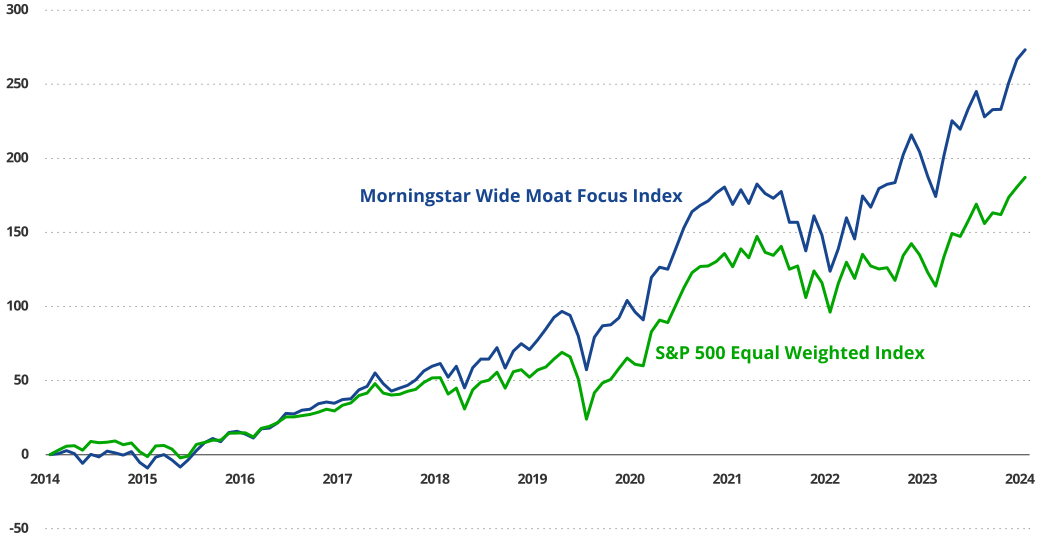
Although this positioning has been a headwind in 2024 due to the dominance of the "Magnificent 7," it could prove beneficial as market dynamics shift. Over the past decade, MOAT has outperformed the S&P 500 Equal Weight Index by an impressive 80+ percentage points when it comes to cumulative returns, highlighting the potential of equal-weighted strategies that focus on high-quality companies with sustainable competitive advantages that are trading at attractive valuations
MOAT Has Dominated The S&P 500 Equal Weight Index Over the Past Decade
Source: Morningstar. Data as of September 30, 2024. Past performance is not a guarantee of future results. Index performance is not illustrative of strategy performance. It is not possible to invest in an index.
Explore VanEck’s Moat Funds
VanEck is proud to be a pioneer in the moat investment space, with a track record dating back to 2012 for our core strategy, the VanEck Morningstar Wide Moat ETF. All VanEck’s moat strategies are powered by Morningstar’s powerful research lens across different investment styles, market capitalizations and geographical regions to provide investors with a wide array of solutions to meet different investment objectives.
Average Annual Total Returns* (%)
| As of September 30, 2024 | |||||||||
| 1 MO | 3 MO | YTD | 1 YR | 3 YR | 5 YR | 10 YR | LIFE 04/24/12 |
||
| MOAT (NAV) | 1.74 | 11.93 | 14.31 | 29.02 | 10.96 | 15.47 | 13.49 | 14.82 | |
| MOAT (Share Price) | 1.71 | 11.94 | 14.23 | 28.94 | 10.96 | 15.45 | 13.47 | 14.82 | |
| MWMFTR (Index) | 1.79 | 12.08 | 14.75 | 29.68 | 11.55 | 16.04 | 14.08 | 15.40 | |
| Performance Differential (NAV - Index) | -0.05 | -0.15 | -0.44 | -0.66 | -0.59 | -0.57 | -0.59 | -0.58 | |
| S&P 500 Index | 2.14 | 5.89 | 22.08 | 36.35 | 11.91 | 15.98 | 13.38 | 14.39 | |
*Returns less than one year are not annualized.
Effective June 20, 2016, Morningstar implemented several changes to the Morningstar Wide Moat Focus Index construction rules. Among other changes, the index increased its constituent count from 20 stocks to at least 40 stocks and modified its rebalance and reconstitution methodology. These changes may result in more diversified exposure, lower turnover, and longer holding periods for index constituents than under the rules in effect prior to this date. Past performance is no guarantee of future results.
The gross expense ratio for MOAT is 0.47%.
The performance data quoted represents past performance. Past performance is not a guarantee of future results. Investment return and principal value of an investment will fluctuate so that an investor's shares, when redeemed, may be worth more or less than their original cost. Performance may be lower or higher than performance data quoted. Please call 800.826.2333 or visit vaneck.com for performance current to the most recent month ended.
Related Insights

Related Insights
30 March 2026
The Moat Index added NVIDIA, Broadcom and new names following its quarterly review, as tech dislocations created opportunity, while maintaining a value tilt and notable discount to fair value.
11 March 2026
Valuation discipline and sector allocation tilted exposure towards consumer staples, industrials and health care, supporting gains as software lagged.
12 January 2026
A strong December capped a year of resilience for moat strategies, as quality stock selection and renewed exposure to mega-caps position them for 2026.
23 December 2025
The 4Q 2025 reconstitution of the Morningstar® Wide Moat Focus Index saw selective additions to the Magnificent 7, including NVIDIA and Meta, as AI-driven volatility created valuation opportunities. Despite adding growth-oriented tech names, the Index remains contrarian.
09 December 2025
Market breadth improved in November, lifting both the Moat Index and SMID Moat Index, with health care and materials driving gains despite weakness in technology and consumer names.