From Magnificent to Stretched: Rethink US Equity Allocations
15 October 2025
Read Time 5 MIN
Key takeaways:
- A small number of companies dominate US equity market size and earnings, making investors reliant on the fortunes of a select few.
- Many broadly owned investment solutions hold the same top stocks, creating overlap that amplifies investor exposure to these stocks.
- Stretched valuations and heavy exposure may weigh on long-term return potential.
The dominance of the "Magnificent 7" companies over the last several years has been well-documented. Now, unsurprisingly, other companies are gaining spotlight as their standout returns catch the attention of investors and spur new descriptions, like the Fab Four, Big Six and Elite Eight.
.The Outsized Impact of US Equity Market Leaders
The dominance of the largest US companies has been on full display in recent years. Look no further than the influence the 10 largest companies in the S&P 500 Index are having on markets. These companies now account for an eye-popping portion of both total market size and share of corporate profits in the US.
Largest US Companies Are Dominating the Market
10 Largest Companies as Share of the S&P 500 Index (1985 – 2025)

Source: Compustat, IBES, FactSet, Goldman Sachs Global Investment Research. Past performance is not a guarantee of future results. Index performance is not illustrative of fund performance. It is not possible to invest in an index.
Look Through the Illusion of Differentiation
The concentration within the S&P 500 Index is not an isolated situation. Many investment strategies, often available to investors in ETF format, also hold significant exposure to many of the same companies that dominate the S&P 500. As of September 30, 2025, there were nine companies in the US with a trillion-dollar market capitalization. Those companies have notable, if not significant, exposure across many different US investment approaches.
Exposure to $1 Trillion Companies
Weight Associated with US Companies with $1T Market Cap (as of 9/30/2025)
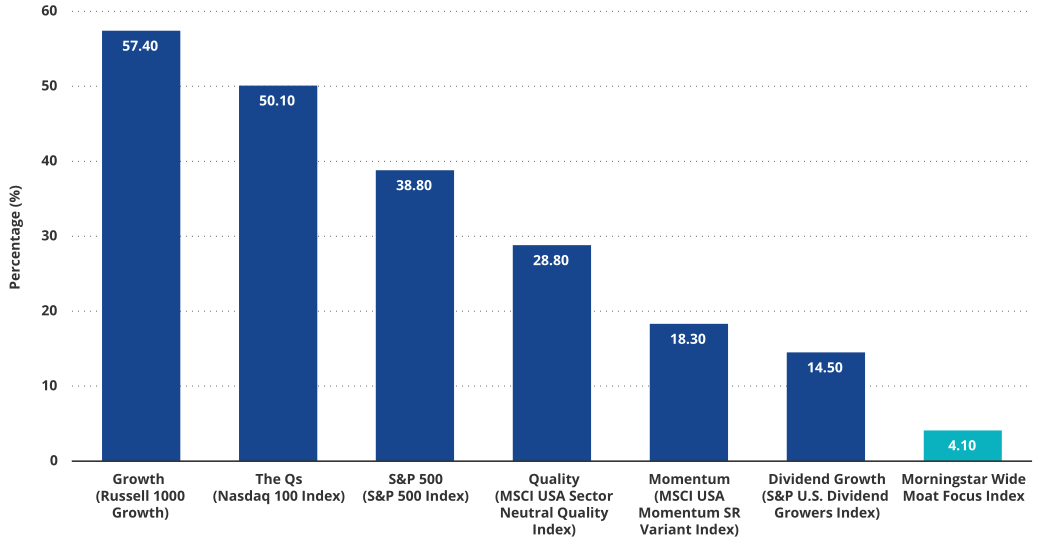
Source: Morningstar. All data as of 9/30/2025 except for S&P US Dividend Growers Index which is as of 8/31/20225. Trillion-dollar companies comprise NVIDIA, Microsoft, Apple, Alphabet, Amazon.com, Meta, Broadcom, Tesla, and Berkshire Hathaway. Past performance is not a guarantee of future results. Index performance is not illustrative of fund performance. It is not possible to invest in an index. Not intended as a recommendation to buy or to sell any of the securities mentioned herein.
Take a look at the top 10 holdings of many widely popular indexes that underlie mutual funds and ETFs. Below is a sample of popular indexes — ranging from factor indexes to dividend indexes—linked to funds with hundreds of billions of dollars in assets under management.
Unique Top 10 Holdings Rare Among Popular U.S. Large Cap Indexes
Shading Represents Unique Holdings Among the Group’s Top Ten (as of 9/30/2025)
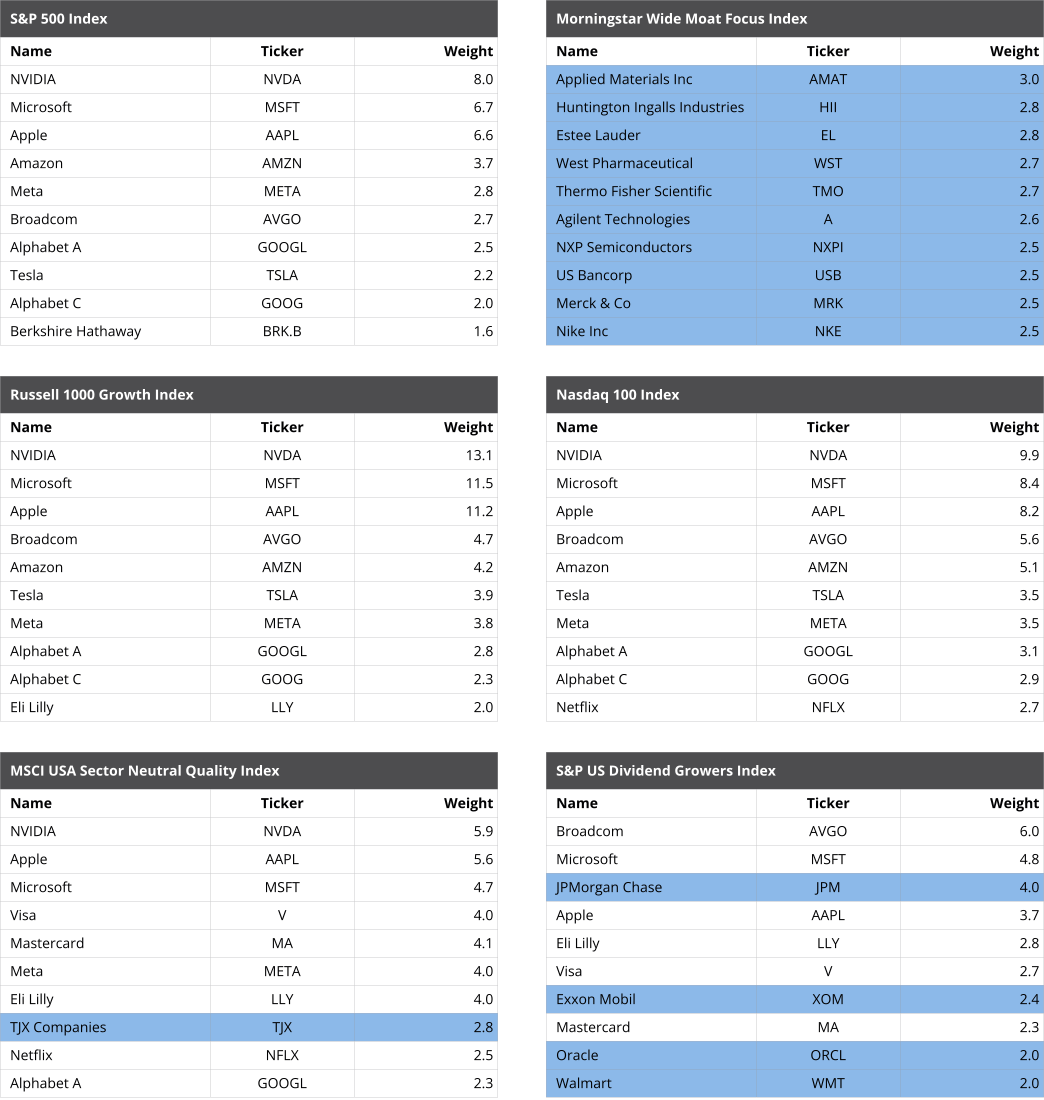
Source: Morningstar. All data as of 9/30/2025 except for S&P US Dividend Growers Index which is as of 8/31/20225. Past performance is not a guarantee of future results. Index performance is not illustrative of fund performance. It is not possible to invest in an index. Not intended as a recommendation to buy or to sell any of the securities mentioned herein.
Stretched Valuations Have Led to Muted Returns
The forward P/E ratio of the S&P 500 Index sat at approximately 25 at the end of September. This implies that the index is trading at more than 25 times forward earnings estimates. Largely, investors have been happy to pay that multiple as many companies, particularly the Magnificent 7, have managed to notably expand profits in recent periods.
Stretched valuations and changing market dynamics are not necessarily reasons to shift a portfolio or underweight any given sector. In fact, many believe there is plenty of room to run from here. But they are certainly a good reason to consider diversification. Since 1991, high forward P/E ratios have preceded long-term S&P 500 performance that was underwhelming at best, and in negative territory at worst.
S&P 500 Returns Have Been Underwhelming at Current Valuations
Forward P/E Ratios Relative to Future Annualized Return (8/1991 – 9/2015)

Source: FactSet; Morningstar. Past performance is not a guarantee of future results. P/E represents the ratio of price to earnings. In this case, forward P/E represents index stock prices versus forecast earnings one year into the future. Index performance is not illustrative of fund performance. It is not possible to invest in an index. Not intended as a forecast or prediction of future results.
Diversify Your Portfolio with Quality Companies at Attractive Valuations
Its focus on attractive valuations is what can give this systematic strategy its contrarian bias by leading it to out-of-favor stocks trading well below their intrinsic value. The strategy has long offered diversification benefits while historically providing a compelling risk/reward profile, in spite of its lack of exposure to mega-cap tech and other leading exposures in the S&P 500 Index.
Related Insights

Related Insights
12 January 2026
A strong December capped a year of resilience for moat strategies, as quality stock selection and renewed exposure to mega-caps position them for 2026.
23 December 2025
The 4Q 2025 reconstitution of the Morningstar® Wide Moat Focus Index saw selective additions to the Magnificent 7, including NVIDIA and Meta, as AI-driven volatility created valuation opportunities. Despite adding growth-oriented tech names, the Index remains contrarian.
09 December 2025
Market breadth improved in November, lifting both the Moat Index and SMID Moat Index, with health care and materials driving gains despite weakness in technology and consumer names.
10 November 2025
Markets extended gains in October as earnings strength, AI investment, and Fed easing supported sentiment, helping moat strategies show selective strength.
08 October 2025
Tech gains helped moat strategies navigate September’s headwinds, with fresh picks from the quarterly Moat Index review keeping value opportunities in focus.