ITM ETF: Question & Answer
12 March 2024
Read Time 7 MIN
- What are investment grade municipal bonds, and how big is the market?
- What makes municipal bonds attractive relative to other types of bonds?
- What is the VanEck Intermediate Muni ETF?
- How is the fund’s index constructed?
- Why might investors be interested in intermediate duration munis?
- What is roll yield?
- How do munis compare in the risk/reward profile?
- How does the portfolio management team decide which bonds in the index to own?
- Where can investors buy VanEck Intermediate Muni ETF?
What are investment grade municipal bonds, and how big is the market?
Investment-grade municipal bonds are a type of debt security issued by a state, municipality, county, or other local government with credit ratings of Baa3/BBB—or above.
These bonds are issued to raise capital for various types of public infrastructure and public benefit projects. Investment grade municipals can be issued as either general obligation bonds or revenue bonds. General obligation bonds are backed by the full faith, credit, and taxing power of the issuer. In contrast, revenue bonds are secured by the revenue generated by a specific project that is being financed.
As of the third quarter of 2023, SIFMA estimated that roughly $4.04 trillion worth of municipal bonds are currently outstanding.
What makes municipal bonds attractive relative to other types of bonds?
- Potential for Higher Yields: Compared to taxable fixed income securities, municipal bonds may offer investors higher taxable equivalent yields, especially for investors in a high tax bracket.
- Tax Advantages: the interest income generated by municipal bonds is generally exempt from federal income tax and, in some cases, exempt from state and local taxes, as well. Investors in higher tax brackets can see the benefits of investing in municipal securities when comparing a municipal bond’s taxable equivalent yield to the yield on a taxable bond.
Capitalize on Higher Tax-Equivalent Yield

Source: ICE Data Services. Data as of 2/29/2024. Please see important index definitions at the end of this content. Index performance is not illustrative of fund performance. It is not possible to invest directly in an index.
What is the VanEck Intermediate Muni ETF?
The VanEck Intermediate Muni ETF is an exchange-traded fund that seeks to track the performance of an index composed of investment-grade municipal bonds with intermediate-term maturities.
How is the fund’s index constructed?
VanEck Intermediate Muni ETF (ITM) seeks to track the ICE Intermediate AMT-Free Broad National Municipal Index (“Intermediate Index”). The Intermediate Index tracks the overall performance of the U.S. dollar-denominated intermediate-term tax-exempt bond market. Securities must have at least 6 years but less than 17 years remaining in the term to final maturity, a fixed coupon schedule, and an investment grade rating. Qualifying securities must have at least $10 million currently outstanding face value and must be part of a deal with an original offering size of at least $100 million. Limited offering securities are included in the Intermediate Index; primary and secondarily insured securities qualify for inclusion based on the insured rating. Private placement, variable rate demand obligations, securities in legal default, floating rate debt, municipal commercial paper, and debt issued under the Municipal Liquidity Facility are excluded from the index. The Intermediate Index is rebalanced monthly on the last calendar day of the month, and constituents are market cap weighted.
Why might investors be interested in intermediate duration munis?
The muni yield curve is an important indicator of the health of the municipal bond market and the broader economy. Traditionally, the intermediate part of the curve remains positively sloped and steep, providing attractive roll yield for investors who target these maturities. Steepness refers to the degree of absolute difference between yields of different maturities. This part of the curve makes for a compelling entry to invest due to the higher yield spreads.
Additionally, yields are currently well above historical levels. The recent rate hiking cycle has produced the highest yields in over a decade and presents an attractive income opportunity.
Advantage Steepness in AAA Muni Curve

Source: Bloomberg. Data as of 2/29/2024.
What is roll yield?
As bonds move closer to final maturity, they typically will have a lower yield each year as they roll down the curve. When a bond’s yield drops, its price increases (yield and price move in the opposite direction). Roll yield refers to the amount of price appreciation that occurs as its maturity ages. A strategy targeting the steepest part of the curve may benefit by accessing this roll-yield effect and the inherent price boost that occurs as bonds age. Despite an inverted curve at the short end of the curve, much of the intermediate section remains steep.
Capture High Roll Yield
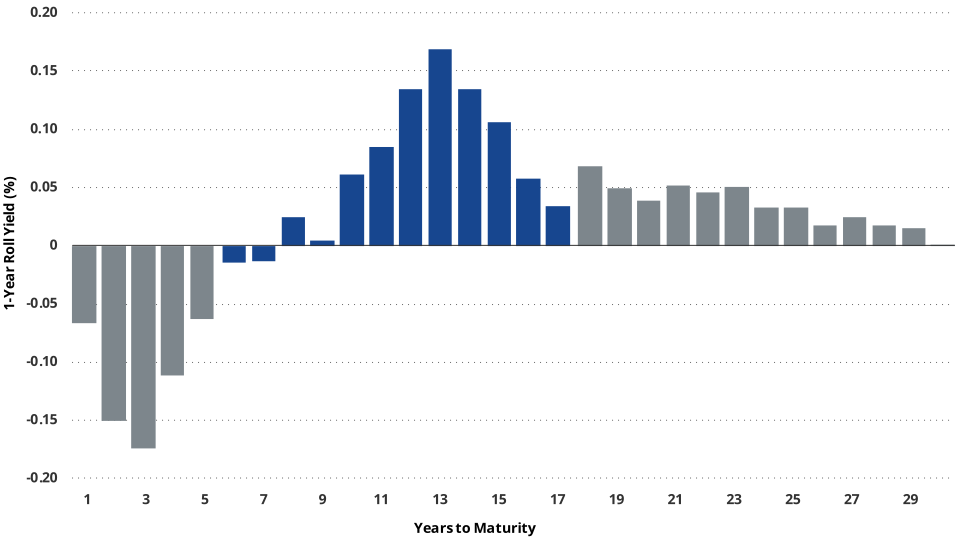
Source: Bloomberg. Data as of 2/29/2024.
How do munis compare in the risk/reward profile?
Munis make a compelling case from a risk/reward perspective. They feature less risk than corporate bonds and typically have a higher return compared to government bonds. Their tax-exempt status enhances these returns.
From a credit perspective, the Intermediate Index only includes municipal bonds with an investment grade rating. Credit agencies designate these as having a low risk of default. Historically, investment-grade municipal bonds have had very few defaults, with only one in 2022. Since 2013, the average five-year default rate for municipal bonds, including non-investment grade, has been just 0.08%, significantly lower than the 7.8% rate for global corporate bonds, underscoring municipal bonds as a safer investment option.
From a risk standpoint, for investors looking to minimize risk while not compromising on returns, intermediate investment-grade municipal bonds have a strong investment case.
Investment Grade Municipal Bond Taxable-Equivalent Risk/Return
2/28/2019 - 2/29/2024

Source: Factset. Data as of 2/29/2024. For illustrative purposes only. Taxable-equivalent return represents the return a taxable bond would have to earn to match – after federal taxes – the return available on a tax-exempt municipal bond (excluding AMT). Municipal bonds may be subject to state and local taxes as well as to federal taxes on gains and may be subject to alternative minimum tax. The chart displays the returns of the ICE BofA US Municipal Securities Index on a tax-equivalent return basis and compares such returns to other asset classes as represented by the indexes described at the end of this blog. Municipal, corporate, agency and mortgage-backed bonds are not guaranteed by the full faith and credit of the United States and carry the credit risk of the issuer. Municipal bonds are exempt from federal taxes and often state and local taxes. U.S. Treasuries are exempt from state and local taxes, but subject to federal taxes. Other securities listed are subject to federal, state and local taxes. Standard deviation is the statistical measure of the historical volatility of a portfolio. Historical information is not indicative of future results; current data may differ from data quoted. The listed indices are unmanaged and are not securities in which an investment can be made. Past performance is not a guarantee of future results. Please see important index definitions at the end of this content. Index performance is not illustrative of fund performance.
How does the portfolio management team decide which bonds in the index to own?
The Fund, using a “passive” or indexing investment approach, attempts to approximate the investment performance of the Intermediate Index. Unlike many investment companies that try to “beat” the performance of a benchmark index, the Fund does not try to “beat” the Intermediate Index and does not take temporary defensive positions inconsistent with its investment objective of seeking to replicate the Intermediate Index. Because of the practical difficulties and expense of purchasing all the securities in the Intermediate Index, the Fund does not purchase all the securities in the Intermediate Index. Instead, the Adviser utilizes a “sampling” methodology in seeking to achieve the Fund’s objective. As such, the Fund may purchase a subset of the bonds in the Intermediate Index to hold a portfolio of bonds with generally the same risk and return characteristics of the Intermediate Index. The graphic below illustrates this process.

* International Data Corporation (third-party pricing service). The municipal income ETF investment process is subject to change at any time. For illustration purposes only.
Where can investors buy VanEck Intermediate Muni ETF?


To receive more Municipal Bonds insights, sign up in our subscription center.
Related Insights

Related Insights
26 January 2026
08 April 2026
High yield munis offer tax-exempt income, historically lower default rates than corporate high yield, and distinct sector exposure. Here's what defines this asset class.
06 April 2026
Municipal bonds offer tax-free income and improved yields, making them attractive for investors seeking higher after-tax returns. With tax-equivalent yields rising, munis present a compelling opportunity today.
17 February 2026
With rates elevated, munis may provide a way to convert cash allocations into tax-exempt income in today’s yield environment.. Strong flows, attractive after-tax yields, and ETF access make munis a practical planning tool in 2026.
26 January 2026
Brightline East and West show that some munis depend more on the cash flow of a single project. Learn how to spot risk factors and make smarter infrastructure investing decisions.
18 December 2025
Get your portfolio ready for 2026 with detailed insights from VanEck’s investment team about the factors driving risk and returns in their respective asset classes.