Tourism and Tax Revenues: An Overlooked Link to Municipal Bonds
02 June 2025
Read Time 4 MIN
As investors in the municipal bond space, we spend much of our time tracking rate movements, credit trends and fiscal policy. But one external force that could quietly reshape state and local government finances, and in turn, the municipal bond market, is a slowdown in international tourism to the United States. For many municipalities, foreign visitors represent a critical stream of tax revenue. When that revenue disappears or declines meaningfully, the impact can cascade from local budgets to bond markets, particularly for investors exposed to certain kinds of revenue-backed debt.
Why International Tourism Trends Matter for the Municipal Bond Market
International travelers aren’t just sightseeing, they’re spending. And that spending translates into real dollars for states and cities through sales taxes, hotel and occupancy taxes, and transportation-related levies. Places like Florida, New York, Nevada, and California depend heavily on this activity to fund essential services.
In Florida, for example, state sales tax collections topped $36 billion in fiscal year 2023, equal to more than 70% of the state’s general revenue according to the Florida Department of Revenue. Similarly, hotel taxes are a core revenue source in cities like Las Vegas and New Orleans — revenue that declines in lockstep with falling occupancy rates. Add to this the transportation-related taxes from rental cars and ride-hailing services in tourist-heavy metros like San Francisco or Los Angeles, and you begin to see just how embedded tourism is in municipal fiscal health.
Economic Ripple Effects Beyond Direct Tax Losses
When international tourism declines, the direct hit to tax collections is only the first domino. Local economies dependent on visitors often experience job losses in hospitality and retail, reduced business profits, and, ultimately, softer income and corporate tax receipts. Hawaii stands out as a high-risk example where tourism accounts for a significant share of the state’s GDP, making it especially vulnerable to global travel trends.
While domestic travel can help partially offset these losses, U.S.-based tourists tend to spend less and stay for shorter periods. International travelers, by contrast, often book longer, more expensive trips, making their absence more economically painful.
Changes in Passengers at Major U.S. Airports
Rolling 30-day vs. same 30-days a year prior at Orlando, NYC, LA, Atlanta, Denver, Dallas, Houston and DC airports (ORD, JFK, LAX, ATL, DEN, DFW, IAH, IAD).
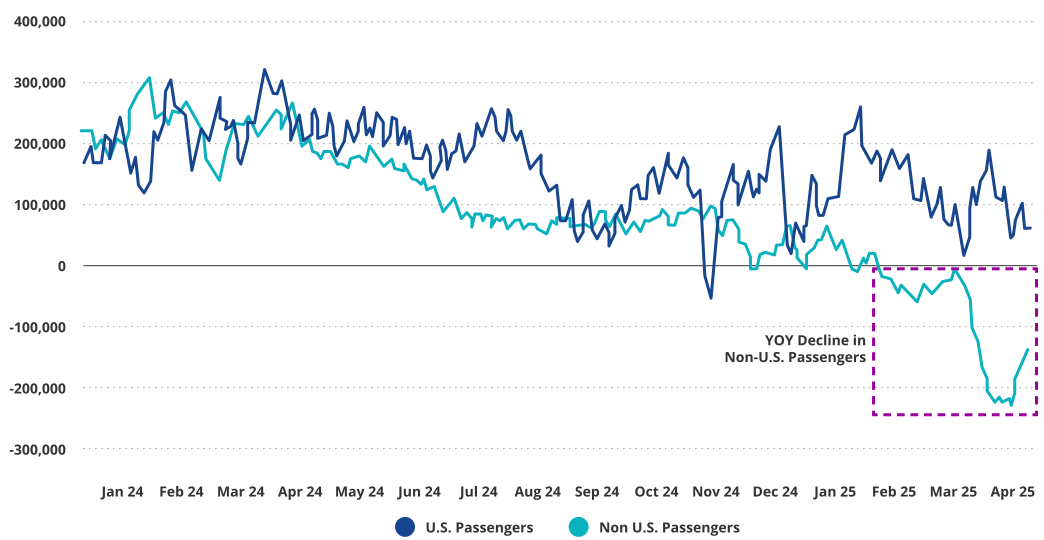
Source: U.S. Travel Association as of April 2025.
The Munis Connection: Revenue Bonds Under Pressure
For muni investors, the key question is how this tourism drag could affect the performance and creditworthiness of municipal bonds. The most immediate concern is revenue bonds. These instruments are directly tied to specific cash flows, many of which rely on tourism-driven activities. Bonds issued to finance airports, convention centers, transit systems, and sports venues in major tourist cities could face cash flow stress if visitor-related revenues fall short.
During the pandemic, we saw how airport revenue bonds lost value when travel came to a halt. A slower, more structural drop in international tourism could lead to similar weakness in other corners of the revenue bond market.
Even general obligation (GO) bonds could be exposed indirectly. If municipalities need to adjust budgets by cutting services, raising taxes, or delaying capital investments, their broader credit profile may weaken. That, in turn, could potentially lead to rating downgrades and higher borrowing costs down the line.
Investor Sentiment and Market Volatility
Beyond fundamentals, the bond market is sensitive to sentiment. If international visitor numbers continue to fall, and particularly if recession concerns rise globally, investors may demand a higher risk premium for bonds issued by tourism-reliant issuers. This could drive widening spreads and create volatility in portfolios concentrated in these regions.
Municipalities that are highly dependent on tourism revenues but lack deep fiscal reserves or diversified economies may also face refinancing challenges if bond values decline or borrowing costs rise.
The Case for National Diversification
This evolving dynamic makes one thing clear: municipal investors should think carefully about geographic and sector concentrations. Relying heavily on one region or one type of bond structure can expose portfolios to risks that aren't always obvious on the surface, such as changes in international tourism patterns.
This is why investing in the municipal asset class through a nationally diversified strategy, like VanEck’s municipal bond ETFs, may provide meaningful risk mitigation. By spreading exposure across states, sectors, and credit types, these ETFs are designed to absorb regional shocks while preserving tax income potential and tax-exempt advantages.
Diversification doesn’t eliminate risk, but it does help ensure that a slowdown in one part of the country or one sector of the economy doesn’t derail an investor’s broader income strategy. In a market shaped not just by interest rates but by everything from global travel patterns to local tax receipts, that kind of flexibility is becoming more important than ever.
Related Insights

Related Insights
26 January 2026
01 December 2025

17 February 2026
With rates elevated, munis may provide a way to convert cash allocations into tax-exempt income in today’s yield environment.. Strong flows, attractive after-tax yields, and ETF access make munis a practical planning tool in 2026.
26 January 2026
Brightline East and West show that some munis depend more on the cash flow of a single project. Learn how to spot risk factors and make smarter infrastructure investing decisions.
18 December 2025
Get your portfolio ready for 2026 with detailed insights from VanEck’s investment team about the factors driving risk and returns in their respective asset classes.
01 December 2025
With the Fed easing and muni supply surging, long-duration municipal bonds stand out, offering tax-exempt yields that now rival or exceed Treasuries and even some riskier fixed income assets.