Commodity Strategies Diverge as Roll Yield Takes Over
08 April 2026
Read Time 6 MIN
Key Takeaways:
- The CMCI Index is built for commodity investing across full market cycles, using maturity diversification to reduce volatility and drawdowns.
- Today’s market is the exception, not the rule, with steep backwardation favoring front-month, energy-heavy indices like the S&P GSCI.
- Contango has been the dominant regime for most of the past two decades, and the CMCI Index's design specifically mitigates that persistent drag.
- PIT adapts dynamically, pursuing near-term opportunities and rotating when conditions shift.
- CMCI and PIT provide complementary strategic and tactical commodity exposure.
A rare and powerful market dynamic is unfolding.
Energy markets have been turned upside down by a historic supply disruption. A conflict-driven shutdown of Gulf oil production, estimated at nearly 9 million barrels per day, has driven crude oil futures into steep backwardation. As of April 7, front-month WTI is trading near $110 per barrel, while prices for delivery in late 2026 slope down toward the mid-$70s. This creates a powerful positive roll yield tailwind.
In Understanding the Components of Commodity Futures Returns, we looked at how spot price movement, collateral yield and roll yield drive commodity returns. We’re seeing that framework in action today, with roll yield now taking center stage.
When futures curves are backwardated, investors rolling expiring contracts sell high and buy low, earning a positive spread. History shows how consequential this can be. During the structurally backwardated energy markets of the 1970s and early 1980s, S&P Goldman Sachs Commodity Index (S&P GSCI) roll yield averaged 4.77% and 2.41% annualized, respectively. In contrast, when energy contango dominated the 2000s, that same figure turned sharply negative, to -8.25%.
The current environment is squarely in the first camp—and it is historically rare.
CMCI: Built for the Long Game
The UBS Constant Maturity Commodity Index (“CMCI Index”), the benchmark behind both the VanEck CMCI Commodity Strategy ETF (CMCI) and CM Commodity Index Fund , was designed with a specific, long-term view: commodity futures markets are in contango most of the time, and when in contango, front-month concentration is the most expensive place for investors to sit.
The Index addresses this by spreading exposure across the futures curve, spreading positions three months to three years. Combined with broader commodity diversification, this approach mitigates the negative roll yield impact that has historically been the biggest drag on commodity returns over time.
The numbers bear this out.
Today’s Roll Yield vs. Long-Term Trends
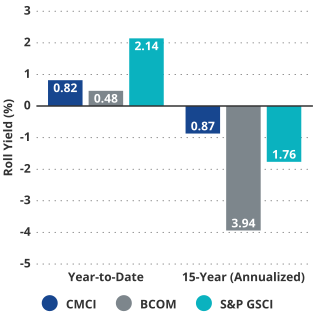
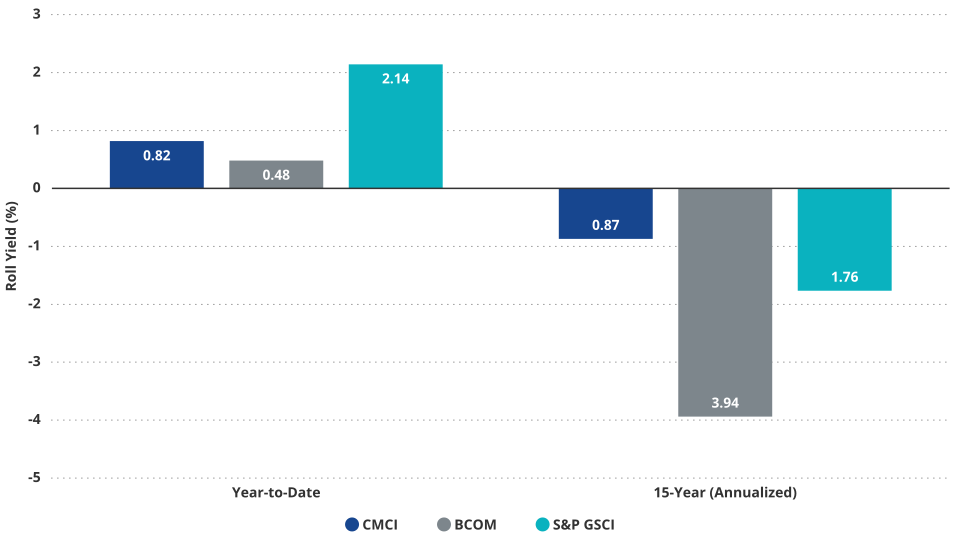
Source: Bloomberg, VanEck. Data as of 3/31/2026. CMCI: UBS Bloomberg Constant Maturity Commodity Index (CMCITR) ; BCOM: Bloomberg Commodity Index; S&P GSCI: S&P Goldman Sachs Commodity Index. Annualized roll yield refers to the annualized return the amount of return generated from the rolling of a short-term futures contract into a longer-term contract and profits from the convergence of the futures price toward a higher spot or cash price. Past performance is no guarantee of future results. Index performance is not representative of fund performance. It is not possible to invest directly in an index. Please see index definitions and other important disclosures at the end of this content. Fund performance current to the most recent month end is available by visiting vaneck.com or by calling 800.826.2333.
Why the CMCI Index Is Lagging—And Why That's Expected
The feature that makes this strategy a more resilient long-term holding is precisely what is causing it to lag in the current environment, when near-term backwardation is steep.
Spreading maturity exposure across the curve means the strategy holds some exposure in the longer-dated portion of the energy curve, parts of which is still in contango beyond 2027. At the same time, lower energy concentration relative to the S&P GSCI means it captures less of the sector generating the most positive roll yield today.
Neither of these is a flaw. It is a tradeoff.
This strategy was built to mitigate the persistent headwind of contango, not maximize returns during short-lived periods of extreme backwardation. This design has been right for the vast majority of the past two decades, and will be right again when this supply shock resolves and the curve normalizes.
In short: the CMCI strategy is a strategic all-weather commodity allocation. The S&P GSCI is a high-beta, energy-concentrated tactical instrument that may perform well in environments like today’s, but carries different risks across cycles. Investors who chose the CMCI approach for its volatility management, drawdown characteristics, and roll efficiency made a sound, well-reasoned decision — one that is temporarily in an unfavorable regime, not one that has been invalidated.
The Case for PIT: Tactical Flexibility Across Changing Regimes
For investors seeking to actively participate in environments like the current one, the VanEck Commodity Strategy ETF (PIT) offers a different approach. Unlike passive indices, PIT is not constrained to a fixed position on the curve. It can dynamically allocate across maturities and sectors, which means it can lean into front-month energy exposure when backwardation is steep and reposition as conditions evolve.
In a market where front-month energy backwardation is generating positive roll yield and longer-dated contracts remain in contango, that flexibility matters. An active manager can position explicitly to capture that spread. PIT returned 18.64% in March 2026 alone and 36.61% in Q1 2026, its strongest quarter since inception. That performance reflects the tactical advantage of being unconstrained, with the ability to lean into front-month energy exposure today and rotate as fundamentals evolve.
PIT Cumulative Returns Reflect Tactical Flexibility
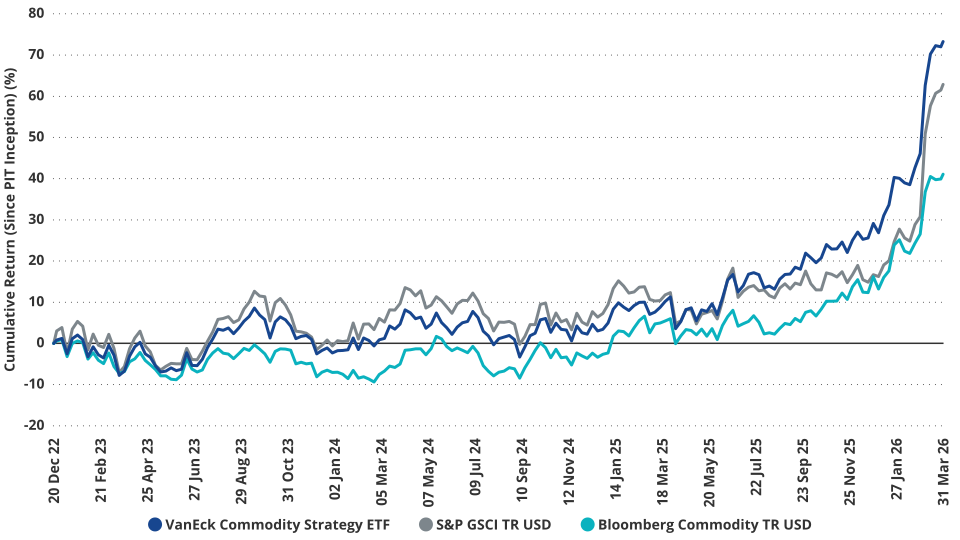
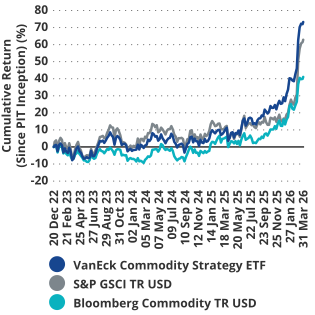
Source: Morningstar, VanEck. Data as of March 31, 2026. Inception date of PIT is 12/20/2022. Past performance is no guarantee of future results. Index performance is not representative of fund performance. It is not possible to invest directly in an index. Please see index definitions and other important disclosures at the end of this content. Fund performance current to the most recent month end is available by visiting vaneck.com or by calling 800.826.2333.
Average Annual Total Returns as of 3/31/2026 (%)
| 1 Mo | YTD | 1 Yr | 3 Yr | Life (12/20/2022) | |
| PIT (NAV) | 18.64 | 36.61 | 54.19 | 21.32 | 18.22 |
| PIT (Market Price) | 18.54 | 37.04 | 54.31 | 21.48 | 18.31 |
| Bloomberg Commodity Index | 11.50 | 24.41 | 32.29 | 13.88 | 11.07 |
Returns less than one year are not annualized.
PIT Gross Expense Ratio: 0.55%
The performance data quoted represents past performance. Past performance is not a guarantee of future results. Investment return and principal value of an investment will fluctuate so that an investor's shares, when redeemed, may be worth more or less than their original cost. Performance may be lower or higher than performance data quoted. Please call 800.826.2333 or visit vaneck.com for performance current to the most recent month end.
Two Different Paths for Commodity Investing
The current environment is a reminder that commodity investing involves not only what you own in different regimes, but also how you own it.
Roll yield can dominate outcomes depending on the shape of the futures curve, and different strategies are built to harness or mitigate that effect in varying ways.
- VanEck CMCI Commodity Strategy ETF (CMCI) and CM Commodity Index Fund are designed to deliver a smoother long-term experience across typical market conditions.
- VanEck Commodity Strategy ETF (PIT) provides the flexibility to adapt across regimes, seeking the strongest opportunities wherever they emerge.
These are complementary, not competing, approaches. Understanding how they differ and when those differences matter are essential to making informed allocation decisions in commodities today.
Related Insights

Related Insights
25 September 2026
16 September 2026
25 September 2026
A proposed diesel export ban could idle much of Gulf Coast refining, push up gasoline prices, and discourage the investment needed to ease supply over time.
16 September 2026
A shuttered Strait of Hormuz drained reserves, throttled Asian refining, and exposed a supply system with no slack left. We remain constructive on oil-levered equities.
07 August 2026
Global rearmament is a metals race in disguise. Defense budgets are surging, hardware drives the spend, and China controls the supply — yet resource equities remain unpriced. We see an opportunity.
23 July 2026
After three strong years, many nuclear and uranium stocks have given back a chunk of their gains. We look at what drove the pullback, what’s gone right, and the opportunity ahead.
22 July 2026
Permian gas was literally worth less than nothing, for years. New pipeline infrastructure is changing that. Find out why this structural shift has us more convicted than ever on Permian E&P companies.