The ETFs Powering the AI Supply Chain
27 February 2026
Read Time 6 MIN
What Actually Powers AI?
It’s easy to think of AI as a purely digital phenomenon built on code and data floating in the cloud. But every model runs on physical hardware, consumes real electricity, and depends on materials that are pulled from the ground.
Training a frontier model like GPT-4 reportedly consumed around 50 gigawatt-hours of energy, which is enough to power San Francisco for three days.1 And that’s just the training phase. Inference, which is the process of actually serving AI to hundreds of millions of users, demands even more sustained power over time.
All of that computation flows through three critical layers:
- Semiconductors that do the math.
- Energy that keeps the data centers running around the clock.
- Strategic metals embedded in the hardware itself.
When any of those layers hits a bottleneck like a chip shortage, a power constraint, or an export ban on critical minerals, it affects every corner of the AI economy.
How Can You Invest in the AI Supply Chain?
Rather than chasing the handful of software names that dominate AI headlines, investors can target the physical infrastructure that every one of those companies depends on. VanEck offers three ETFs, each mapped to a distinct layer of the AI supply chain.
| ETF | Role in AI Supply Chain | Why It Matters for AI | Why Invest |
| SMH | The advanced chips: GPUs, AI accelerators, that perform the trillions of calculations behind model training and inference. | Hyperscalers are spending hundreds of billions on AI compute. No chips, no AI. | Concentrated access to the 25 largest U.S.-listed semiconductor companies. |
| NLR | Uranium mining, reactor construction, and nuclear power generation: the 24/7 baseload electricity AI requires. | Data center power demand is set to double by 2030. Nuclear is the only scalable zero-carbon option. | Full nuclear value chain exposure, from miners to utilities. |
| REMX | Rare earth and strategic metals embedded in every server and data center. | China controls ~90% of rare earth processing. Supply chain risk is real and growing. | Pure-play global exposure to miners, refiners, and recyclers of critical metals. |
Source: VanEck. These are not recommendations to buy or to sell any security.
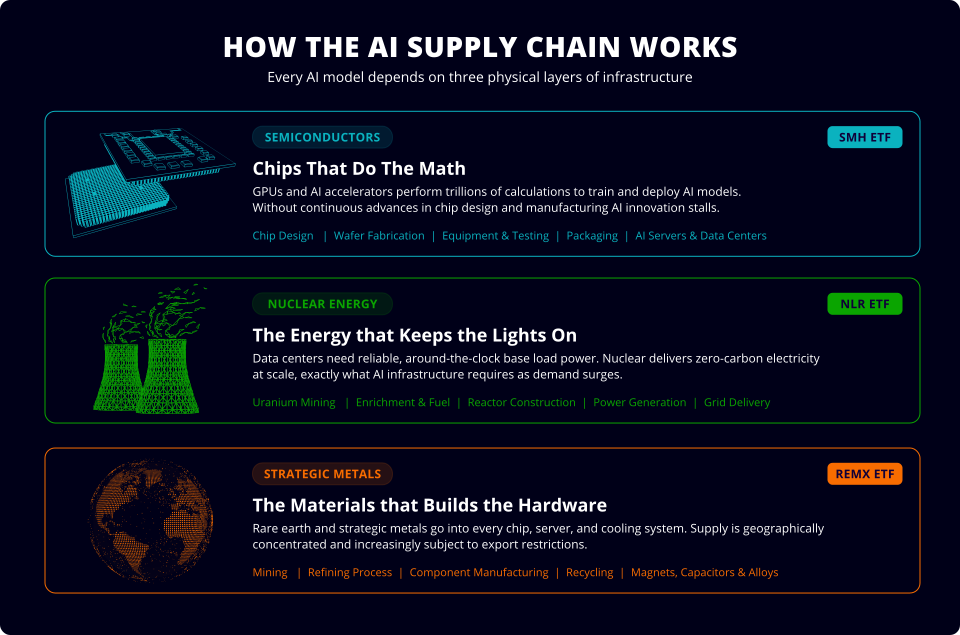
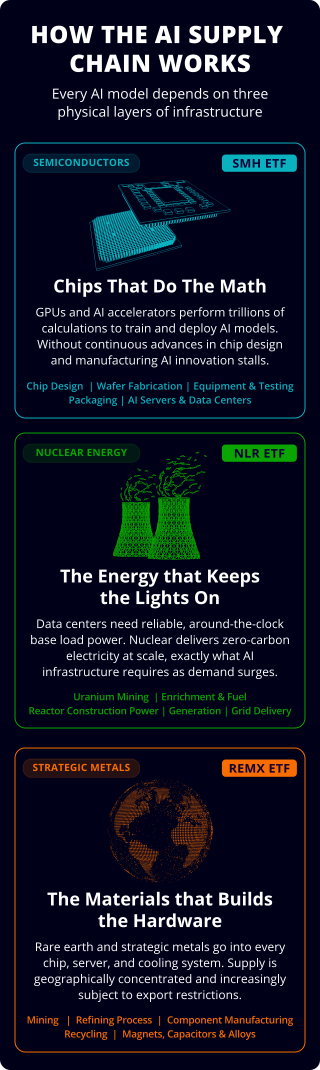
How the AI Supply Chain Works
AI runs on physical infrastructure. Before a model can answer a question or generate an image, semiconductors have to process the data, power plants have to keep the servers running, and raw materials have to be mined, refined, and built into hardware. Each layer depends on the one below it. Here’s how the three layers connect.
Source: VanEck. These are not recommendations to buy or to sell any security.
Why Semiconductors Are Critical to AI?
Without advanced chips, none of this works. GPUs and custom accelerators handle the trillions of matrix multiplications required to train large language models, generate images, and run autonomous systems. The entire AI wave is, at its core, a semiconductor demand story.
The semiconductor industry also has a structural moat and only a handful of companies worldwide can manufacture the most advanced chips. That concentration creates real pricing power and long-duration demand for the companies at the top of the food chain.
SMH: Invest in the Semiconductors Driving AI
The VanEck Semiconductor ETF (SMH) tracks the MVIS®US Listed Semiconductor 25 Index, covering the largest U.S.-listed chip companies across design, manufacturing, and equipment. It’s a single way to access the core of the AI buildout.
Why AI Needs Reliable Energy
The challenge is that most of the U.S. energy grid was built decades ago. Solar and wind help, but they’re intermittent—and a data center can’t afford to go dark when the wind stops blowing.
That’s why nuclear is getting serious attention. Microsoft, Meta, and Amazon have all announced plans to secure nuclear power for their AI infrastructure. The federal government has moved to ease nuclear plant regulations and fund next-generation reactor designs. Nuclear delivers exactly what a data center needs: reliable, scalable, zero-carbon baseload power, 24 hours a day.
NLR: Invest in the Industry Powering AI
The VanEck Uranium and Nuclear ETF (NLR) covers the full nuclear value chain—uranium mining, reactor construction and engineering, maintenance, and electricity generation. The fund tracks the MVIS® Global Uranium & Nuclear Energy Index. For investors looking to position for the nuclear renaissance that AI is accelerating, NLR offers a direct way in.
What Materials Are Important to AI?
Every AI chip, server rack, and cooling system is built from a cocktail of specialized metals. Here are a few raw materials that matter most:
- Neodymium and dysprosium power the high-strength permanent magnets inside hard drives, server fans, and cooling pumps.
- Copper carries massive electrical currents through the busbars and wiring that connect clustered AI systems.
- Tantalum goes into the capacitors that regulate voltage in GPUs and memory modules during rapid workload shifts.
- Gallium and germanium are essential for advanced chip fabrication and the high-speed fiber optics inside data centers.
The geopolitical dimension here is hard to ignore. China produces the majority of the world’s rare earths and controls nearly all of the processing capacity. The Chinese government recently imposed export licensing rules that require foreign buyers to disclose end-use applications—effectively restricting access for U.S. defense and advanced technology purchasers.
Western governments are investing in domestic mining and processing alternatives, but reshoring these supply chains is a multi-year project. Demand from the AI buildout, meanwhile, keeps climbing.
REMX: Invest in the Materials Building AI
The VanEck Rare Earth and Strategic Metals ETF (REMX) tracks the MVIS® Global Rare Earth/Strategic Metals Index, which requires constituent companies to derive at least 50% of revenue from the rare earth and strategic metals industry.
Invest in the AI Buildout with VanEck
The biggest AI winners over the next decade may not be the companies writing the models. They may be the companies making the chips those models run on, generating the electricity those chips consume, and mining the metals that make all the hardware possible.
VanEck’s AI supply chain ETFs let investors gain targeted exposure to the physical infrastructure that every AI company depends on.
1 Source: MIT Technology Review (May 2025), https://www.technologyreview.com/2025/05/20/1116327/ai-energy-usage-climate-footprint-big-tech/
Related Insights


Related Insights
09 April 2026


09 April 2026
Gen Z and younger millennials have reshaped finance, work, and entertainment. The GENZ ETF captures the companies built to serve the economy they created.
02 April 2026
VanEck’s TruSector ETFs are designed to deliver full market-cap sector exposure and help asset allocators track sector benchmarks with greater precision.
20 March 2026
U.S. equity markets shifted from a sector rotation driven by AI disruption fears to a broad sell-off fueled by geopolitical shocks in Iran and a surprisingly weak jobs report, raising stagflation concerns.