The Next Phase of AI: Digital Native Economy
04 May 2026
Read Time 7 MIN
Key Takeaways:
- The AI trade is expanding. As agents complete tasks, consumer execution platforms may capture value alongside chip and cloud companies.
- The moat moves beneath the screen. Embedded payments and logistics matter more when AI handles discovery and front-end experience matters less.
- GENZ captures the execution layer. It holds the consumer platforms where AI agents may initiate and complete transactions on behalf of users.
For most of the internet era, the app was the destination.
Consumers opened an app to pay a friend, order dinner, book a ride, make a trade, or place a bet. The companies that won built the best digital storefronts, captured user attention, and became the default interface for everyday economic activity.
That model may be starting to shift.
As artificial intelligence evolves from answering questions to completing tasks, the next phase of the digital economy may be less about which app a user opens and more about which platforms an AI agent can actually transact through. In that world, the interface matters less than the infrastructure beneath it. The winners may not simply be the companies with the best front-end experience, but the companies with the payments, logistics, merchant relationships, data, and digital workflows that agents can access and act on.
This is the transition from the app economy to the agent economy.
And it may represent another way to think about the next phase of the AI trade.
How Is Agentic AI Changing Digital Commerce?
For years, digital commerce has been built around clicks, taps, and screens. The consumer browses. The platform presents choices. The transaction happens inside the app.
Agentic AI introduces a different model.
Instead of navigating every step manually, a consumer may increasingly delegate tasks to an AI assistant: reorder groceries, book a ride to the airport, compare prices on a product, pay a bill, split a purchase, or find the fastest way to complete a task. The consumer still makes the decision, but the path from intent to transaction becomes more automated.
That has important implications for investing.
If AI agents begin to mediate more consumer activity, then value may shift toward the platforms that sit closest to execution. Not just the platforms that attract traffic, but the ones that can actually fulfill an instruction.
In other words, the companies that can turn intent into action.
AI Shopping and Agentic Activity Indicators
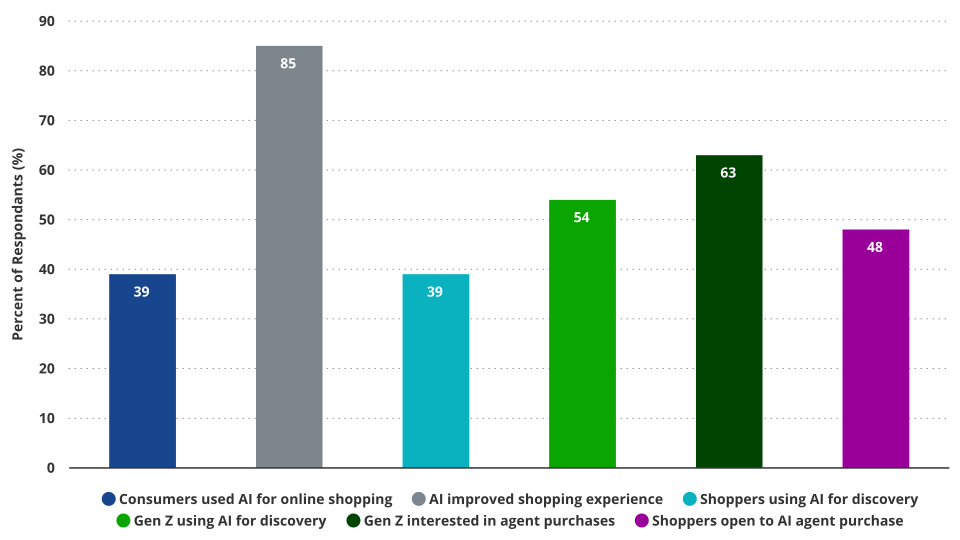
Sources: Adobe for Business, April 16, 2026. Salesforce, March 24, 2025. Salesforce, October 14, 2025.
Why Does the Agent Economy Matter for the Digital Native Economy?
The digital native economy is already built around this kind of behavior.
Gen Z and younger millennials do not separate digital life from economic life. Their finances are mobile, their work is increasingly platform-based, their shopping happens inside digital ecosystems, and their entertainment is interactive and always on. For this consumer, the phone is not simply a communication device. It is the wallet, the storefront, the office, and the entertainment hub.
That is what makes the digital native economy compelling as an investment theme.
It is not just about technology adoption. It is about a structural shift in how a generation earns, spends, and plays. The platforms serving these behaviors are no longer niche disruptors. They are becoming core economic infrastructure for a growing and increasingly dominant consumer cohort.
The next step may be that these same platforms become the transaction layer for agentic commerce.
The Consumer Side of the AI Trade
Much of the AI discussion to date has focused on semiconductors, hyperscalers, cloud infrastructure, and model developers. Those layers are critical. They power the entire ecosystem.
But AI does not end at inference.
If the next chapter of AI is about agents taking action on behalf of users, then consumer platforms may become an increasingly important part of the story. An agent can recommend a product, but it still needs a platform to complete the purchase. It can identify the lowest-cost ride, but it still needs a network to dispatch the car. It can suggest a payment option, but it still needs a wallet or payment rail to execute the transaction.
That is where the digital native economy enters the conversation.
The companies serving this part of the economy are not just destinations for user engagement. They may also be the endpoints through which AI-driven actions are executed.
What Is the Execution Layer and Why Does It Matter More in the Agent Economy?
The app economy rewarded companies that owned the user interface.
The agent economy may reward companies that own the execution layer.
That execution layer can take many forms:
- payment networks and digital wallets,
- e-commerce and merchant platforms,
- local delivery and logistics systems,
- online marketplaces,
- app-based financial services,
- digital communities with embedded commerce,
- and platforms that connect identity, trust, and fulfillment.
These are the systems that make digital activity possible. They do not just attract the consumer; they help complete the transaction.
That distinction matters.
In a world where AI can increasingly handle discovery, compare options, and simplify decisions, some front-end experiences may become less differentiated. But the platforms that actually process the payment, coordinate the delivery, facilitate the booking, or maintain the customer relationship could become even more important.
The moat may move beneath the screen.
Why Does GENZ Fit the Shift from the App Economy to the Agent Economy?
The VanEck Digital Native Economy ETF (GENZ) was built to capture the companies serving the consumer-facing layer of the digital economy. The strategy focuses on platforms tied to how the next generation pays, works, and plays, across digital finance, gig economy platforms, and online sports betting and gaming.
That framework already reflects a major generational shift in consumer behavior. But viewed through the lens of AI, it may also represent exposure to something broader: the consumer infrastructure that could help power the agent economy.
The same platforms that have already become essential to digital-native consumers may be the ones best positioned for a future in which AI agents help initiate and manage more of those interactions.
In that sense, the digital native economy may be more than a consumer behavior story. It may also be one way to access the next phase of AI.
A Different Way to Think About the Future of AI
The first phase of the AI trade has been dominated by the builders of intelligence.
The next phase may increasingly include the enablers of action.
That does not mean every company in the consumer internet wins. Some platforms may face pressure if AI reduces brand-based discovery or compresses the value of the front end. But the companies with embedded payments, repeat engagement, structured inventories, fulfillment systems, and strong digital relationships may be better positioned than the market currently appreciates.
That is why the idea of moving from app economy to agent economy is so interesting.
It suggests that the future of AI may not only belong to those who create intelligence, but also to those who sit where intelligence meets transaction. For investors, that opens up another way to think about the opportunity. Not just through the infrastructure that powers AI. But through the digital-native platforms where AI may increasingly go to work.
Related Insights



Related Insights

20 August 2026
AI and semiconductor volatility gave way to an August recovery as a leveraged hedge fund unwind cleared, and Super Micro and Palantir led BUZZ Index gains.
23 July 2026
After three strong years, many nuclear and uranium stocks have given back a chunk of their gains. We look at what drove the pullback, what’s gone right, and the opportunity ahead.
22 July 2026
TSMC posted record Q2 profit, raised its full-year revenue growth outlook to above 40%, and announced a $100 billion expansion in Arizona as AI demand continues to outpace supply. Here is what it means for SMH and SMHX.