Hawks – Standing Their Ground
23 February 2023
Read Time 2 MIN
Fed Rate Hike Expectations
The market raised its peak rate expectations for the U.S. a little bit more, as the U.S. Federal Reserve’s (Fed’s) minutes signaled more rate hikes “in order to attain a stance of monetary policy that is sufficiently restrictive to return inflation to 2 percent over time”. This morning’s secondary estimate of the U.S. Q4 GDP was not incompatible with the “somewhat higher peak rate/slower rate cuts” scenario. Even though personal consumption was revised down (albeit not recessionary), the upside revision of Q4 GDP deflator was quite meaningful. Higher “risk-free” rates have a direct impact on emerging markets (EM) debt total return, and if this process is accompanied by higher rates’ volatility, spread returns on lower-rated EM bonds might get hit as well. This is exactly what happened during the reversal of January’s rally.
EM Monetary Policy Stance
A perception that a central bank might be falling behind the curve – or forced to ease prematurely – can weigh on bonds even during the “everything rally”. With that in mind, we are happy to report that EM “Alumni” echoed the Fed’s hawkish sentiment – Israel’s larger than expected hike a few days ago was followed by South Korea’s hawkish hold, which left room for more policy tightening due to high uncertainty about the inflation forecast. Back in “EM proper”, India’s central bank minutes signaled another rate hike in April – note that this came before January’s shocking upside inflation surprise. Mexico’s central bank minutes also showed a great deal of caution, with some board members saying that underlying inflation is more persistent than expected and that it might be risky to signal a smaller rate hike in March.
LATAM Rate Cycle
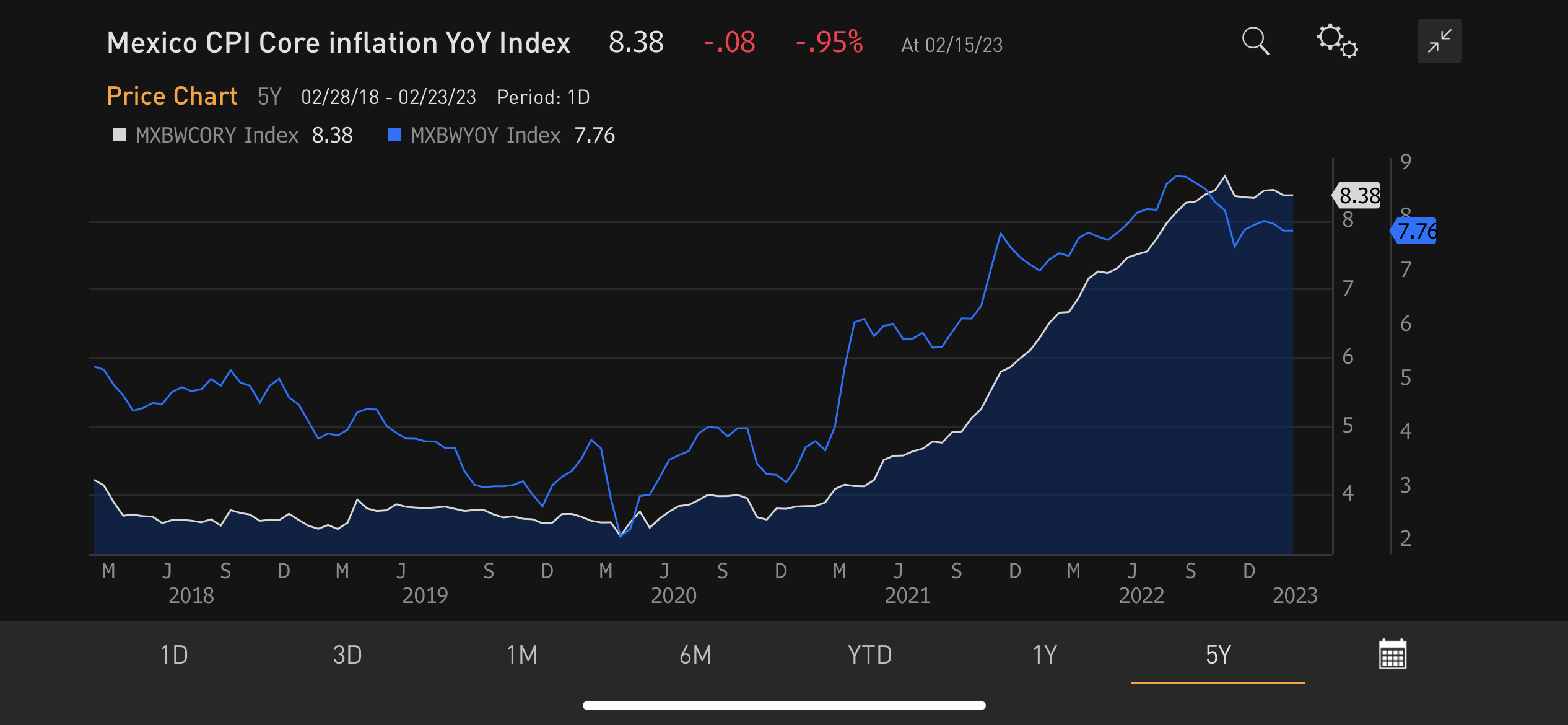
Mexico’s bi-weekly inflation prints showed that such caution is totally justified – despite a small downside surprise. Disinflation is still slow (see chart below), and both core and headline inflation are well above the target range. Brazil’s mid-month inflation release tomorrow will also be closely watched. The consensus sees sizable moderation – from 5.87% year-on-year to 5.59% – but (ironically) if this scenario were to materialize, we might end up with more calls from Luiz Inácio Lula da Silva’s (Lula’s) administration to lower the policy rate in order to prop up growth. Such demands quieted down lately, and the market was quick to respond by pricing in more rate cuts on a 1-year horizon (131bps). Stay tuned!
Chart at a Glance: Mexico Disinflation – Progress Still Slow
Source: Bloomberg LP.
MXBWCORY Index – Mexico CPI Core Inflation YoY Percent Change Biweekly.
MXBWYOY Index – Mexico CPI Yearly Percent Change Biweekly.
Related Insights

Related Insights
07 April 2025
06 March 2025
20 February 2025
10 February 2026
Debasement is back in focus. Here’s what’s driving it, what could reverse it and how we’re positioning portfolios for both scenarios.
07 April 2025
Trump’s tariffs spark trade war fears, fueling market volatility, inflation risk, and recession threats. With global retaliation likely, near-term growth is clearly at risk.
06 March 2025
Trump’s tariffs, AI’s next phase, and a potential U.S. gold revaluation could shake markets—investors who stay ahead of these transitions will be best positioned.
20 February 2025
China's AI breakthrough, persistent inflation, gold’s outperformance, and rising energy demand underscore a shifting investment landscape.
16 January 2025
In 2025, navigating turbulence means balancing tech innovation, inflation hedges, energy shifts, and risks from spending cuts and inflation.