CNY Strength and DM Bond Weakness Drive EM Outperformance
11 September 2025
Read Time 9 MIN
Key Takeaways:
- EM bonds are far outpacing DM bonds (again!) as G10 yields rise and CNY strengthens.
- EM inflation has eased while DM inflation builds, with little reform risk.
- CNY strength is, boosting broader EMFX as China trade links with EM are greater than the U.S.
The VanEck Emerging Markets Bond Fund was up 2.78% in August, compared to up 1.89% for its benchmark. YTD, the fund is up 13.47%, compared to 11.28% for its benchmark, 50% J.P. Morgan GBI-EM Global Diversified Index/50% J.P. Morgan EMBI Global Diversified Index, and 7.26% and 5.92% for the Global Agg and 10-year treasuries, respectively.1
During August we took a brief break from our extreme caution on USD duration as it had worked perhaps too quickly, making Saudi and Philippines big winners for the fund. We intend to reverse these soon. Our tiny exposure to very selected China corporates continues to crush it and leads the outperformers, and Brazil in local currency was a big winner. Another big winner was our severe underweight to India in both local and USD, which performed poorly in August.
We remain very bullish on local currency, while very cautious on USD duration (after a brief boost to our USD duration during August based largely on the low duration view having worked very well but also very quickly). The fund has around 60% in curated local currency, 40% in mostly higher-yielding USD bonds. Carry is 6.49%, yield to worst (YTW) is 7.9%, and duration is 3.9 (down from 4.8 in July).
Average Annual Total Returns* (%) (In USD)
| As of August 31, 2025 | |||||||||
| 1 Mo | 3 Mo | YTD | 1 Yr | 3 Yrs | 5 Yrs | 10 Yrs | |||
| Class A: NAV (Inception 07/09/12) | 2.56 | 6.20 | 13.16 | 10.88 | 9.97 | 3.75 | 4.36 | ||
| Class A: Maximum 5.75% load | -3.34 | 0.09 | 6.66 | 4.50 | 7.82 | 2.53 | 3.75 | ||
| Class I: NAV (Inception 07/09/12) | 2.78 | 6.51 | 13.47 | 11.39 | 10.46 | 4.15 | 4.70 | ||
| Class Y: NAV (Inception 07/09/12) | 2.75 | 6.44 | 13.52 | 11.28 | 10.33 | 4.03 | 4.62 | ||
| 50% GBI-EM/50% EMBI | 1.89 | 4.81 | 11.28 | 9.07 | 9.11 | 1.63 | 3.54 | ||
| As of June 30, 2025 | |||||||||
| 1 Mo | 3 Mo | YTD | 1 Yr | 3 Yrs | 5 Yrs | 10 Yrs | |||
| Class A: NAV (Inception 07/09/12) | 3.71 | 6.87 | 10.51 | 13.04 | 10.68 | 4.77 | 3.35 | ||
| Class A: Maximum 5.75% load | -2.25 | 0.73 | 4.16 | 6.54 | 8.51 | 3.54 | 2.74 | ||
| Class I: NAV (Inception 07/09/12) | 3.76 | 7.00 | 10.54 | 13.33 | 11.04 | 5.08 | 3.64 | ||
| Class Y: NAV (Inception 07/09/12) | 3.91 | 7.12 | 10.82 | 13.51 | 11.03 | 5.04 | 3.59 | ||
| 50% GBI-EM/50% EMBI | 2.60 | 5.47 | 8.94 | 11.93 | 8.72 | 1.89 | 2.88 | ||
* Returns less than one year are not annualized.
Expenses: Class A: Gross 1.83%, Net 1.21%; Class I: Gross 1.37%, Net 0.86%; Class Y: Gross 1.33%, Net 0.96%. Expenses are capped contractually until 5/01/26 at 1.20% for Class A, 0.85% for Class I, 0.95% for Class Y. Caps exclude acquired fund fees and expenses, interest, trading, dividends, and interest payments of securities sold short, taxes, and extraordinary expenses.
The performance data quoted represents past performance. Past performance is not a guarantee of future results. Investment return and principal value of an investment will fluctuate so that an investor’s shares, when redeemed, may be worth more or less than their original cost.
Performance may be lower or higher than performance data quoted. Please call 800.826.2333 or visit vaneck.com for performance current to the most recent month ended.
The “Net Asset Value” (NAV) of a Fund is determined at the close of each business day , and represents the dollar value of one share of the fund; it is calculated by taking the total asset of the fund, subtracting total liabilities, and dividing by the total number of shares outstanding. The NAV is not necessarily the same of the ETF’s intraday trading value. Investors should not expect to buy or sell shares at NAV.
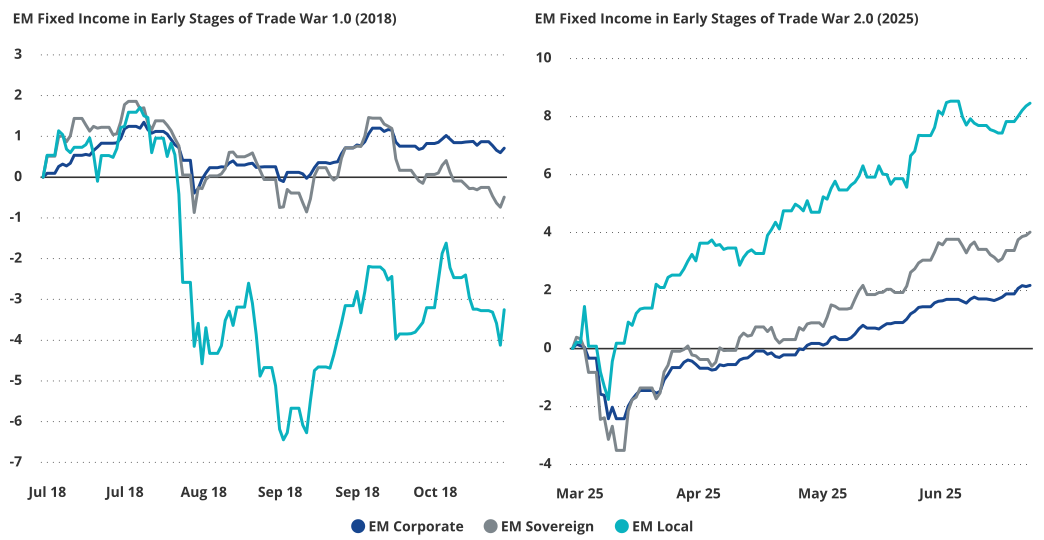
We continue to see two major trends boosting EM bonds – the ongoing selloff of G-10 30y yields (from Japan to the UK and the US) combined with the related and ongoing rally of CNY. They are interrelated because the strength of EMFX reinforces their low inflation paths and actually supports duration on EM local currency bonds, while duration in DM bonds sells off. Both trends support EM bonds. This is why duration is not a monolith. Mexican 30-year yields are lower by over 100bp in 2025! Seemingly incredibly given its strong connection to the US, so we’re picking the hardest comparable in EM by mentioning Mexico. We show the aggregate EM local currency paths in Trump 1 and Trump 2, and the market continues to struggle for an explanation. As we’ve argued, the source of this exceptional behavior is the far superior fiscal positions of most EMs relative to over-indebted DMs. This has led Chinese and Asian EM inflation downward relative to the DMs, which continues to strengthen EM currencies. We note this to remind that the big wheel turning is fiscal and its monetary implications, namely that EM central banks are far more credible on their inflation focus. We tied this all together in “The Curiously Unpopular Case for RMB/CNY Appreciation”.
Exhibit 1 - Trump 1 Hurt EM, Trump 2 Helping...Why?
Source: VanEck Research, Bloomberg LP. as of August 2025. EM Corporate is represented by the J.P. Morgan CEMBI Broad Diversified Index which tracks the performance of US dollar-denominated bonds issued by emerging market corporate entities.; EM Local is represented by the J.P. Morgan GBI-EM Global Core which tracks local currency bonds issued by emerging markets governments. The index weighting methodology limits the weight of countries with larger debt stocks, with a maximum of 10% and a minimum of 1% to 3% depending on the amount of the country’s eligible debt outstanding.; EM Sovereign is represented by the J.P. Morgan EMBI Global Diversified Index which is comprised of U.S. dollar-denominated Brady bonds, Eurobonds, and traded loans issued by emerging markets sovereign and quasi-sovereign entities. The index weighting methodology limits the weight of countries with larger debt stocks. Past performance is no guarantee of future results. Index performance is not representative of fund performance. It is not possible to invest directly in an index.
The first trend, rising G-10 30y yields, is driven by the “fiscal dominance” thesis we’ve been presenting for over a decade. High government indebtedness translates into a central bank less or unable to hike rates purely due to inflation. EM inflation has been declining and DM inflation rising as a result. The risk to this trend is fiscal austerity and/or structural reform in the over-indebted DMs, and we see very low odds of this. In fact, odds of the Fed, for example, suppressing interest rates using heterodox tools (like yield curve control) seem to be a serious scenario.
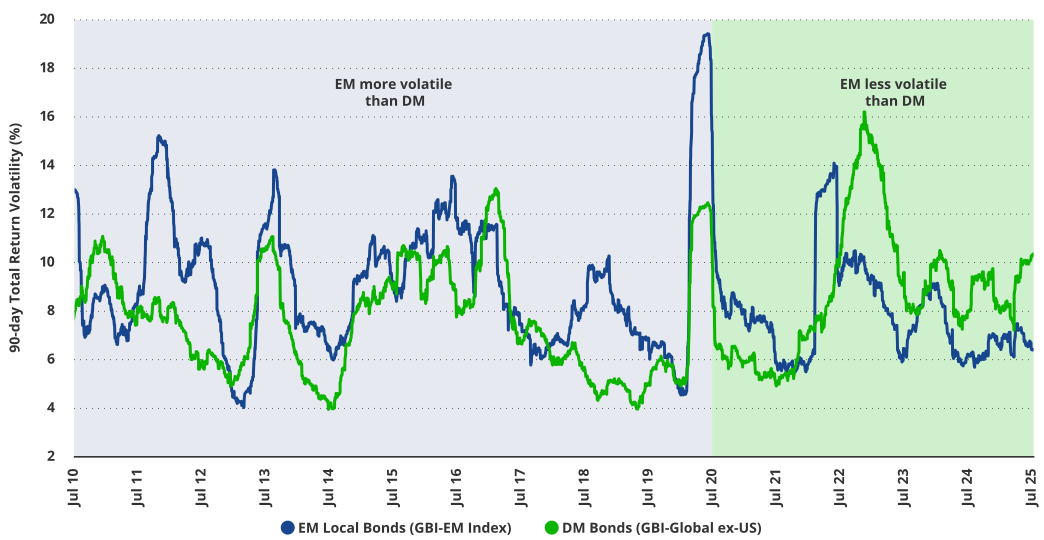
This trend has its opposite, as obviously money is going somewhere. Although many focus on the USD’s moves versus EUR, JPY, or GBP, we think that because they are all subject to the same ”fiscal dominance” and are provably highly correlated with each other. They are all in the same “overindebted G-10” bucket so to speak. As a result, it is CNY’s strength that is noteworthy. Most EM trades far more with China than with the US, so CNY revaluation is a real boost to other EM currencies as we’ve seen in 2025. Given the strong net international investment position of China and many EMs, meaning a net long USD position, simple game-theory should tell you that the incentive to reshore (or bring to other non-US shores) assets to EMs is profound. The simplest example is Japan, a key funder of US Treasuries. Hedged into JPY, US Treasuries yield ¼ of what a Japanese government bond (JGB) yields, or 100bp lower, due to FX hedging costs. This characterizes many key buyers of Treasuries. Exhibit 2 shows that EM bonds are now in a lower volatility regime than DM bonds. Not only is outright carry or yield or ex-post return superior, but actual volatility is lower. There really is no clearer signal for investors, who largely have avoided EM bonds for the past decade.
Bonus Exhibit 2 - EM Local Bonds Less Volatile than DM Bonds
EM Local Bonds vs DM Sovereigns - 90-day Total Return Volatility (%)
Source: VanEck Research, Bloomberg LP. Data as of July 2025.
During August we took a brief break from our extreme caution on USD duration as it had worked perhaps too quickly, making Saudi and Philippines big winners for the fund. We intend to reverse these soon. Our tiny exposure to very selected China corporates continues to crush it leading the outperformers, and Brazil in local currency was a big winner. Another big winner was our severe underweight to India in local and USD which performed poorly in August. We remain very bullish on local-currency while very cautious on USD duration (after a brief boost to our USD duration during August based largely on the low duration view having worked very well but also very quickly). The fund has around 60% in curated local currency, 40% in mostly higher-yielding USD bonds. Carry is 6.49%, YTW is 7.9%, and duration is 3.9 (down from 4.8 in July).
Exposure Types and Significant Changes
The changes to our top positions are summarized below. Our largest positions in August were Brazil, Mexico, South Africa, Thailand, and Malaysia:
- We increased our local currency exposure in Mexico and Colombia. Mexico is a likely winner from solid growth in the U.S. and the next stage of the trade war 2.0, while the central bank is credibly reducing the policy rate (at a slower speed). These factors strengthened the country’s technical and policy test scores. Colombia’s central bank staying on hold (despite persistent political pressure from the government) and a prospect of a market-friendly political change after the presidential elections improved the policy/politics test score for the country.
- We also increased our hard currency sovereign exposure in Bolivia, as the as the market started to price in a more pro-reform presidential election scenario, which got confirmed by the 1st round results. In terms of our investment process, this improved the country’s policy/politics test score.
- Finally, we increased our local currency exposure in Poland and Hungary. Poland’s 2026 budget raised some concerns about the pace of fiscal consolidation, but the net borrowing needs are likely to be close to the 2025 level, which was revised lower, improving the technical test score for the country. Hungary’s inflation is slowing, the market’s expectations for this cycle’s terminal rate might be too high, and the government is sticking to its 2025 and 2026 fiscal targets despite weaker growth, boosting Hungary’s policy/politics and economic test scores.
- We reduced our local currency exposure in Malaysia and Thailand, as both positions are popular longs which now started to look elevated worsening the technical test score for the countries. An additional consideration in Malaysia is that solid Q2 GDP growth is likely to support the central bank’s decision to remain on hold for now.
- We also reduced our hard currency sovereign exposure in Saudi Arabia on the back of concerns about global duration against the backdrop of Saudi Arabia’s low spread-to-yield ratio, which worsened the technical test score for country.
- Finally, we reduced our hard currency sovereign exposure in Argentina. Sovereign bonds were popular longs which makes them vulnerable to stronger political noise in the runup to the mid-term elections. The market is also not very happy about the authorities’ attempts to maintain stable/strong currency before the elections, which boost local interest rates and can slow (or even reverse) the reserve accumulation. In terms of our investment process, this worsened the technical and policy/politics test scores for Argentina.
1 As of 8/31/2025. Global Agg is represented by the ICE BofA Global Broad Market Index; 10-year treasuries represented by the ICE BofA Current 10-Year US Treasury Index.
ICE BofA Global Broad Market Index tracks the performance of investment grade debt publicly issued in the major domestic and eurobond markets, including sovereign, quasi-government, corporate, securitized and collateralized securities.
ICE BofA Current 10-Year US Treasury Index is comprised of the most recently issued 10-year US Treasury note.
J.P. Morgan EMBI Global Diversified Index is comprised of U.S. dollar-denominated Brady bonds, Eurobonds, and traded loans issued by emerging markets sovereign and quasi-sovereign entities. The index weighting methodology limits the weight of countries with larger debt stocks.
J.P. Morgan GBI-EM Global Diversified Index tracks local currency denominated EM government debt. The index weighting methodology limits the weight of countries with larger debt stocks, with a maximum of 10%.
Related Insights

Related Insights
18 December 2025
Get your portfolio ready for 2026 with detailed insights from VanEck’s investment team about the factors driving risk and returns in their respective asset classes.
04 December 2025
EM high yield has extended its 2025 momentum, delivering strong carry and compelling yields. With higher credit quality and lower defaults, the segment offers a more attractive risk profile than US high yield.
28 October 2025
The EM Debt team just returned from the Fall IMF Annual Meeting, here are their takeaways.
26 June 2025
Stagflation risks, rising recession odds, and shifting global power dynamics are reshaping the investment landscape—forcing investors to rethink where safety and opportunity truly lie.
25 June 2025
Emerging markets bonds have been quietly outperforming U.S. and global broad markets over the past decade, offering high yields, strong fundamentals, and diversification amid global risks.