FLTR ETF: Question & Answer
Read Time 10+ MIN
- What are floating rate notes and how big is the market?
- How does an FRN coupon adjust?
- How do FRN Rate Reset Mechanics work?
- What impacts the price of FRNs?
- What happens to FRNs when spreads widen?
- How do FRNs differ from loans or other short duration strategies?
- Why are FRNs attractive now?
- How can investors use FRNs within a portfolio?
- What makes FLTR’s strategy unique?
- Who should own FRNs?
What are floating rate notes and how big is the market?
Unlike other bonds which typically pay a fixed coupon, floating rate notes (or “FRNs”) pay a coupon that adjusts periodically with prevailing interest rates. Because FRN coupons reflect current interest rates, the price of the bonds are not sensitive to changes in rates. This is in contrast to fixed rate bonds in which the coupon does not change with interest rates but the price will increase/decrease as rates decline/increase. As a result, FRN prices have near-zero sensitivity to interest rates and coupons will actually increase as rates go up, making them potentially attractive in rising rate environments. In other respects such as credit risk, they are similar to other bonds from the same issuer.
The FRN market was approximately $720 billion in size as of 10/31/20241. The size of the market tends to correlate with the level of short-term interest rates, as demand for FRNs tends to increase as rates rise and vice versa. Both the Secured Overnight Financing Rate (SOFR) and target Fed Funds rate increased significantly since the beginning of 2022, and accordingly the market size has increased over the past couple of years with JP Morgan seeing approximately $107bn in issuance through October 2025, $82bn in 2024 and $48bn in 2023.
Following the most aggressive Federal Reserve tightening cycle in four decades, short-term yields have remained elevated. This environment has continued to support strong demand for FRNs as investors seek floating-rate exposure that benefits from higher income levels while maintaining limited price sensitivity. Even as markets begin to anticipate potential rate cuts in 2026, FRNs remain attractive due to their spread above SOFR and insulation from interest rate driven volatility. The FRN market’s steady expansion underscores investor confidence in the asset class as a tool for managing interest rate uncertainty.
SOFR vs Fed Funds
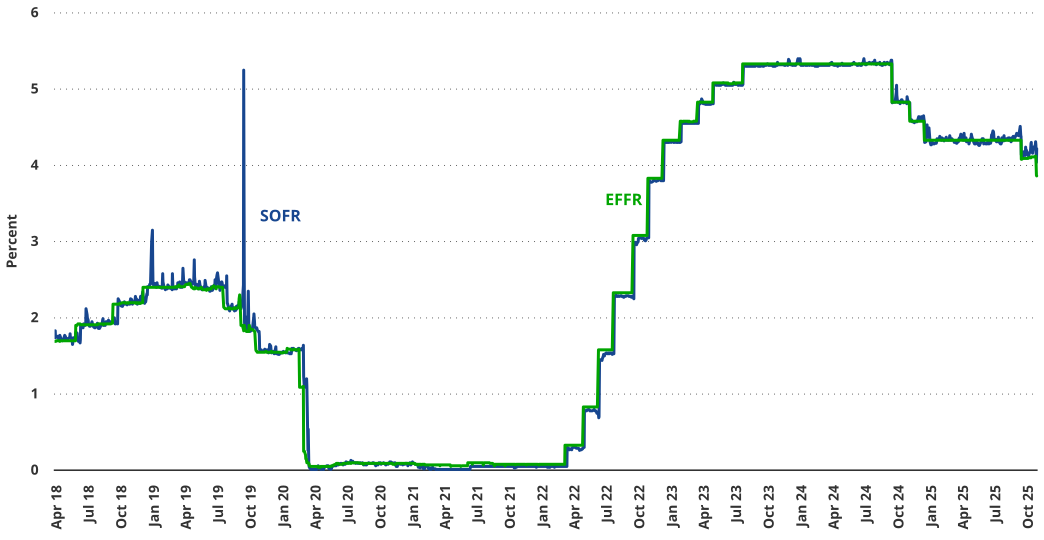
Source: New York Fed.
FRNs are often issued as a component of multi-tranche issuances along with fixed rate bonds. Banks and other financial companies tend to be the largest issuers of floating rate notes, as they help to match the duration of their assets. Non-corporate issuers, including the U.S. Treasury and government agencies, are also very active in the market. The overall FRN market is predominantly rated investment grade and is concentrated in bonds with maturities of less than five years.
How does an FRN coupon adjust?
The terms of an FRN issue specify a coupon formula, which is generally a fixed spread above a floating rate. In the majority of cases, the floating rate is defined as SOFR. The spread over the floating rate primarily compensates investors for the additional credit risk (e.g., the risk of a deterioration in credit quality including a potential default) they are assuming by investing in the bond. Credit spreads generally increase as the creditworthiness of an issuer decreases. In addition, credit spreads for longer maturities are typically higher than lower maturities.
Spreads Tend to Increase with Maturity

Source: ICE Data Services, as of 10/31/2025. Based on constituents of the MVS US Investment Grade Floating Rate Index.
For example, an FRN may specify a quarterly coupon compounded daily SOFR over each period plus a fixed spread of 1.04% plus. If compounded daily SOFR were to be 4%, the coupon rate for the period would be 5.04%.
How do FRN Rate Reset Mechanics work?
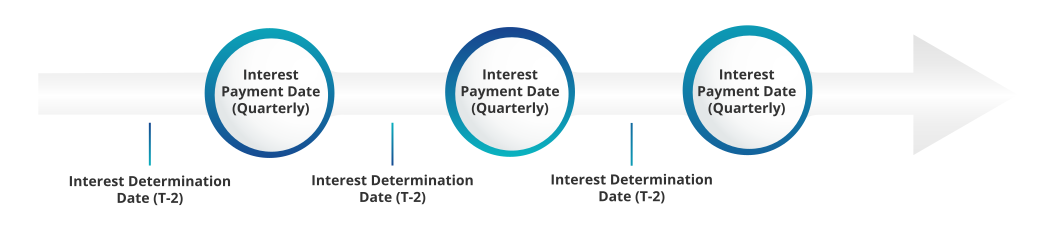
Floating rate notes (FRNs) offer investors a coupon that is equal to a fixed spread over a short-term reference rate (usually SOFR) that adjusts each period. Because the coupon adjusts with prevailing interest rates, FRNs have near zero sensitivity to changes in interest rates, unlike fixed coupon bonds which decline in price as rates move up. In addition, the spread on corporate FRNs allow investors to earn additional yield above the risk-free rate. Among FRNs, it is typical for SOFR (which is an overnight rate) to be compounded over the period.
To simplify: Coupon = reference rate + fixed spread. This is illustrated below:
FRN Coupons Adjust Each Period

What impacts the price of FRNs?
As mentioned, FRN coupons adjust with prevailing short-term interest rates. As a result, prices have virtually no sensitivity to changes in interest rates. Investors will not suffer mark-to-market losses as interest rates rise but will also not benefit from interest rate declines. This is in contrast to fixed coupon bonds, which will exhibit a sensitivity to interest rates that is measured by interest rate duration. Longer maturity bonds have longer durations, all else equal.
Other changes in the market can impact FRN prices, however, primarily due to the fixed spread that is specified for each bond. The spread paid above the floating rate does not change over the life of the bond. Because this spread primarily reflects credit risk, changes in the creditworthiness of the issuer and general changes in credit conditions can impact FRNs.
What happens to FRNs when spreads widen?
If credit spreads widen, the value of an FRN may decline to compensate investors for the additional spread that is needed. This sensitivity is referred to as spread duration. In contrast to interest rate duration, which measures price sensitivity to interest rates, spread duration measures sensitivity to a change in credit spreads of that issuer. Longer maturities and more credit oriented sectors will generally have higher spread durations than lower maturities and non-credit issuers such as government agencies. Investors are typically compensated for this additional spread risk through a higher spread, and therefore a higher coupon.
The result of this spread exposure is potentially higher volatility and drawdowns when spreads widen as compared to non-credit sensitive FRNs such as those issued by the U.S. Treasury, but also a higher yield which historically has allowed FRNs to recover and outperform in the long-term. Recent market experience reinforces this behavior. For example, during brief credit-spread widening episodes in 2023 and mid-2025 which were driven by economic slowdown concerns, FRNs experienced limited, short-lived price declines before quickly recovering as corporate fundamentals remained solid. Although credit spreads can impact valuations, the low interest-rate duration of FRNs helped shield investors from the larger rate-driven drawdowns that can affect traditional fixed-rate bonds.
In many ways, the risk profile of corporate FRNs is closer to short-term corporate bonds, which also have credit exposure but also greater sensitivity to interest rate movements compared to corporate FRNs. This rate exposure may help or hurt performance depending on the interest rate environment. Recently, performance of fixed coupon bonds, even with shorter maturities, has suffered due to rate volatility.
FRNs with Higher Spread Exposure Outperformed (10 Years)
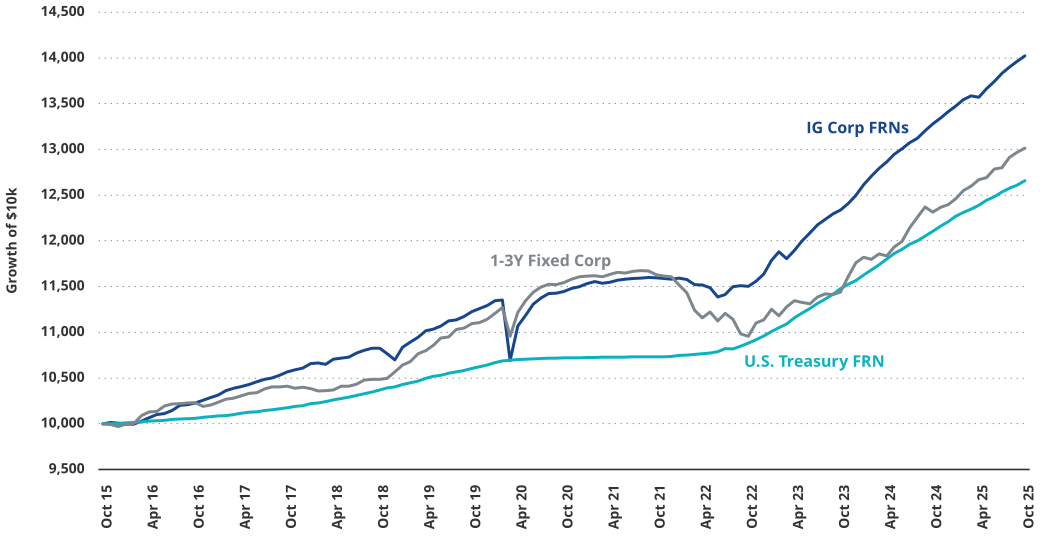
Source: Morningstar Direct. IG Corps represented by MVIS US Investment Grade Floating Rate Index, US Treasury FRN by ICE BofA US Floating Rate Treasury Index and 1-3Y Fixed Corp by ICE BofA 1-3Y US Corp Index. Past performance is no guarantee of future results. Index performance is not representative of fund performance. It is not possible to invest directly in an index.
How do FRNs differ from loans or other short duration strategies?
Compared to investment grade short term bonds (e.g., 1-3 year or 1-5 year fixed coupon strategies), the primary difference is that FRNs have a near-zero duration and virtually no sensitivity to changes in interest rates. Therefore, investors looking to shorten their overall exposure to interest rate may find an allocation to FRNs attractive. Since FRNs are also investment grade, this does not entail assuming significantly more credit risk. The yield on FRNs will vary based on prevailing rates and spread levels. Currently FRNs offer a yield pick-up over fixed rate short-term bonds.
FRNs offering Higher Yields

Source: ICE Data Services, as of 10/31/25. IG FRNs represented by the MVIS US Investment Grade Floating Rate Index, 1-5Y US Corp by ICE BofA 1-5 Year US Corporate Index, 1-3Y Corp by ICE BofA 1-3 Year US Corporate Index, UST FRNs by ICE BofA US Floating Rate Treasury Index, 1-5Y US Corp/Gov by ICE BofA 1-5 Year US Corporate & Government Index and 2Y US Treasury by ICE BofA Current 2-Year US Treasury Index. Past performance is no guarantee of future results. Index performance is not representative of fund performance. It is not possible to invest directly in an index.
Similar to FRNs, bank loans also have coupons that are based on floating rates and therefore have very little sensitivity to changes in interest rates. In that sense, both can be attractive as portfolio diversifiers, particularly if rates are rising or expected to rise. However, FRNs and bank loans have very different credit profiles. Although generally secured by an issuer’s assets, the loan universe is predominantly high yield, and therefore investors earn higher spreads to reflect the much higher level of credit risk. Loans tend to be more illiquid and often have extended settlement periods. This can be a concern in periods of high volatility and risk-off environments, where it may be more difficult to sell loans to satisfy redemptions. Loan returns have also exhibited much higher volatility compared to FRNs historically.
Why are FRNs attractive now?
After two years of yield-curve inversion, the curve has turned positive again as the Federal Reserve begins a measured easing cycle, lowering the policy rate to 3.75 – 4.00 % in October 2025 while long-term yields stay elevated amid persistent inflation and heavy Treasury supply. Investors continue to hold near-record cash balances in money-market funds, yet those vehicles offer limited upside once policy rates peak. In this environment, IG FRNs remain a compelling short-duration income solution with a yield of 5.12% exceeding short-term and fixed-rate corporate bonds, while exhibiting far less price volatility. For more info, please check out this blog.
How can investors use FRNs within a portfolio?
The unique characteristics of FRNs provide several benefits within a fixed income portfolio:
- Protection against rising or volatile rates: the near-zero duration makes FRN prices insensitive to movements in interest rates, which may be particularly attractive when long-term bond yields are rising or volatile.
- Enhanced yield: FRNs currently offer higher yields comparable to short-term fixed securities as the reference rate (SOFR) is still relatively high.
- Diversification: Because they are insensitive to movements in interest rates, FRNs have a lower correlation to other fixed rate asset classes than short-term bonds. Further, the sector mix of the FRN universe differs from that of the broader corporate bond market, so may provide sector and issuer diversification as well.
- High quality: FRNs are rated investment grade, as opposed to bank loans which are issued by high yield borrowers and generally have lower levels of liquidity.
The high quality and near-zero duration can also make FRNs attractive as a cash alternative or complement for investors with longer holding periods who can tolerate a degree of volatility that comes from movements in credit spreads. They can serve as a tactical allocation for investors who wish to earn higher yields than money markets while avoiding the interest-rate sensitivity of longer-duration bonds.
What makes FLTR’s strategy unique?
VanEck® IG Floating Rate ETF (FLTR®) provides access to corporate FRNs, allowing investors to efficiently gain exposure to this segment. Investors may also benefit from the diversification and high credit quality that FRNs can provide.
Further, FLTR’s index is designed to provide an enhanced yield versus the broader FRN universe. This is done in two ways. First, FLTR’s index focuses on corporate FRNs only, and does not include non-credit issuers such as the U.S. Treasury and government agencies. This results in a higher average spread and a higher overall yield versus the broad market. Second, FLTR’s index re-weights constituents so that there is a higher weight towards longer maturity bonds. As mentioned above, credit spread curves tend to be upwards sloping, and a higher weight to longer maturities results in higher spreads, without assuming additional interest rate risk.
Designed to Provide Higher Yield Potential

Source: ICE Data Services, as of 10/31/2025. Past performance is no guarantee of future results. Index performance is not representative of fund performance. It is not possible to invest directly in an index.
The result of this unique design is a higher yielding strategy that has outperformed other ultrashort investment options historically.
Performance Relative to the Morningstar Open End Funds – U.S. Ultrashort Bond Category

| Trailing Returns | 1 Year | Peer group percentile | Peer group rank | 3 Years | Peer group percentile | Peer group rank | 5 Years | Peer group percentile | Peer group rank | 10 Years | Peer group percentile | Peer group rank | 5/1/2011 - 10/31/2025 | Peer group percentile | Peer group rank |
| VanEck IG Floating Rate ETF | 5.51 | 9 | 23 | 6.82 | 5 | 9 | 4.13 | 7 | 11 | 3.27 | 8 | 8 | 2.47 | 10 | 9 |
| US Fund Ultrashort Bond | 4.92 | 45 | 121 | 5.56 | 41 | 93 | 3.21 | 45 | 91 | 2.44 | 55 | 88 | 1.86 | 50 | 51 |
| # Investments in Peer Group | 245 | 215 | 193 | 2.71 | 147 | 90 | |||||||||
| 25th Percentile | 5.16 | 5.82 | 3.36 | 2.71 | 2.11 | ||||||||||
| 50th Percentile | 4.86 | 5.44 | 3.14 | 2.48 | 1.83 | ||||||||||
| 75th Percentile | 4.49 | 5.04 | 2.95 | 2.19 | 1.46 |
Source: © Morningstart, Inc. All Rights Reserved. Data as of 10/31/2025. The information contained herein: (1) is proprietary to Morningstar; (2) may not be copied or distributed; and (3) is not warranted to be accurate, complete or timely. Neither Morningstar nor its content providers are responsible for any damages or losses arising from any use of this information. Past performance is no guarantee of future results. The peer group chart presents trailing total return percentile rankings against the Morningstar Open End Funds – U.S. – Ultrashort Bond category, which comprised 245 funds as of 10/31/2025.
This chart is for illustrative purposes only. Performance information for the Fund reflects temporary waivers of expenses and/or fees. Had the Fund incurred all expenses, investment returns would have been reduced. Investment return and value of the shares of the Fund will fluctuate so that an investor's shares, when sold, may be worth more or less than their original cost. Performance may be lower or higher than performance data quoted. Fund returns reflect dividends and capital gains distributions. Performance current to the most recent month end is available by calling 800.826.2333 or on vaneck.com. Please click here for FLTR standardized performance. VanEck IG Floating Rate ETF commenced on 4/25/2011. See disclosures at the end of this commentary. See descriptions for active mutual fund open-end peer group universe and category average (including mutual funds and ETFs) at the end of this commentary.

Who should own FRNs?
Floating rate notes may be appropriate for investors seeking an enhanced yield versus risk-free rates with minimal interest-rate risk. Because FRN coupons reset with prevailing reference rates, they can be particularly useful in environments where rates are elevated, volatile, or uncertain, and where traditional fixed-rate bonds face price pressure from rising yields.
FRNs can also function as a cash complement for investors with intermediate holding periods who are willing to accept modest volatility in exchange for higher income potential than money market instruments or Treasury bills. While FRN prices tend to be stable due to low duration, returns are still influenced by credit spreads, meaning short-term volatility is possible during periods of market stress.
1 Based on the market value of the ICE USD Floating Rate Corporate and Quasi-Government index.
Index Descriptions:
MVIS® US Investment Grade Floating Rate Index (MVFLTR): iA modified market capitalization-weighted index that consists of U.S. dollar-denominated floating rate notes issued by corporate issuers and rated investment grade.
ICE BofA US Floating Rate Treasury Index: Tracks the performance of U.S. dollar-denominated floating rate Treasury securities publicly issued in the U.S. domestic market.
ICE BofA 1-3 Year US Corporate Index: Measures the performance of U.S. dollar-denominated corporate debt securities rated investment grade with maturities between one and three years.
ICE BofA 1-5 Year US Corporate Index: Represents the performance of U.S. dollar-denominated investment-grade corporate debt securities with maturities of one to five years.
ICE BofA 1-5 Year US Corporate & Government Index: Tracks the performance of U.S. dollar-denominated investment-grade corporate and government debt securities with maturities between one and five years.
ICE 0–5 Year US Floating Rate Corporate & Quasi-Government Index: A subset of the ICE USD Floating Rate Corporate & Quasi-Government Index including all U.S. domestic securities with a remaining term to final maturity less than five years.
Morningstar Open End Funds – U.S. – Ultrashort Bond Category: Comprises U.S.-domiciled ultrashort bond funds, both mutual funds and ETFs, used for performance percentile ranking comparison.
Related Insights


Related Insights
18 December 2025
Get your portfolio ready for 2026 with detailed insights from VanEck’s investment team about the factors driving risk and returns in their respective asset classes.
04 December 2025
EM high yield has extended its 2025 momentum, delivering strong carry and compelling yields. With higher credit quality and lower defaults, the segment offers a more attractive risk profile than US high yield.
14 July 2025
Fallen angels outperformed the broad high yield market in H1. Whirlpool joined the Index during Q2; Constellation Insurance and Royal Caribbean exited.
10 April 2025
Fallen angels ended Q1 strong, outpacing rising stars with a 21% market value gain and driving a notable shift in market composition.
09 April 2025
Compare corporate and municipal bonds, including risks, returns, and tax benefits. Learn which bond type fits your investment goals.