Global Growth Returns and the 2025 Fiscal Reckoning
17 April 2024
Read Time 4 MIN
They say that no one rings the bell at market tops and bottoms, but some important bells are ringing. Most importantly, gold prices are hitting all-time highs despite outflows from U.S. gold bullion ETFs. Gold prices aren’t just rallying in a small way. They are reaching, bitcoin-like, for the sky.
At the end of 2023, we suggested that the three major macro factors—monetary policy, government spending and global economic growth—would not change much in 2024 (see 2024 Macro Predictions: Sideways 2.0).
Now, gold is signaling that government spending policy could be wildly stimulative, and commodities are signaling that global growth may be picking up. While the “wildly stimulative” scenario—which I will define as big fiscal deficits in 2025 with a failure to address impending Social Security bankruptcy—may only rest at 10% probability, we repeat that investors should prepare for this with a gold/bitcoin/real assets allocation. These assets are in a bull market, which means that healthy corrections can be expected (20%?).
Monetary Policy: Not Very Stimulative to Maybe Looser
I feel like a broken record, but our favorite inflation measure is wage inflation, not food or gas prices. That is the kind of inflation which is endemic and hard to manage once it takes hold. And with wage inflation around 4.5%, not near the Fed’s 2% target, we didn’t expect a big Fed loosening coming into 2024. And that was correct—the Fed has not cut interest rates yet this year.
Yet, the two most important central banks in the world have softened their language. First, the U.S. Fed said that it would reduce its selling schedule of bonds in Chairman Jerome Powell’s comments after the March meeting. And Powell said that the 2% inflation was always a “long-term” target, which suggests that the 2% target is less important in 2024. Therefore, the Fed might be looser—even though wage inflation continues. And while it’s probably false, there have been rumors in China of central bank bond-buying, which they haven’t done in over a decade and never under President Xi Jinping. So, maybe marginally looser monetary policy, but with high wage inflation, we still expect no major changes.
Government Spending: Muted to Out of Control
We entered 2024 expecting that Republicans, in control of the House of Representatives, would seek to slow government spending. While we probably didn’t sufficiently appreciate the amount of some of the Biden Administration’s spending, like with the environmental Inflation Reduction Act (IRA), we didn’t expect any upside surprises in government spending in 2024. But by focusing on the change in spending, we probably underappreciated how large the fiscal deficits continue to be. These deficits are keeping the economy hot—at full employment—and also pressuring inflation higher.
Now let’s look at 2025, which I think the markets are beginning to do. 2025 is a very important policy year for fiscal discipline. The reason is that Social Security will go bankrupt in 2033. If major fiscal problems are only addressed the year after a Presidential election, then it has to be address in 2025, because 2029 is WAY too late to fix any entitlement problem. But in Q1, we just learned that the major parties have nominated the two most profligate “peacetime” spenders in U.S. history.
We have 7% budget deficits in the middle of an economic boom! We may look back on this the same way we now look back at 1% interest rates on 10-year debt—an amazing situation that shouldn’t be and can’t last.
Now we see that the markets are looking at 2025 and worrying. Fiscal spending is not bad for financial markets, of course, until it translates into much higher interest rates.
Are there signals, besides gold, that the market is concerned about 2025? Are other bells ringing? Actually, yes. U.S. credit default swaps are at elevated levels after rising in 2023 during the budget standoff. And emerging market debt has actually been outperforming U.S. debt for the last three years.
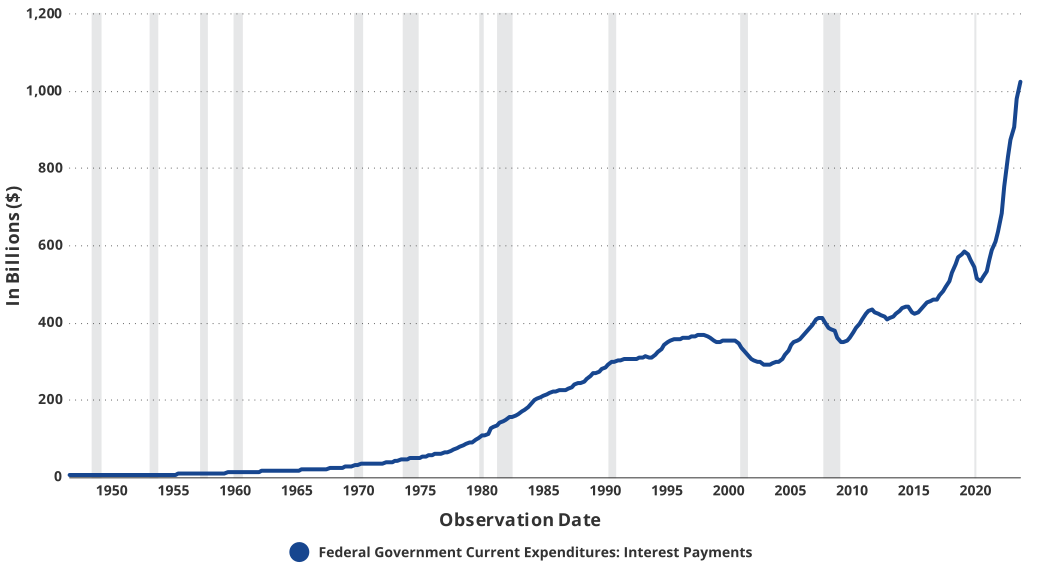
My last piece of evidence for the “out of control” scenario is an article from alternative media site, the Free Press. In an article mainly on social commentary, we suddenly see this chart on government spending.
Federal Government Current Expenditures: Interest Payments
Source: U.S. Bureau of Economic Analysis.
Global Growth: From Low Levels to Expansion
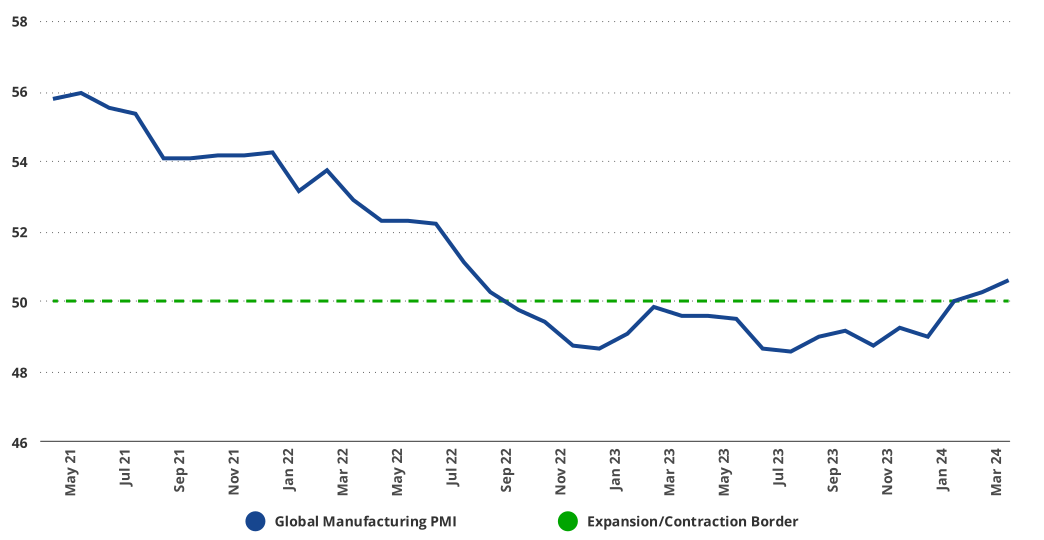
In the first quarter of 2024, the world economy moved into expansion mode, with good upwards momentum. As well, economic data from China in March was quite strong.
Global Growth Picking Up
Source: Bloomberg. Data as of April 2024. Purchasing Managers’ Index: economic indicators derived from monthly surveys of private sector companies. A reading above 50 indicates expansion, and a reading below 50 indicates contraction.
For growth, my favorite statistic is the PMI, partially because it shows a “yes or no” answer. If PMI is over 50, we are in expansion mode. And both global growth and China manufacturing moved into expansion mode in Q1. This is the reason commodity returns have been strong so far this year—and this data supports an allocation to commodities.
China Back In Expansion Mode

Source: Bloomberg. Data as of April 2024.
Related Insights



Related Insights


18 December 2025
Get your portfolio ready for 2026 with detailed insights from VanEck’s investment team about the factors driving risk and returns in their respective asset classes.
17 October 2025
Behind every milestone in VanEck’s 70-year journey are the people whose ideas, integrity and collaboration keep its culture thriving.