February Market Recap: History Rewards the Prepared
12 March 2026
Read Time 6 MIN
Key Takeaways:
- Conflict Duration Matters: Early tactical success does not eliminate the risk of extended economic disruption.
- Energy Is the Transmission Mechanism: Oil and commodity shocks remain the fastest channel from geopolitics to inflation and market volatility.
- Portfolio Construction Must Evolve: In a structurally shifting regime, investors need to think beyond traditional 60/40 allocations to include real assets as a source of resilience.
Wars Rarely End on Schedule
We have seen this movie before.
Russia expected to sweep Ukraine in days. Years later, the war continues.
Every war begins with confidence. Few end on schedule.
In 1914, European leaders believed World War I would end by Christmas. It lasted more than four years.
The Soviet Union entered Afghanistan in 1979 expecting a short campaign. The conflict dragged on for nearly a decade.
The United States toppled Saddam Hussein’s regime in weeks in 2003. The war that followed lasted years.
It would be unwise for markets to ignore that history.
Technology wins battles. Production wins wars.
The duration of the conflict is unknowable. Extrapolating early military success into a near-term victory while discounting the risk of prolonged economic disruption would be a mistake.
In a single week, the U.S. and Israel launched more than 5,000 air attacks. That is industrial-scale engagement.
Wars are not fought only on battlefields. They are fought in factories and energy markets.
And factories and energy markets eventually show up in CPI.
Modern conflicts are hallmarked by long-duration economic contests, not short military campaigns.
Wars Move Faster Than Factories
During World War II, America converted automobile plants into tank factories and retrained millions of workers.
It worked because the United States was already an industrial economy.
Today, the U.S. is primarily a service-driven economy.
Good luck turning an accountant into a welder overnight.
Industrial capacity takes time. Supply chains take time. Skilled labor takes time.
Wars move faster than factories.
The chart below shows total global military expenditure. As rapidly advancing technology meets geopolitical instability, military spending is likely to move structurally higher in the years ahead.
Unprecedented Rise in Global Military Expenditure
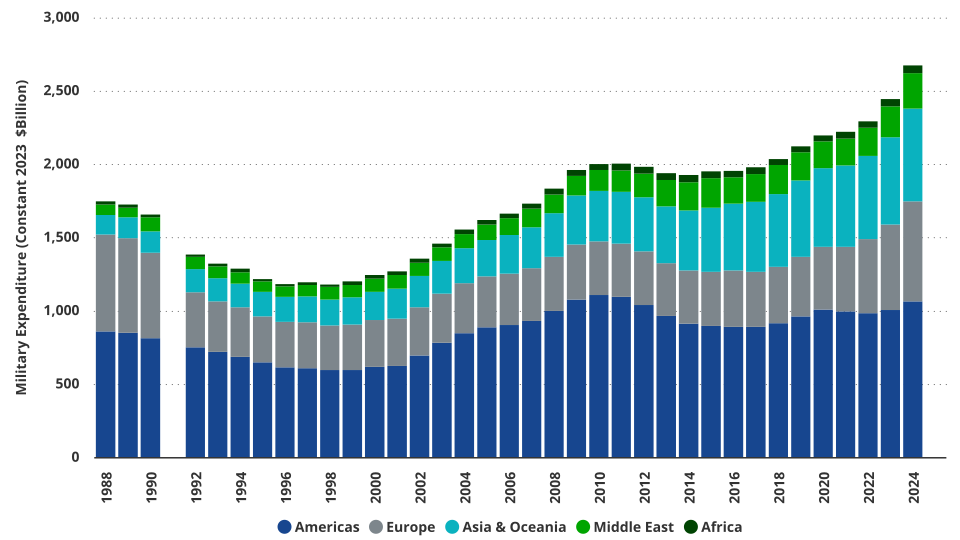

Source: SIPRI. As of 2025.
The Inventory Problem
The Wall Street Journal recently reported that the U.S. is racing to complete its Iran mission before munitions inventories run low. Reuters reported that defense executives were called to the White House to accelerate production.
That is inventory stress.
$20,000 Iranian drones are attacking billion-dollar infrastructure and being defended against with multi-million-dollar munitions.
This is how superpowers bleed: through sustained imbalance.
Iran cannot defeat the U.S. militarily, but it can exploit structural vulnerabilities. The immediate pressure point is energy. With roughly 20% of global oil flowing through the Strait of Hormuz, even brief disruption can send prices sharply higher and trigger cascading volatility across global markets. This is the modern battlefield.
Inflation Risks Are Back
Two weeks ago, we avoided the “i” word.
Not anymore.
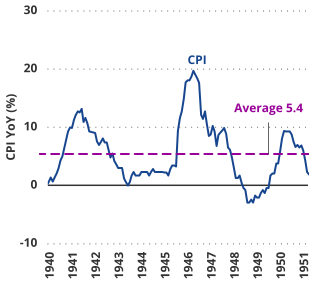
Historically, major conflicts have coincided with rising inflation.
YoY CPI Over Time


Source: Bloomberg. As of 1/31/2026.
Inflation rarely arrives in a straight line. The 1940’s experiences multiple waves. The 1970s had more than one spike. You only know it is over years after the fact.
Inflation Comes in Waves
1940s Inflation

1970s Inflation
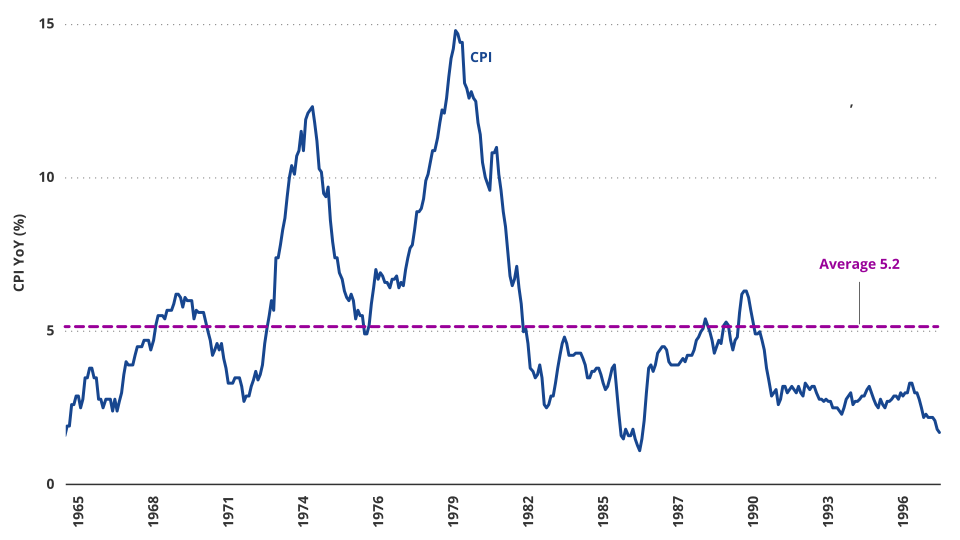
Source: Bloomberg. As of 12/31/1997.
Oil has already briefly moved near $120 per barrel and could move significantly higher.
Oil is in your airline ticket, your grocery bill, and the plastic wrapped around both.
When oil spikes, nearly everyone feels it.
Oil Neared $120 Per Barrel in Early March
Date Range: March 4, 2026 to March 10, 2026


Source: Bloomberg. Data from 3/4/2026–3/10/2026.
Portfolio Implications
The global economy is already operating in a new structural regime.
The post-COVID world is defined by a collision between technological acceleration and real-world constraints: energy, labor, supply chains, and geopolitics. At the same time, de-globalization is shifting the focus toward national resilience and strategic independence.
The result is a system that increasingly favors independence, accountability, and the compounding advantages of technological leadership.
These forces are structural and likely to unfold over many years.
The portfolio implications are profound.
For decades, investors relied on a simple framework: a 60/40 portfolio of stocks and bonds. That framework worked in a world shaped by globalization and declining interest rates.
That world has changed.
Diversification beyond the traditional 60/40 portfolio is becoming increasingly important.
Real assets are already responding.
Portfolios built for the last regime may struggle in the next one. This is the diversification era.
| INDEX | YTD Price Change (%) |
| Bloomberg Gold Subindex Index | +16.70 |
| Bloomberg Commodity Index | +21.77 |
| S&P Global Natural Resources Index | +16.45 |
Source: Bloomberg. As of 3/9/2026. Index performance is not illustrative of strategy performance. It is not possible to invest directly in an index.
Macro themes we’re watching:
Debt
Fiscal excess is fueling innovation and instability.
AI’s Three Phases
Builders spend, Adopters save, Automators replace.
De-Dollarization
Stores of value to hedge against deficits, debt, and geopolitics.
Today’s predominant macro forces are driving the key themes and exposures in VanEck’s models, including the core allocation of the VanEck Wealth Builder Plus Portfolios. The allocations below are representative of the Moderate Portfolio.
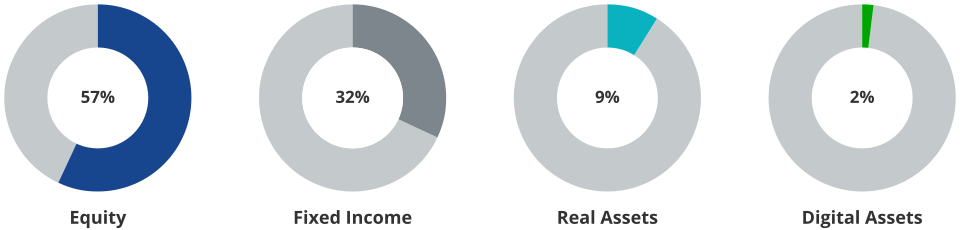
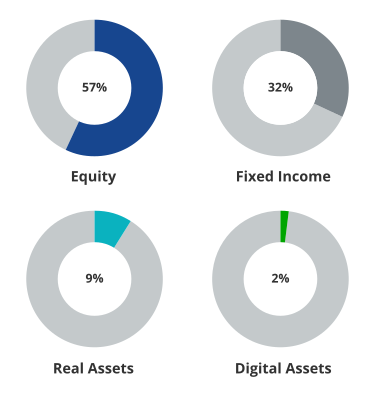
Source: VanEck, 2/28/2026. Not intended as a recommendation to buy or sell any securities or digital assets, or as investment or any call to action.
| Asset Class | Allocation | Related Products |
| Equity | ||
| Economic Moats | 3.6% | MOAT | SMOT |
| AI & Technology | 2.4% | SMH |
| Private Markets | 2.0% | GPZ | BIZD |
| Leapfrog Innovation | 0.7% | GLIN |
| Fixed Income | ||
| Attractive Valuation | 4.7% | MIG |
| Yield & Safety | 2.6% | CLOI |
| Yield & Low Duration | 2.5% | FLTR |
| High Quality High Yield | 2.3% | ANGL |
| Emerging Markets | 1.7% | HYEM |
| Real Assets | ||
| De-Dollarization | 4.2% | OUNZ |
| Diversified Real Assets | 2.1% | RAAX |
| Energy Transition | 1.9% | NLR | EINC |
| Digital Assets | ||
| De-Dollarization | 2.2% | HODL |
Source: VanEck, FactSet. As of 2/28/2026. For illustrative purposes only. Not intended as an offer or recommendation to buy or sell any securities referenced herein. Strategy allocations will vary. Holdings exclude cash.
Index Definitions
The Bloomberg Gold Subindex index is a commodity group subindex of the BCOM composed of futures contracts on Gold. It reflects the return of underlying commodity futures price movements only and is quoted in USD.
Bloomberg Commodity Index (BCOMTR) (the “index”) and comprises exchange-traded future contracts on more than 20 commodities which are weighted to account for economic significance and market liquidity.
The S&P Global Natural Resources Index includes 90 of the largest publicly-traded companies in natural resources and commodities businesses that meet specific investability requirements, offering investors diversified, liquid and investable equity exposure across 3 primary commodity-related sectors: Agribusiness, Energy, and Metals & Mining.
Related Insights


Related Insights

16 January 2026
16 January 2026
18 December 2025
Get your portfolio ready for 2026 with detailed insights from VanEck’s investment team about the factors driving risk and returns in their respective asset classes.
09 December 2025
Liquidity tightened, Bitcoin signaled early stress, AI adoption gained traction, and real assets continued to lead in a shifting market regime.
09 September 2025
Gold signals caution as deficits, debt, and geopolitics test confidence, while AI innovation is reshaping growth for the decade ahead.