DAPP ETF: Question & Answer
30 November 2021
Read Time 5 MIN
The digital asset space has seen exponential growth in recent years and companies at the forefront of the industry range across business lines, including digital asset exchanges, miners, and other infrastructure companies. Digital asset returns have generated substantial investor interest, both retail and institutional, and the broader ecosystem presents a wide variety of investment opportunities. This blog is intended to answer frequently asked questions on digital assets and more specifically, VanEck’s Digital Transformation ETF (DAPP).
- What are the different opportunities in the digital asset space right now?
- What is the difference between Bitcoin and Ethereum?
- What types of companies are considered to be digital asset companies?
- Why would somebody invest in a company instead of the underlying asset class?
- What are the risks associated with digital assets?
- Where does DAPP fit into a portfolio?
- How to buy VanEck ETFs?
What are the different opportunities in the digital asset space right now?
Digital assets can serve as a store of value, growth investment or, fixed income alternative.
- Store of value: Bitcoin is considered “digital gold” with key features such as limited supply and fungibility. Despite volatility, it remains the best performing asset class in recent years, and many market participants argue that its finite supply intuits that bitcoin will not be devalued over time.
- Growth opportunities come in different forms:
- Public equities – digital asset companies cover various business lines supporting the digital asset ecosystem and have exhibited high growth numbers (ex: Coinbase).
- Private companies – there are many firms doing similar business as public companies that have yet to IPO.
- Tokens – generally associated with a specific project or application. Investors can participate in a project in two different ways: 1) purchase a token and spend it within the context of the project/application or 2) purchase the token and hold it, in the hopes that it goes up in value.
- Fixed income: there are emergent fixed income opportunities that are now available to investors willing to provide liquidity and cash within the crypto ecosystem.
What is the difference between Bitcoin and Ethereum?
Bitcoin can be considered a pure store of value or medium of exchange, while Ethereum can be considered a toolkit that is used to build new applications or use cases.
Bitcoin (BTC) is a digital currency that can be traded online and stored in cryptocurrency wallets. The underlying blockchain technology was used to launch Ethereum, a network of applications and contracts that is powered by Ether (ETH), the network’s cryptocurrency. Similar to BTC, ETH is also traded as a cryptocurrency, however its primary purpose is not to establish itself as an alternative monetary system, but rather to facilitate and monetize the operation of the Ethereum smart contract and decentralized application platform.
What types of companies are considered to be digital asset companies?
There are many different business lines in digital assets, and companies have many different focuses.
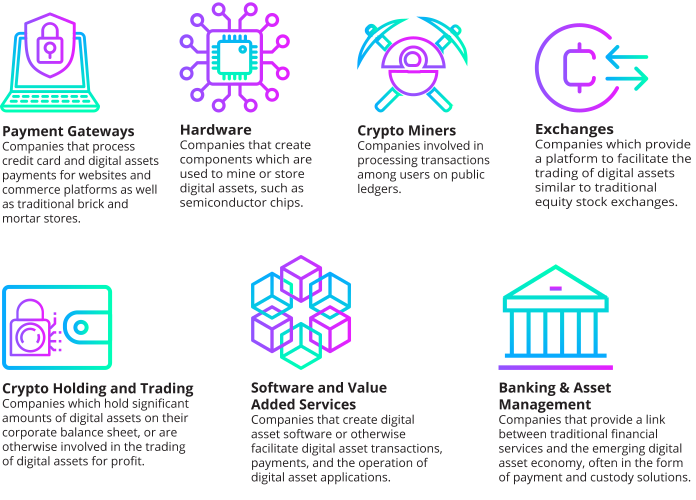
Source: VanEck
These companies are distinctly different from digital assets themselves. Digital asset companies may range from mining to hardware to exchanges that facilitate the trading of digital assets. They may engage in only one of these business lines or, they may engage in multiple, depending on their goals, capabilities and focus within the broader digital asset space. See more on digital asset companies here.
Why would somebody invest in a company instead of the underlying asset class?
Individual companies are centralized organizations working towards a common goal of generating profits and cash flows for investors and shareholders, along with other characteristics shared by the majority of publicly traded companies. Digital assets, on the other hand, aim to be decentralized software protocols, without a CEO or voting rights for shareholders.
Digital asset companies also generate cash flows related to their various business lines, while the vast majority of cryptocurrencies do not generate cash flows. For a user to make a profit on a bitcoin trade, the user has to sell bitcoin at a higher price than what it was bought for, which is not the same as a business-related cash flow.
Companies are also currently regulated, so investors can gain access to digital asset disruption in the known format of a traditional equity ETF wrapper.
What are the risks associated with digital assets?
As early stage companies in an early stage asset class, the primary risks are volatility, regulatory and the potential for extended valuations.
- Digital Asset Volatility – volatility in digital assets may affect digital asset companies, as their profitability and revenue metrics can be closely tied to the price of digital assets themselves.
- Regulatory – changes in laws and regulations could materially impact investor access and sentiment related to digital assets, which could in turn negatively affect digital asset companies.
- Valuation – digital asset companies may become overvalued as digital adoption grows, leading to the possibility that digital asset companies may undergo a drop in price or high levels of volatility.
It is important to keep in mind that the U.S. is not China- regulators have indicated they will not “shut down bitcoin,” and regulation is coming across a number of fronts. The government has been supportive and has seen the potential of the digital asset revolution, making it unlikely they will regulate the opportunity away.
Where does DAPP fit into a portfolio?
The VanEck Digital Transformation ETF can provide exposure in a growth, disruption, innovation, or alternative sleeve, along with serving as a core-satellite allocation. These names are not in the broad market benchmarks (yet), and the return profile does indicate low correlation to the broad market. Investors receive diversification and potential for alpha over a longer time horizon. It’s also important to emphasize that the MVIS Global Digital Asset Equity Index is a new index without a long track record, and that correlations to both digital assets and broad equity benchmarks will most likely not remain static.
Weekly Correlation of Returns (4/4/2021 – 9/25/2021)
| Investment | 1 | 2 | 3 | 4 | 5 | 6 | 7 | 8 |
| MVIS Global Digital Assets Equity Index | 1.00 | |||||||
| MVIS CryptoCompare Bitcoin Index | 0.64 | 1.00 | ||||||
| MVIS CryptoCompare Ethereum Index | 0.57 | 0.74 | 1.00 | |||||
| NASDAQ 100 Index | 0.50 | 0.19 | 0.11 | 1.00 | ||||
| S&P 500 Index | 0.37 | 0.17 | 0.28 | 0.81 | 1.00 | |||
| MSCI ACWI Index | 0.34 | 0.02 | 0.17 | 0.73 | 0.91 | 1.00 | ||
| LBMA Gold Price PM (USD) | -0.29 | -0.17 | 0.00 | 0.02 | 0.37 | 0.45 | 1.00 | |
| NYSE Arca Gold Miners Index | -0.11 | -0.12 | 0.07 | 0.13 | 0.44 | 0.58 | 0.86 | 1.00 |
Source: Morningstar Direct as of 9/30/21.
How can investors buy VanEck ETFs?


To receive more Thematic Investing insights, sign up in our subscription center.