Peak Rates – Mind the Fiscal Gap
26 October 2022
Read Time 2 MIN
The End of EM Tightening Cycles
Tomorrow’s European Central Bank (ECB) rate-setting meeting will be the focal point of the week. A 75bps hike and the terminal rate of 3% are firmly in the price, but the press-conference and guidance will be equally important - both for interest rates (including the shape of the yield curve) and the euro, which staged a mini rally in the past few days. In emerging markets (EM), all eyes are on Brazil, where the central bank is expected to begin its next chapter by keeping the policy rate on hold this afternoon at 13.75%. The central bank’s pro-active response created a huge policy cushion (Brazil’s ex-ante real policy rate is around 8%!) that provided the fundamental support for the currency and local debt this year. The year-to-date total return on the J.P. Morgan’s GBI-EM Brazil Index (U.S. Dollar unhedged) is not just positive, but head and shoulders above the rest (except Turkey – see chart below). However, whether or not this outperformance can be extended going forward will also depend on the outcome of Sunday’s runoff (polls show a technical tie) and its impact on the policy agenda - especially on the fiscal front, where Brazil performed admirably in 2022.
South Africa Fiscal Adjustment
The market is also closely watching the pace of fiscal adjustment in South Africa, where the central bank (SARB) is still catching up with the rest of the EM pack. The SARB delivered two large 75bps hikes in a row, bringing the policy rate to 6.25%, and the just-released medium-term budget projections – especially smaller deficits - should ease the pressure to continue with aggressive hikes. The main concern, as usual, is about the budget execution, as some revenue assumptions look rosy, and spending buffers might not be sufficient, given the global economic and political uncertainties. Still, the market high-fived the headline numbers, with the 10-year yield narrowing by 13bps and the South African rand trading 92bps stronger against the U.S. Dollar (at 10:00am ET, according to Bloomberg LP).
Colombia Tax Reform
Fiscal discussions are all the rage in LATAM, where the Colombian congress is expected to approve the new tax bill in the coming days. What’s at stake here is not only the pace of fiscal adjustment, but also tax reform’s impact on the oil sector, which accounts for a significant portion of Colombia’s export revenue and foreign direct investments. The approval process – and the market reaction to it - will also determine the central bank’s ability to slow the pace of rate hikes. Colombian assets were hit by the recent political and policy noise, with the local debt (J.P. Morgan’s GBI-EM Colombia Index) showing the third worst total return (or rather total loss) year-to-date (see chart below). Stay tuned!
Chart at a Glance: EM Local Debt – Year-To-Date Tally
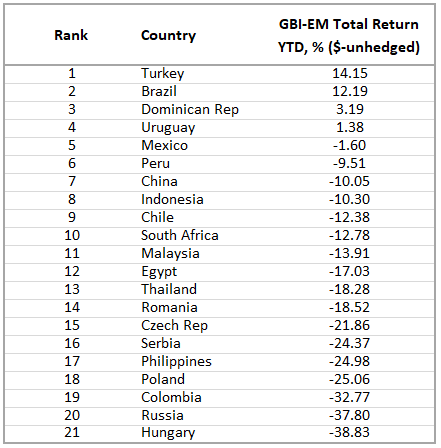
Source: Bloomberg LP.
Related Insights

Related Insights
07 April 2025
06 March 2025
20 February 2025
10 February 2026
Debasement is back in focus. Here’s what’s driving it, what could reverse it and how we’re positioning portfolios for both scenarios.
07 April 2025
Trump’s tariffs spark trade war fears, fueling market volatility, inflation risk, and recession threats. With global retaliation likely, near-term growth is clearly at risk.
06 March 2025
Trump’s tariffs, AI’s next phase, and a potential U.S. gold revaluation could shake markets—investors who stay ahead of these transitions will be best positioned.
20 February 2025
China's AI breakthrough, persistent inflation, gold’s outperformance, and rising energy demand underscore a shifting investment landscape.
16 January 2025
In 2025, navigating turbulence means balancing tech innovation, inflation hedges, energy shifts, and risks from spending cuts and inflation.