
Welcome to VanEck
Select Investor Type
13 April 2023
Read Time 8 MIN
Gold set a new high for the year on 20 March, trading at $2,009 per ounce. This represented a $200 move from its monthly low of $1,809 on 8 March. Gold climbed its way higher as the markets tried to digest the news and assess the ripple effects of the rapid collapse of Silicon Valley Bank (SVB) and Signature Bank over the course of a weekend. The metal found further support as the risks spread to Europe, with major bank Credit Suisse ultimately needing a rescue, which included the surprise wipeout of $17 billion of the bank’s AT1 bonds. Panic and fear subsided as governments, regulators and central banks worldwide intervened and/or reassured investors in an effort to restore market confidence.
Next, attention turned to the Federal Open Market Committee (FOMC) rate decision on 22 March. The U.S. Federal Reserve (Fed) increased the federal funds rate by 0.25% to 5.0%. Rate increases are generally viewed as negative for gold. However, treasury rates, which fell sharply following the banking turmoil, actually fell further after the Fed’s last hike, as did the U.S. dollar. This was positive for gold, which managed to hang on to most of its gains, closing at $1,969 on 3 March – a $142 per ounce (7.8%) advance for the month.
The U.S. dollar (DXY Index)1 fell 2.2%, while the 2-year and 10-year treasury rates dropped 0.79% and 0.45% respectively, during March. Gold stocks outperformed the metal. The NYSE Arca Gold Miners Index (GDMNTR)2 was up 18.7%, and the MVIS Global Juniors Gold Miners Index (MVGDXJTR)3 was up 18.2% during the month of March.
“We believe the market is currently ignoring the negative effect of sustained higher rates on the global financial system.” This was the main message of our gold outlook in our February commentary. There, we provided an example of the recent defaults by two large office owners caused by this higher interest rate environment, and highlighted potential for more problems from the record levels of debt held globally. The collapse of SVB was triggered by the banks’ need to recapitalize as its large portfolio of treasury bonds declined in value due to rising rates. Most would agree that this past month’s events are textbook examples of why one should own gold, so how did gold do? Here are some of our observations:
With that said, gold’s performance over the past +20 years is not too shabby:
Source: Morningstar. Data as of 31 March, 2023. U.S. Stocks represented by S&P® 500 Index; U.S. Bonds represented by Bloomberg Barclays U.S. Aggregate Bond Index; Gold ($/oz) represented by LBMA PM Gold Price; U.S. Treasuries represented by the Bloomberg Barclays U.S. 1-3 Year Treasury Bond Index.
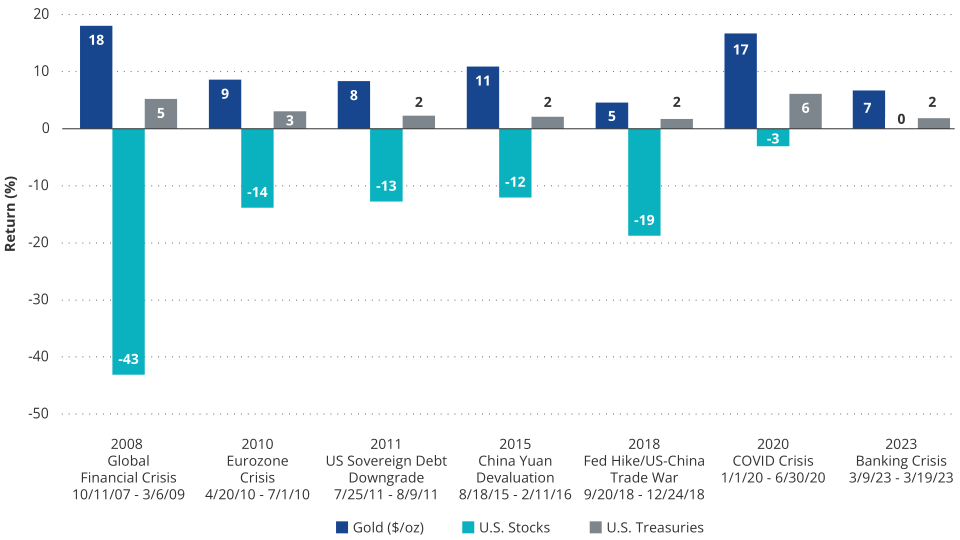
Source: Morningstar. Data as of 31 March, 2023. U.S. Stocks represented by S&P® 500 Index; Gold ($/oz) represented by LBMA PM Gold Price; U.S. Treasuries represented by the Bloomberg Barclays U.S. 1-3 Year Treasury Bond Index.
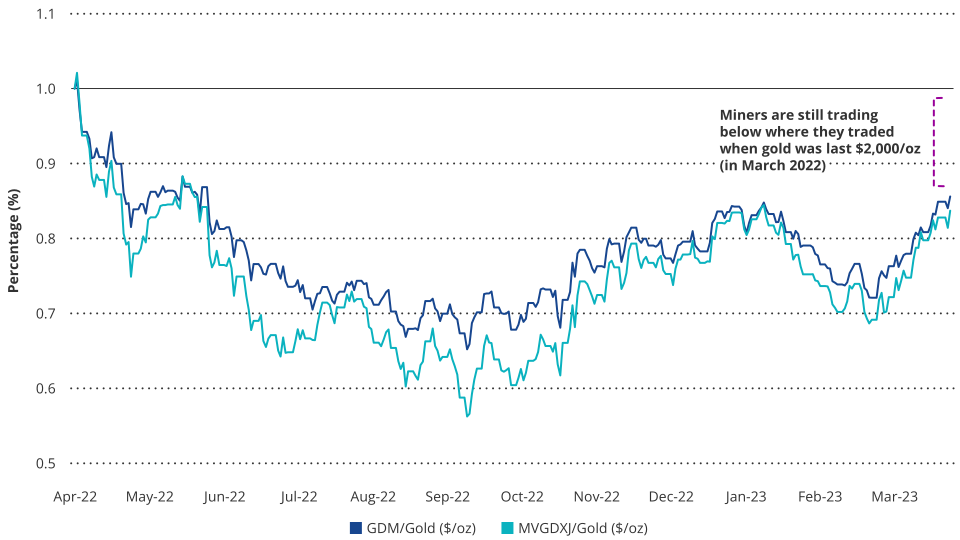
Source: Bloomberg. Data as of 31 March, 2023. Gold Stocks represented by the NYSE Arca Gold Miners Index (GDMNTR).
In short, we would say gold and gold stocks performed precisely how we would expect in this environment. Moreover, we think this performance reaffirms gold’s role as a safe haven investment and as a legitimate form of portfolio insurance. Last month’s developments should act as a wakeup call to those lacking exposure to the gold sector. And the entry point isn’t terrible either. Think about it: despite the heightened level of risk in March, gold didn’t even hit its all-time highs.
We don’t believe the market is fully reflecting the risks ahead. The Fed came to the rescue once again. The crisis seems contained for now. Consumer confidence actually ticked up in March, and the U.S. stock market managed to finish the month with gains. Complacency set in. This market action would suggest the equity market party isn’t over yet. No one wants the party to end, and certainly, no one ever wants to leave too early and miss out. But when there is broken glass on the floor, everyone knows it is time to start figuring out your ride home. Gold may be the perfect vehicle.
We were assured time and again of the strength and resilience of the banking system after the improved regulatory and supervisory regimes that followed the 2008 financial crisis, and yet here we are facing the biggest U.S. banking failure in more than a decade. The resulting banking crisis exposed the fragility and risks facing the global financial system. We believe this is supportive of higher gold prices in the longer term. These risks include (in both the U.S. and globally) persistent and elevated inflation, a weakening economy, debt service strains, elevated geopolitical risks and black swan events.
Last year, we posed these questions:
These questions are more relevant today than ever. They were reasonable questions to ask in 2022 as the Fed embarked on its aggressive rate hiking cycle. There were and there likely continue to be more cracks in the system – something else could break. A black swan event is generally described as having three main attributes: it is unpredictable; it results in severe and widespread consequences; and after its occurrence people (and markets) will rationalize the event as having been predictable (known as “hindsight bias”). No one saw the failure of SVB coming, it certainly had severe consequences and, of course, now everyone is wondering how management and regulators could have possibly missed it! There may be more black swans flying or swimming around out there.
Worsening financial conditions are expected to lead to the end of the Fed’s rate hiking cycle. The market is already pricing in cuts in 2023. This is gold positive. However, we believe the market has yet to price in the negative impact of a policy change in the fight against inflation and the increasing likelihood of a hard landing or recession. Gold’s appeal increases under these scenarios. Investors would have yet to come back in full force to benefit from gold’s role as an inflation hedge, as a safe haven in periods of economic, financial and geopolitical volatility, and importantly, as a portfolio diversifier. What happened in March should crystallize the need to add gold exposure to every portfolio. However, please always consider the risks as well: risk of investing in natural resources companies, industry or sector concentration risk, risk of investing in smaller companies.
1 The U.S. Dollar Index measures the value of the U.S. dollar relative to a basket of foreign currencies, often referred to as a basket of U.S. trade partners' currencies.
2 NYSE Arca Gold Miners Index is a service mark of ICE Data Indices, LLC or its affiliates (“ICE Data”) and has been licensed for use by VanEck UCITS ETF plc. (the “Fund”) in connection with VanEck Gold Miners UCITS ETF (the “Sub-Fund”). Neither the Fund nor the Sub-Fund is sponsored, endorsed, sold or promoted by ICE Data. ICE Data makes no representations or warranties regarding the Fund or the Sub-Fund or the ability of the NYSE Arca Gold Miners Index to track general stock market performance. ICE DATA MAKES NO EXPRESS OR IMPLIED WARRANTIES, AND HEREBY EXPRESSLY DISCLAIMS ALL WARRANTIES OF MERCHANTABILITY OR FITNESS FOR A PARTICULAR PURPOSE WITH RESPECT TO THE NYSE ARCA GOLD MINERS INDEX OR ANY DATA INCLUDED THEREIN. IN NO EVENT SHALL ICE DATA HAVE ANY LIABILITY FOR ANY SPECIAL, PUNITIVE, INDIRECT, OR CONSEQUENTIAL DAMAGES (INCLUDING LOST PROFITS), EVEN IF NOTIFIED OF THE POSSIBILITY OF SUCH DAMAGES. ICE Data Indices, LLC and its affiliates (“ICE Data”) indices and related information, the name "ICE Data", and related trademarks, are intellectual property licensed from ICE Data, and may not be copied, used, or distributed without ICE Data's prior written approval. The Fund have not been passed on as to its legality or suitability, and is not regulated, issued, endorsed, sold, guaranteed, or promoted by ICE Data.
3 MVIS®️ Global Junior Gold Miners Index is the exclusive property of MarketVector Indexes GmbH (a wholly owned subsidiary of Van Eck Associates Corporation), which has contracted with Solactive AG to maintain and calculate the Index. Solactive AG uses its best efforts to ensure that the Index is calculated correctly. Irrespective of its obligations towards MarketVector Indexes GmbH (“MarketVector”), Solactive AG has no obligation to point out errors in the Index to third parties. The VanEck Junior Gold Miners UCITS ETF is not sponsored, endorsed, sold or promoted by MarketVector and MarketVector makes no representation regarding the advisability of investing in the Fund.
This is a marketing communication. Please refer to the prospectus of the UCITS and to the KID before making any final investment decisions.
This information originates from VanEck (Europe) GmbH, which has been appointed as distributor of VanEck products in Europe by the Management Company VanEck Asset Management B.V., incorporated under Dutch law and registered with the Dutch Authority for the Financial Markets (AFM). VanEck (Europe) GmbH with registered address at Kreuznacher Str. 30, 60486 Frankfurt, Germany, is a financial services provider regulated by the Federal Financial Supervisory Authority in Germany (BaFin).
The information is intended only to provide general and preliminary information to investors and shall not be construed as investment, legal or tax advice VanEck (Europe) GmbH, VanEck Switzerland AG, VanEck Securities UK Limited and their associated and affiliated companies (together “VanEck”) assume no liability with regards to any investment, divestment or retention decision taken by the investor on the basis of this information. The views and opinions expressed are those of the author(s) but not necessarily those of VanEck. Opinions are current as of the publication date and are subject to change with market conditions. Certain statements contained herein may constitute projections, forecasts and other forward-looking statements, which do not reflect actual results. Information provided by third party sources is believed to be reliable and have not been independently verified for accuracy or completeness and cannot be guaranteed. Brokerage or transaction fees may apply.
All performance information is based on historical data and does not predict future returns. Investing is subject to risk, including the possible loss of principal.
No part of this material may be reproduced in any form, or referred to in any other publication, without express written permission of VanEck.
© VanEck (Europe) GmbH / VanEck Asset Management B.V.

15 December 2025
15 December 2025