


Dividends are the cornerstone of stock market investing, representing a consistent way that companies share their profits with investors. Most companies listed on stock exchanges reward shareholders by paying out a portion of their earnings in the form of dividends, providing an additional stream of income beyond potential stock price appreciation.
While the immediate impact of dividends might seem minor compared to the capital gains a stock can deliver, their true power is revealed over the long term. When reinvested, dividends contribute to compound growth, significantly enhancing total returns. Historical data shows that dividends can account for a large portion of the total return of stocks, especially during periods of market stagnation or volatility. For long-term investors, dividends often become a key driver of wealth accumulation and financial stability.
- Dividends are a key driver of long-term returns, especially when reinvested to leverage compounding.
- Metrics like the payout ratio help assess whether dividends are sustainable and support future growth.
- Dividend yields vary by sector and region – for instance, the energy and utility sectors are typically known for offering higher payouts compared to tech or healthcare.
- Accumulating vs. distributing ETFs: Both deliver similar total returns when taxes are excluded. The choice depends on income needs versus growth goals.
The Role of Dividends in Portfolio Returns and the Risks of Dividend Traps
Dividends represent a share of a company’s profits that is distributed to its shareholders as compensation for the risks they bear. Essentially, dividends provide investors with a return on their investment in addition to potential capital gains. Not all companies, however, pay dividends. Young, growth-focused companies typically do not pay dividends, as they either have not yet generated profits or prefer to reinvest earnings into the business to fuel expansion.
In contrast, established corporations are more likely to make regular dividend payments. These companies often generate consistent cash flows and have fewer high-growth opportunities, allowing them to return a portion of their profits to shareholders.

Dividend Payout Ratios and Retained Earnings
Most companies distribute only a portion of their profits as dividends, while the rest, known as retained earnings, are reinvested to support future growth. This balance is critical, as it indicates that the company has identified compelling investment opportunities that could drive future expansion.
To measure how much of a company's earnings are paid out as dividends, investors use a key metric called the dividend payout ratio. This ratio shows what percentage of earnings is returned to shareholders. A relatively low payout ratio can indicate that a company is prudently managing its profits, investing enough in growth while still rewarding its shareholders. Conversely, a very high payout ratio could signal that the company is not reinvesting enough for future growth, or that it might struggle to sustain its dividend in the long term.
Avoiding Dividend Traps
Dividend yield represents the annual dividend, divided by the stock price. While high dividend yields can be appealing, investors must be cautious of dividend traps. A dividend trap occurs when a company has a seemingly attractive dividend yield, but that yield is unsustainable due to weak underlying financials such as high debt or faltering earnings growth. For instance, a company may have a high dividend yield simply because its stock price has just fallen, artificially inflating the yield. But the stock’s decline can be a sign of underlying problems.
A key question for investors to ask is whether the dividend is sustainable. High yields can sometimes be a red flag, indicating that the company may be cutting into critical resources to maintain payouts, which could lead to future dividend cuts or financial distress.
Investors can reduce the risk of falling into a dividend trap by examining key financial metrics such as the payout ratio, cash flow, and earnings stability. Additionally, some exchange-traded funds (ETFs) are designed to filter out companies with unsustainable dividends, offering a diversified portfolio of financially sound dividend-paying companies. Such ETFs aim to make it easier for investors to avoid traps without needing extensive financial expertise.
Indexes’ Dividend Payout Ratios
Source: Bloomberg, October 2024.
How Dividends and Reinvestment Drive Wealth Through Compounding
When investing in shares, the performance of your investment can come from two main sources: price return and dividend return. The price return is the capital appreciation of the stock, while the dividend return comes from the company paying out a portion of its profits to shareholders. Together, these two sources form what is known as total return.
Over time, dividends, especially when reinvested, often become the primary contributor to total investment performance. This is due to the powerful effect of compounding, where reinvested dividends generate additional returns as they themselves start to earn returns. This snowball effect significantly enhances the value of an investment over the long term.
Reinvesting dividends enables investors to purchase more shares, and with each additional share purchased the potential for both price appreciation and future dividend payments grows. This compounding effect becomes more pronounced over time, making dividend reinvestment a key strategy for long-term wealth accumulation.
A clear illustration of the power of reinvested dividends can be seen when comparing the performance of stock market indices with and without dividend reinvestment. For example, in the U.S. stock market, the S&P 500 Index, a benchmark representing the 500 largest publicly traded companies, shows a dramatic difference in returns when dividends are reinvested versus when they are not.
Reinvesting dividends substantially boosts total returns compared to relying solely on price appreciation.
The graph below highlights the significant gap in performance over time, underscoring the importance of reinvesting dividends to maximize returns and benefit from the power of compounding.
The effect of compound interest: S&P 500 Index
Source: Morningstar, VanEck, November 2024.
How Dividend Payments Provide Steady Income Streams for Investors
Dividends as a Source of Income

For many investors, dividends are more than just a way to grow wealth: they also serve as a reliable source of income. This can be particularly appealing for retirees, who often depend on dividends for their annual income while keeping the capital they have invested intact. The regularity of dividend payments from well-established companies or funds can provide a relatively predictable and stable income stream, helping to meet living expenses without having to sell off assets.
Sector Differences in Dividend Payments

Looking across different sectors, we see notable variations in dividend distribution patterns. Certain industries, such as energy, have traditionally offered high dividend yields, consistently returning a significant portion of their profits to shareholders. This is because energy companies often generate steady cash flows and face few opportunities for rapid expansion, leading them to distribute a larger portion of their earnings as dividends.
In contrast, technology firms are generally known for reinvesting their profits back into the business to fuel innovation and growth. As a result, many tech companies offer lower dividend yields or may not pay dividends at all, preferring to allocate capital toward research and development, acquisitions, or other expansion strategies.
Dividend Yields per Sector of the S&P 500 Index
The S&P 500, as one of the most important benchmarks of the U.S. stock market, comprises companies from a wide range of sectors. Dividend yields vary significantly across these sectors, depending on the nature of a company’s business, its growth prospects, and its profitability.
Some sectors, such as utilities and consumer staples, are known for offering higher dividend yields. These sectors typically consist of stable, mature companies that generate steady cash flows and return a significant portion of their earnings to shareholders. On the other hand, sectors like technology and healthcare typically offer lower dividend yields as they prioritize reinvestment in innovation and growth.
Below are examples of dividend yields by sector within the S&P 500, offering insights into how each sector contributes to investor income:
- Energy: Known for high dividend payouts due to steady demand and mature business models.
- Utilities: Often provide reliable dividends as they operate in essential industries with stable cash flows.
- Consumer Staples: Include companies that produce essential goods, offering dependable dividends.
- Financials: Banks and financial services businesses often pay high dividends, though these can be more sensitive to economic cycles.
- Technology: Tech companies typically have low yields, as they reinvest heavily into research and development.
- Healthcare: Like technology, this sector often prioritizes reinvestment for growth, but some mature companies still offer dividends.
Understanding the dividend yield differences by sector can help investors to create balanced portfolios that align with both income and growth objectives. While these generalizations provide a helpful framework, it's important to note that exceptions exist within every sector, and individual companies may deviate significantly from these norms.
Dividend Yields per Sector of the S&P 500
Source: Bloomberg, VanEck. Sectors defined according to GICS. September 2024.
The graph above highlights the significant variations in dividend yields across sectors within the S&P 500 over the years. The energy sector consistently has shown higher dividend yields, driven by steady demand and mature business models that generate reliable cash flows. By contrast, the technology sector has much lower yields as companies reinvest heavily in innovation and growth. Materials, with moderate dividend yields, reflect the cyclical nature of their businesses, often influenced by commodity price fluctuations. The data demonstrates how each sector's underlying business dynamics and priorities—such as reinvestment or stable payouts—shape dividend distribution patterns.
Dividend Insights from Two Major Global Indices
The MSCI World Index and the S&P 500 Index are two of the most widely followed benchmarks among global investors. They represent a broad exposure to developed markets and are often used to assess market trends and income potential.
The graph below highlights the annual dividend yields of these two major indices, offering a clear view of how dividends contribute to total investor returns across global and U.S. equities:
- MSCI World Index: Captures dividend yields from a diverse set of companies across developed markets worldwide.
- S&P 500 Index: Tracks the 500 largest publicly traded companies in the U.S., offering insight into dividend income within the American equity landscape.
Yearly Dividend Trends: MSCI World vs. S&P 500
Source: Morningstar, VanEck, December 2024.
Investing in High-Dividend Stocks and ETFs: Opportunities and Considerations
High-dividend stocks pay dividends significantly above the market average. Companies may offer these higher dividends for various reasons:
- Lower growth prospects: A company may have limited opportunities for growth compared to its peers. As a result, it opts to distribute a larger share of its earnings to shareholders rather than reinvesting in expansion.
- Declining share prices: If a firm's share price has dropped, the dividend yield may appear more attractive compared to its current valuation. However, investors should exercise caution. A declining stock price could indicate market concerns about the company’s ability to maintain or grow future payouts.
While high-dividend stocks can provide a lucrative income stream, it’s crucial for investors to analyze the underlying fundamentals to ensure the dividend is sustainable. High yields can be enticing, but they often come with increased risk.
High-dividend ETFs invest in a diversified portfolio of stocks that offer above-average dividend yields. These funds are particularly appealing for investors looking to generate income while benefiting from the diversification that ETFs provide.
However, higher yields can come with higher risks. For instance, sectors like oil and financial institutions often feature high-dividend stocks, but these industries face significant challenges related to future growth and regulatory pressures. While the diversification inherent in an ETF can help mitigate individual stock risks, investors should remain vigilant about the overall health and outlook of the sectors they are investing in.
One option to consider is VanEck Morningstar Developed Markets Dividend Leaders UCITS ETF (TDIV), which aims to offer a balance of high-yield stocks and diversification. TDIV uses a screening process to focus on companies with strong financial health, sustainable earnings, and a reliable history of dividend payouts. However, investors should be aware of the risks associated with this ETF, including foreign currency risk, which can lead to fluctuating returns due to exchange rate volatility, and equity market risk, which reflects the inherent unpredictability of stock markets. Investors must refer to ETFs documents. The decision to invest in the ETF should take into account all the characteristics or objectives of the ETF as described in the KID, the prospectus and the sustainability related disclosure, or related documents before making an investment decision. Learn more about TDIV here: Dividend ETF | TDIV | VanEck.

Understanding Dividend Taxes and Withholding Taxes
When investing in dividend-paying stocks or ETFs, it's essential to account for dividend taxes. Many countries impose taxes on dividends received by investors, reducing the net income derived from dividend payments. Tax regimes can vary significantly between countries, and personal circumstances such as income levels can further impact how much tax an investor owes.
Investing in accumulating ETFs can sometimes simplify the tax process. However, due to the wide variations in tax rates across different jurisdictions, it’s crucial to consult a tax advisor to understand your specific obligations.
In addition to dividend taxes, many countries also impose a withholding tax on dividends paid by companies to shareholders. This tax is deducted at the source before dividends are distributed to the investor. It’s a lesser-known tax that can significantly affect dividend income, especially for cross-border investments.
Withholding tax rates vary from country to country. For instance, some countries levy a tax of 0%, while others may charge more than 30%. However, investors may be eligible to recuperate some of this tax based on bilateral double-taxation treaties, agreements between countries designed to prevent investors from being taxed on the same income twice.
Below is a table summarizing the dividend tax rates applied in several European countries.
Withholding Tax Rates for Non-Residents on Dividends and Around the World 2024
swipe
| United States | 30% |
| Austria | 0 or 27.5% |
| Belgium | 30% |
| Denmark | 27% |
| Germany | 25% |
| Ireland | 25% |
| Italy | 26% |
| Netherlands | 15% |
| Norway | 25% |
| Poland | 19% |
| Portugal | 25% |
| Spain | 19% |
| Sweden | 30% |
| Switzerland | Between 0 & 35% |
| United Kingdom | 0% |
| Australia | 30% |
| China | 10% |
| Hong Kong | 0% |
| Japan | 15% |
| Singapore | 0% |
Source: Price Waterhouse Cooper, November 2024. (Note there are certain exemptions that may apply)
If you're affected by withholding taxes, it's wise to consult a tax advisor.
Accumulating vs. Distributing ETFs: Choosing the Right Investment Strategy

Accumulating ETFs are designed for investors who prioritize capital growth over immediate income. Unlike traditional dividend-paying investments, these ETFs do not distribute dividends to shareholders. Instead, they automatically reinvest any dividends received from the underlying portfolio companies back into the fund. This process enhances the effect of compound interest, allowing your investment to grow more rapidly over time.
When dividends are reinvested, they are used to purchase additional shares of the ETF, which can lead to generating even more distributions in the future. This cycle continues, effectively compounding returns without any active cash management required from the investor. As such, accumulating ETFs are particularly well-suited for long-term investors who are focused on building wealth and are less concerned about generating immediate income.

In contrast, distributing ETFs are designed for investors seeking regular income from their investments. These ETFs pay out the dividends they receive to shareholders at set intervals, providing a steady cash flow. This can be particularly appealing for retirees or those needing a reliable income stream.
However, investing in distributing ETFs requires more active involvement from the investor. Once dividends are received, it’s up to the investor to decide how to use those distributions—whether to reinvest them back into the fund to enhance growth or to spend them to cover living expenses. This added decision-making responsibility can be important for managing income and investment strategy effectively.
Understanding the Total Return Parity Between Accumulating and Distributing ETFs
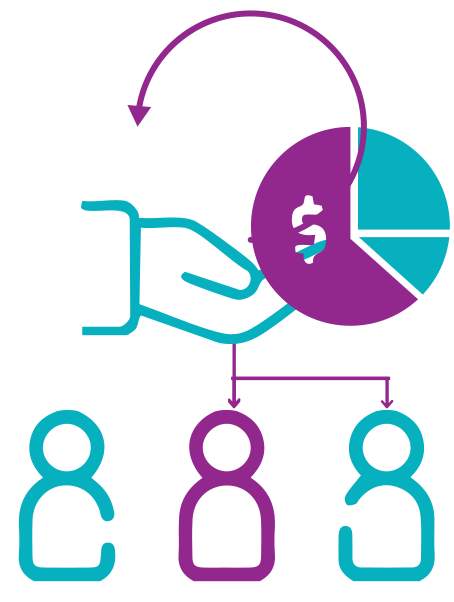
Accumulating and distributing ETFs offer equivalent total returns over time, assuming taxes are disregarded. In accumulating ETFs, dividends are automatically reinvested as they are paid out, fostering compounding growth within the fund. In contrast, distributing ETFs pay dividends directly to investors, who can choose to reinvest them manually.
The key point is that both ETF structures provide the same potential total return, as the reinvestment of dividends in an accumulating ETF mirrors what an investor could achieve with a distributing ETF, provided dividends are reinvested promptly and without additional costs.
When choosing between accumulating and distributing ETFs, it is crucial to consider factors such as tax implications, reinvestment strategies, and personal preferences to determine which option aligns best with individual investment goals.
Dividend ETFs offer both accumulating and distributing options, allowing you to choose the strategy that best aligns with your financial goals. Understanding the differences between accumulating and distributing ETFs can help you make informed decisions about your investment approach and potential profits from stocks that pay dividends. If you're interested in dividend investing, consider exploring VanEck’s Dividend ETF. Please note that investing is subject to risk including the risk of capital loss. Investors must refer to the prospectus, the KID and other relevant documents before investing.