EMs – All Grown Up?
27 September 2022
Read Time 2 MIN
EM Tightening Cycle
There were more signs of responsible policy-making in emerging markets (EM), as well as some nice macroeconomic results this morning. Central banks in Hungary and Nigeria delivered larger than expected rate hikes to combat persistent inflation pressures. Hungary’s nominal policy rate looks like it belongs in Latin America (LATAM) – at 13%, it is higher than all regional policy rates except Brazil (13.75%). There are good reasons why the Hungarian national bank had to go for another supersized hike (+125bps) – post-election fiscal adjustment is still slow, and domestic political noise adds pressure on the currency (hence, the need to “overcompensate” on the monetary front). Hungary’s example, however, underscores that EM is not a monolith – even within a region. Central banks in Poland and especially the Czech Republic are decidedly more dovish. The Czech National Bank is expected to extend its pause this week – at a mere 7% against the backdrop of 17.2% annual inflation.
Prospects For Rate Cuts In EM
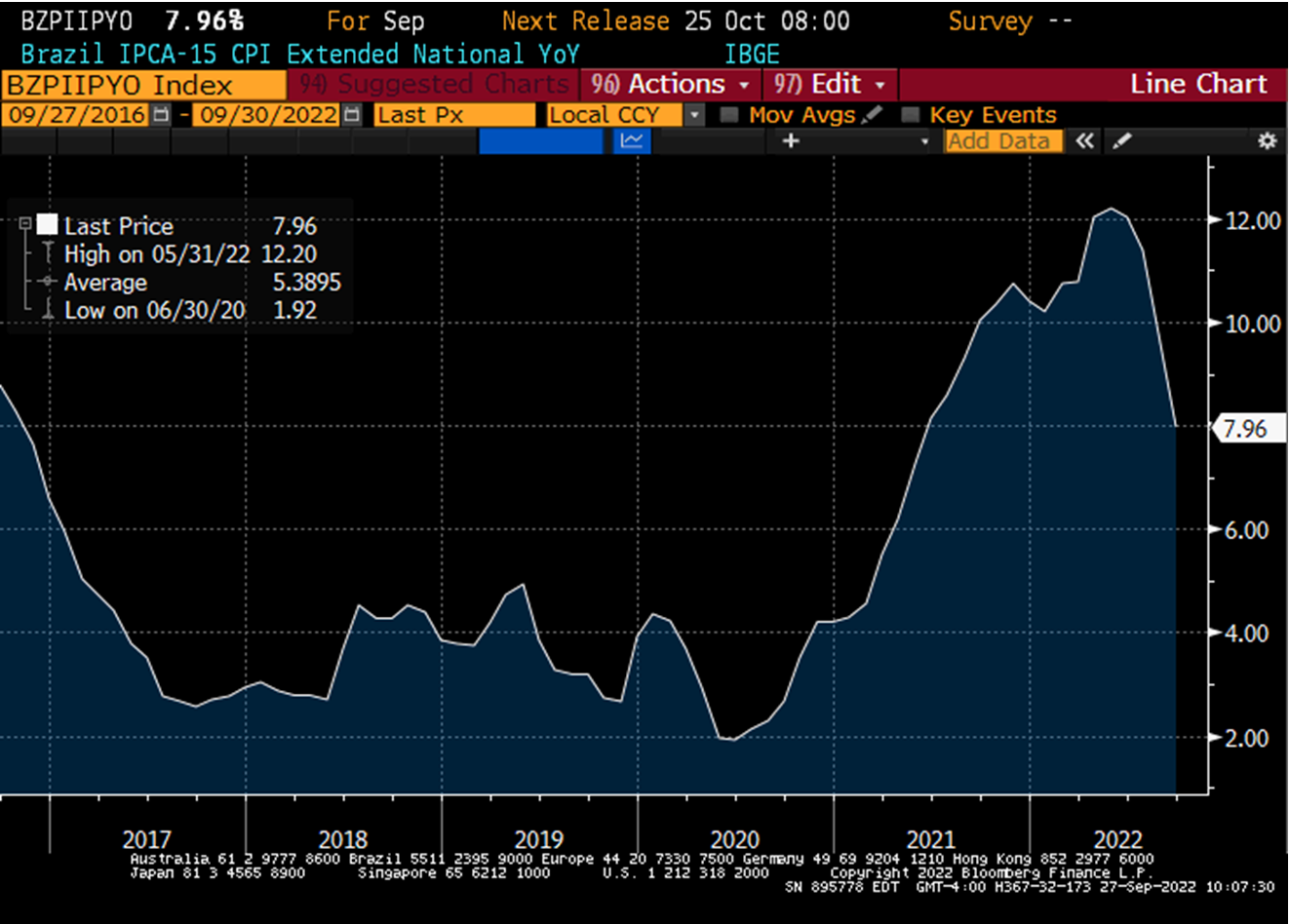
Going back to Hungary’s nominal policy “neighborhood,” Brazil’s central bank minutes sounded hawkish despite signs of further disinflation. Mid-month inflation eased more than expected, dropping below 8% year-on-year (see chart below). However, not all of it was due to Brazil’s early and aggressive rate hike frontloading. Disinflation also reflected some tax cuts, which explains the central bank’s caution and intention to keep the policy rate “high” for a “sufficiently long period.” How long is “long”? Brazil’s local swap curve currently prices in rate cuts later in Q2-2023/Q3-2023. This is not impossible, provided there are no additional political complications (we are very close to the hotly contested elections) and inflation continues to move closer to the target range.
EM Easing And Exchange Rates
Brazil’s credible policy response to the inflation surge is one of the reasons why the Brazilian real remains one of the best performing global currencies so far this year. EMs are generally praised for tightening much earlier than developed markets (DM) peers in this cycle. “Grown-up” policies? Yes. But the real test for EMs might be their ability to start earlier policy easing without adverse consequences for economic fundamentals or asset prices. China’s easing (including small rate cuts) added to deprecation pressures on the currency, forcing authorities to step up policy support for the renminbi. So, it is not that simple. Stay tuned!
Chart at a Glance: Brazil Disinflation – Nice Optics*
Source: Bloomberg LP
*Brazil IPCA-15 CPI Extended National YOY Index - Index that measures Brazil’s YoY Consumer Price Index. IPCA is the benchmark inflation index observed by the Central Bank of Brazil.
Related Insights

IMPORTANT DEFINITIONS & DISCLOSURES
This material may only be used outside of the United States.
This is not an offer to buy or sell, or a recommendation of any offer to buy or sell any of the securities mentioned herein. Fund holdings will vary. For a complete list of holdings in VanEck Mutual Funds and VanEck ETFs, please visit our website at www.vaneck.com.
The information presented does not involve the rendering of personalized investment, financial, legal, or tax advice. Certain statements contained herein may constitute projections, forecasts and other forward looking statements, which do not reflect actual results. Information provided by third-party sources are believed to be reliable and have not been independently verified for accuracy or completeness and cannot be guaranteed. Any opinions, projections, forecasts, and forward-looking statements presented herein are valid as of the date of this communication and are subject to change without notice. The information herein represents the opinion of the author(s), but not necessarily those of VanEck.
The views contained herein are not to be taken as advice or a recommendation to buy or sell any investment in any jurisdiction, nor is it a commitment from Van Eck Associates Corporation or its subsidiaries to participate in any transactions in any companies mentioned herein. This content is published in the United States. Investors are subject to securities and tax regulations within their applicable jurisdictions that are not addressed herein.
All investing is subject to risk, including the possible loss of the money you invest. As with any investment strategy, there is no guarantee that investment objectives will be met and investors may lose money. Diversification does not ensure a profit or protect against a loss in a declining market. Past performance is no guarantee of future results.