Sentiment Swings and Fundamentals
17 February 2023
Read Time 2 MIN
Fed Rate Expectations
The market expectations for the U.S. Federal Reserve policy trajectory continue to adjust higher, reflecting better than expected domestic activity and slower than expected disinflation. The peak rate implied by Fed Funds Futures rose to 5.3% - with the tail risk extending to 6% and with the probability of the June rate hikes reaching 60% (compared to 4% on February 1). This re-adjustment led to some market movements – including lower-yielding and higher-rated assets (which often have higher duration as well). Upcoming changes at the Bank of Japan’s helm – with potential implications for inflows into Investment Grade (IG) bonds both in emerging markets (EM) and developed markets (DM) – present an extra layer of uncertainty, especially as the market is also trying to assess China’s ability to deliver on the growth front and turn the housing sector around.
EM Diversification
High Yield (HY) bonds in EM might have some insulation in the form of wider spreads (compared to IG), but spreads show a lot of co-movement with interest rate volatility in the U.S. (see chart below). So, until the dust settles and the market internalizes a new scenario for the Fed, EM spreads might remain under pressure. Now, a key EM lesson from 2022 is that selectivity pays off – even in the environment of higher global rates and the strong U.S. dollar. Several LATAM currencies – with their “plush” real rate cushions – outperformed many EM and major FX peers in February. Further, some EMs are arguably less correlated with risks like higher Fed rates, but instead correlated with China reopening (so, keep an eye on the next batch of China’s activity gauges).
Brazil Politics
One activity the current environment is not good for is playing with fire in local politics/policy. Yep, “return, I will, to old Brazil” saga continues, with President Luiz Inácio Lula da Silva (Lula) delivering a daily dose of comments on the central bank independence and the inflation target (with other ministers and MPs joining the chorus from time to time). Brazil’s economic activity proxy for December was a touch better than expected, but growth is still expected to soften a lot this year, inviting more populist attempts to prop it up – and not only by putting pressures on the central bank, but also by expanding low-interest lending via the Brazilian Development Bank (BNDES). Both policy options are sub-optimal as regards investors in local bonds. Stay tuned!
Chart at a Glance: U.S. Rates Volatility and EM Spreads – A Lot of Co-Movement
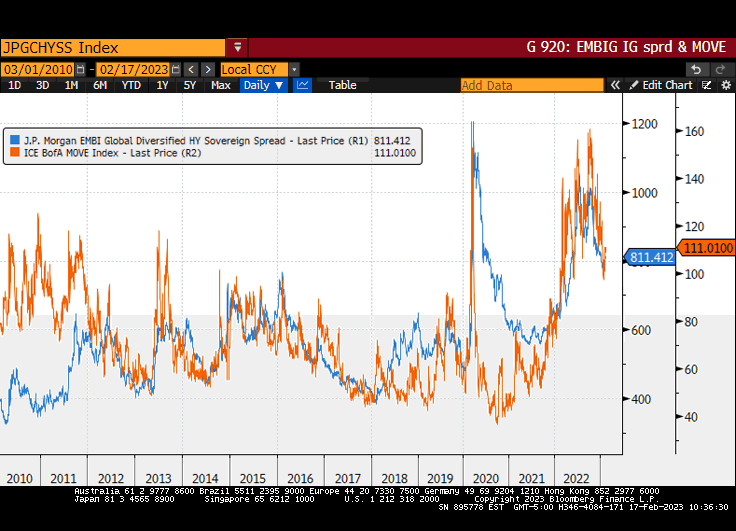
Source: Bloomberg LP.
Ice BofA MOVE Index (MOVE) is a measure of U.S. interest rate volatility that tracks the movement in U.S. Treasury yield volatility.
Related Insights

IMPORTANT DEFINITIONS & DISCLOSURES
This material may only be used outside of the United States.
This is not an offer to buy or sell, or a recommendation of any offer to buy or sell any of the securities mentioned herein. Fund holdings will vary. For a complete list of holdings in VanEck Mutual Funds and VanEck ETFs, please visit our website at www.vaneck.com.
The information presented does not involve the rendering of personalized investment, financial, legal, or tax advice. Certain statements contained herein may constitute projections, forecasts and other forward looking statements, which do not reflect actual results. Information provided by third-party sources are believed to be reliable and have not been independently verified for accuracy or completeness and cannot be guaranteed. Any opinions, projections, forecasts, and forward-looking statements presented herein are valid as of the date of this communication and are subject to change without notice. The information herein represents the opinion of the author(s), but not necessarily those of VanEck.
The views contained herein are not to be taken as advice or a recommendation to buy or sell any investment in any jurisdiction, nor is it a commitment from Van Eck Associates Corporation or its subsidiaries to participate in any transactions in any companies mentioned herein. This content is published in the United States. Investors are subject to securities and tax regulations within their applicable jurisdictions that are not addressed herein.
All investing is subject to risk, including the possible loss of the money you invest. As with any investment strategy, there is no guarantee that investment objectives will be met and investors may lose money. Diversification does not ensure a profit or protect against a loss in a declining market. Past performance is no guarantee of future results.